



Forbesichthys agassizii (Putnam, 1872)
Spring cavefish
Hochladen Photos und videos
Bilder | Google Bild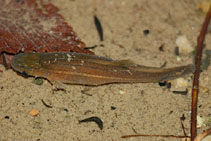 Forbesichthys agassizii
Photo von Niemiller, M.L.
Bilder | Google Bild
Photo von Niemiller, M.L.
Klassifizierung / Names Namen | Synonyme | Catalog of Fishes(Gattung, Arten) | ITIS | CoL | WoRMS | Cloffa
> Percopsiformes (Trout-perches, pirate perches and cavefishes) > Amblyopsidae (Cavefishes)
Etymology: agassizii: Named after the great naturalist Louis Agassiz (Ref. 10294).
Eponymy: Stephen Alfred Forbes (1844–1930) was an entomologist, self-taught naturalist, farmer and ecologist. [...] Jean Louis Rudolphe Agassiz (1807–1873) was a Swiss-American geologist, glaciologist and zoologist whose speciality was ichthyology. [...] (Ref. 128868), visit book page.
Etymology: agassizii: Named after the great naturalist Louis Agassiz (Ref. 10294).
Eponymy: Stephen Alfred Forbes (1844–1930) was an entomologist, self-taught naturalist, farmer and ecologist. [...] Jean Louis Rudolphe Agassiz (1807–1873) was a Swiss-American geologist, glaciologist and zoologist whose speciality was ichthyology. [...] (Ref. 128868), visit book page.
Umwelt: Milieu / Klimazone / Tiefenbereich / Verbreitungsgebiet Ökologie
; süßwasser demersal; standorttreu (Ref. 126106). Temperate; 39°N - 35°N
Verbreitung Territorien | FAO Gebiete | Ökosysteme | Vorkommen | Punkt Karte | Einführungen | Faunafri
North America: portions of Tennessee, Kentucky, Illinois and Missouri, U.S.A.
Größe / Gewicht / Alter
Geschlechtsreife: Lm ? range ? - ? cm
Max length : 9.0 cm TL Männchen/unbestimmt; (Ref. 10294); common length : 5.3 cm TL Männchen/unbestimmt; (Ref. 12193); max. veröff. Alter: 3.00 Jahre (Ref. 10294)
Max length : 9.0 cm TL Männchen/unbestimmt; (Ref. 10294); common length : 5.3 cm TL Männchen/unbestimmt; (Ref. 12193); max. veröff. Alter: 3.00 Jahre (Ref. 10294)
Kurzbeschreibung Bestimmungsschlüssel | Morphologie | Morphometrie
Rückenflossenweichstrahlen (insgesamt) : 9 - 11; Afterflossenweichstrahlen: 9 - 11; Wirbelzahl: 33 - 35. Scales minute and embedded. Pelvic fins absent. Branched caudal fin rays 11-17; branchiostegal rays 6. Triads of sensory papillae occur midlaterally and scattered clusters of neuromasts are present on the head. Coloration uniform dark gray to back with paler venter.
Body shape (shape guide): elongated.
Body shape (shape guide): elongated.
Adults occur in springs and caves (but almost always near surface). They live underground but emerge above ground in springs (Ref. 5723). Active in springs at night and usually retreat underground during the day. The few individuals which venture into the spring portions of their habitat may show strong rheotaxis for half to one-minute periods but usually show strong thigmotaxis and hide under rocks or debris (Ref. 34868). Feed at night on amphipods, midge larvae, tiny worms and micro-crustaceans. Fecundity averages about 100 eggs per female (Ref. 10294). Eggs are carried in gill chambers of females (Ref. 205).
Lebenszyklus und Paarungsverhalten Geschlechtsreife | Fortpflanzung | Ablaichen | Eier | Fruchtbarkeit | Larven
Incubates eggs in gill chamber of females (Ref. 205).
Hauptreferenz
Laden Sie Ihre Referenzen hoch | Referenzen | Koordinator | Partner
Etnier, D.A. and W.C. Starnes, 1993. The fishes of Tennessee. The University of Tennessee Press, Knoxville, Tennessee, USA. (pls. check date). (Ref. 10294)
IUCN Rote Liste Status (Ref. 130435: Version 2025-2 (Global))
nicht bedroht (LC) ; Date assessed: 27 January 2012
CITES
Not Evaluated
Bedrohung für Menschen
Harmless
Nutzung durch Menschen
FAO - Publication: search | FishSource |
Mehr Information
Trophische Ökologie
Lebensmittel (Beutetiere)
Nahrungszusammensetzung
Nahrungsaufnahme
Lebensmittelrationen
Räuber
Lebensmittel (Beutetiere)
Nahrungszusammensetzung
Nahrungsaufnahme
Lebensmittelrationen
Räuber
Populationsdynamik
Wachstumsparameter
Max. Alter/Größen
Länge-Gewicht-Rel.
Länge-Länge-Verhältnis.
Längenhäufigkeiten
Massenkonvertierung
Rekrutierung
Dichte
Wachstumsparameter
Max. Alter/Größen
Länge-Gewicht-Rel.
Länge-Länge-Verhältnis.
Längenhäufigkeiten
Massenkonvertierung
Rekrutierung
Dichte
Lebenszyklus
Fortpflanzung
Geschlechtsreife
Reifung/Kiemen rel.
Fruchtbarkeit
Ablaichen
Laichaggregationen
Eier
Eientwicklung
Larven
Larven Pop.Dyn.
Fortpflanzung
Geschlechtsreife
Reifung/Kiemen rel.
Fruchtbarkeit
Ablaichen
Laichaggregationen
Eier
Eientwicklung
Larven
Larven Pop.Dyn.
Anatomie
Kiemenoberfläche
Gehirn
Otolith
Kiemenoberfläche
Gehirn
Otolith
Physiologie
Körperliche Zusammensetzung
Nährstoffe
Sauerstoffverbrauch
Schwimmart
Schwimmgeschwindigkeit
Visuelle Pigmente
Fischgeräusche
Krankheiten und Parasiten
Toxizität (LC50s)
Körperliche Zusammensetzung
Nährstoffe
Sauerstoffverbrauch
Schwimmart
Schwimmgeschwindigkeit
Visuelle Pigmente
Fischgeräusche
Krankheiten und Parasiten
Toxizität (LC50s)
Genetik
Genom
Genetik
Heterozygotie
Vererbbarkeit
Genetische Vielfalt
Genom
Genetik
Heterozygotie
Vererbbarkeit
Genetische Vielfalt
Menschenbezogen
Aquakultur-Systeme
Aquakultur Profile
Zuchtlinien
Ciguatera-Fälle
Briefmarken, Münzen, Verschiedenes.
Aquakultur-Systeme
Aquakultur Profile
Zuchtlinien
Ciguatera-Fälle
Briefmarken, Münzen, Verschiedenes.
Tools
Zusatzinformationen
Download XML
Zusammenfassung | Punktdaten | Namen | Photos
Internet Quellen
AFORO (otoliths) | Alien/Invasive Species database | Aquatic Commons | BHL | Cloffa | Websites from users | FishWatcher Einträge suchen | CISTI | Catalog of Fishes: Gattung, Arten | DiscoverLife | ECOTOX | FAO - Publication: search | Faunafri | Fishipedia | Fishtrace | GloBI | Google Books | Google Scholar | Google | IGFA World Record | OneZoom | Open Tree of Life | Otolith Atlas of Taiwan Fishes | PubMed | Reef Life Survey | Socotra Atlas | TreeBase | Tree of Life | Wikipedia: Gehe zu, Suchen | | Zoologischer Rekord
Schätzungen auf der Grundlage von Modellen
|
Phylogenetischer Diversitätsindex (Ref. 82804) |
PD50 = 1.0081 [Uniqueness, from 0.5 = low to 2.0 = high]. |
| Bayesian length-weight | a=0.00389 (0.00180 - 0.00842), b=3.12 (2.94 - 3.30), in cm total length, based on all LWR estimates for this body shape (Ref. 93245). |
|
Trophische Ebene (Ref. 69278) |
3.3 ±0.44 se; based on food items. |
| Generation time | 1.6 ( na - na) years. Estimated as median ln(3)/K based on 1 growth studies. |
|
Widerstandsfähigkeit (Ref. 120179) |
hoch, Verdopplung der Population dauert weniger als 15 Monate. (K=0.67; tm=1; tmax=3; Fec = 100). |
|
Anfälligkeit der Fischerei (Ref. 59153) |
Low vulnerability (21 of 100). 🛈 |