



Coregonus sardinella Valenciennes, 1848
Sardine cisco
Adicionar as suas observações no Fish Watcher
| Native range | All suitable habitat | Point map | Year 2050 |

|
| This map was computer-generated and has not yet been reviewed. |
| Coregonus sardinella AquaMaps Data sources: GBIF OBIS |
Adicionar o seu Fotografias e vídeos
Fotografias | Imagem do Google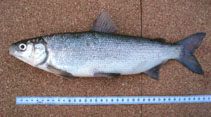 Coregonus sardinella
Fotografia de Runfola, D.M.
Fotografias | Imagem do Google
Fotografia de Runfola, D.M.
Classificação / Nomes Nomes comuns | Sinónimos | Catalog of Fishes(Género, Espécies) | ITIS | CoL | WoRMS | Cloffa
> Salmoniformes (Salmons) > Salmonidae (Salmonids) > Coregoninae
Etymology: Coregonus: Greek, kore = pupils of the eye + Greek, gonia = angle (Ref. 45335); sardinella: sardinella meaning small sardine (Ref. 1998).
More on author: Valenciennes.
Etymology: Coregonus: Greek, kore = pupils of the eye + Greek, gonia = angle (Ref. 45335); sardinella: sardinella meaning small sardine (Ref. 1998).
More on author: Valenciennes.
Ambiente: milieu / zona climática / intervalo de profundidade / gama de distribuição Ecologia
marinhas; Água doce; estuarina pelagic-neritic; anádromo (Ref. 126106). Polar; 78°N - 62°N, 45°E - 95°W
Distribuição Territórios | Áreas FAO | Ecossistemas | Ocorrências | Mapa dos pontos | Introduções | Faunafri
North America: Murchison River, Canada to Bristol Bay, Alaska; ascends Yukon River to British Columbia, and Mackenzie River to Fort Simpson (Ref. 5723). Asia: Bering Sea, Chukot land and Kolyma River to Kara River on the northern end of the Urals (Ref. 593). Lakes and lower course of large rivers of Arctic Ocean basin from Pechora drainage to eastern Siberia (Ref. 59043). Belongs to Coregonus artedi complex. Occasionally hybridizes with Coregonus nelsoni (Ref. 27547).
Tamanho / Peso / Idade
Maturidade: Lm ? range ? - ? cm
Max length : 47.0 cm TL macho/indeterminado; (Ref. 5723); common length : 23.0 cm TL macho/indeterminado; (Ref. 1998); peso máx. Publicado: 555.00 g (Ref. 593); Idade máx. registada: 26 anos (Ref. 1998)
Max length : 47.0 cm TL macho/indeterminado; (Ref. 5723); common length : 23.0 cm TL macho/indeterminado; (Ref. 1998); peso máx. Publicado: 555.00 g (Ref. 593); Idade máx. registada: 26 anos (Ref. 1998)
Descrição breve Chaves de identificação | Morfologia | Morfometria
Espinhos dorsais (total) : 0; Raios dorsais moles (total) : 12 - 14; Espinhos anais: 0; Raios anais moles: 10 - 13; Vértebras: 58 - 64. Body elongate, somewhat compressed laterally, greatest body depth at front of dorsal fin. Head about 19 - 24 % of total length; eyes large; snout length usually less than eye diameter; mouth moderate, terminal, lower jaw always protruding, maxillary at a distinct angle, extending posteriorly to below anterior half of the eye; a small cluster of teeth present on the tongue. Overall coloration silvery, usually brown to dark green on the back, becoming silvery on sides and below. The small non-anadromous form that remains in fresh water is without spotting on the back and only the pelvic fins have black pigment on the tips., the remaining fins are unpigmented. The larger, anadromous form has dark spots on the head, back, dorsal, and adipose fins, and sometimes, on the pectoral fins; all fins have usually dark pigment on the tips.
Body shape (shape guide): fusiform / normal; Cross section: compressed.
Body shape (shape guide): fusiform / normal; Cross section: compressed.
Adults occur in coastal waters, estuaries, large lakes and rivers (Ref. 5723). Lake-dwelling populations appear to be non-migratory, while those found in streams or brackish water move considerable distances to reach or leave spawning sites (Ref. 27547). Semi-anadromous populations forage in estuaries, lower courses of rivers, backwaters and lakes (Ref. 59043). Nerito-pelagic (Ref. 58426). Feed on planktonic crustaceans and insects (Ref. 1998); also plant material (Ref. 27547) and fishes (Ref. 58426). Do not usually feed during its spawning run (Ref. 28219, 28860, 28861). Migratory forms are observed to live longer than fresh water forms (Ref. 1998). Spawn in deep pools on sand and gravel (Ref. 59043). Flesh is said to be tasty (Ref. 1998).
Ciclo de vida e comportamento de acasalamento Maturidade | Reprodução | Desova | Ovos | Fecundidade | Larvas
Spawning occurs at night, peaking between 8 pm and midnight. A female spawns almost vertically upward, with her ventral side upstream. She is joined by as many as five males who swim vertically and close to her. As the spawners approach the surface, eggs and milt are released. The fish break the surface, fall over backward, and swim back to the bottom of the pool (Ref. 27547).
Referência principal
Carregar as suas referências | Referências | Coordenador | Colaboradores
Page, L.M. and B.M. Burr, 1991. A field guide to freshwater fishes of North America north of Mexico. Houghton Mifflin Company, Boston. 432 p. (Ref. 5723)
CITES
Not Evaluated
Ameaça para o homem
Harmless
Utilização humana
Pescarias: espécies comerciais; peixe desportivo: sim
FAO - Publication: search | FishSource | Sea Around Us
Mais informação
Ecologia Trófica
Produtos alimentares (presas)
Composição da dieta
Consumo alimentar
Rações alimentares
Predadores
Produtos alimentares (presas)
Composição da dieta
Consumo alimentar
Rações alimentares
Predadores
Dinâmica das populações
Parâmetros de crescimento
Idades / tamanhos máximos
Comprimento-peso rel.
Comprimento-comprimento rel.
Frequência de comprimento
Conversão de massa
Recrutamento
Abundância
Parâmetros de crescimento
Idades / tamanhos máximos
Comprimento-peso rel.
Comprimento-comprimento rel.
Frequência de comprimento
Conversão de massa
Recrutamento
Abundância
Ciclo de vida
Reprodução
Maturidade
Maturidade/Rel. das guelras
Fecundidade
Desova
Agregações de desova
Ovos
Desenvolvimento dos ovos
Larvas
Dinâmica larvar
Reprodução
Maturidade
Maturidade/Rel. das guelras
Fecundidade
Desova
Agregações de desova
Ovos
Desenvolvimento dos ovos
Larvas
Dinâmica larvar
Anatomia
Área branquial
Cérebro
Otólitos
Área branquial
Cérebro
Otólitos
Fisiologia
Composição corporal
Nutrientes
Consumo de oxigénio
Tipo de natação
Velocidade de natação
Pigmentos visuais
Som de peixe
Doenças e Parasitas
Toxicidade (LC50s)
Composição corporal
Nutrientes
Consumo de oxigénio
Tipo de natação
Velocidade de natação
Pigmentos visuais
Som de peixe
Doenças e Parasitas
Toxicidade (LC50s)
Relacionado com o ser humano
Sistemas de aquacultura
Perfis para aquacultura
Estirpes
Casos de Ciguatera
Selos, moedas, diversos.
Sistemas de aquacultura
Perfis para aquacultura
Estirpes
Casos de Ciguatera
Selos, moedas, diversos.
Ferramentas
E-book | Guia de campo | Ferramenta auxiliar de frequências de comprimento | Ferramenta sobre a história de vida | Mapa dos pontos |
Captura-MSY |
Relatórios especiais
Descarregue XML
Fontes da internet
AFORO (otoliths) | Alien/Invasive Species database | Aquatic Commons | BHL | Cloffa | Websites from users | Consultar FishWatcher | CISTI | Catalog of Fishes: Género, Espécies | DiscoverLife | ECOTOX | FAO - Publication: search | Faunafri | Fishipedia | Fishtrace | GloBI | Google Books | Google Scholar | Google | IGFA World Record | OneZoom | Open Tree of Life | Otolith Atlas of Taiwan Fishes | PubMed | Reef Life Survey | Socotra Atlas | TreeBase | Árvore da vida | Wikipedia: ir para, procurar | World Records Freshwater Fishing | Zoobank | Registo zoológico
Estimativas baseadas em modelos
Temperatura preferida (Ref. 123201): -1.8 - 2.7, mean -0.8 °C (based on 1616 cells).
Índice de diversidade filogenética (Ref. 82804): PD50 = 0.5000 [Uniqueness, from 0.5 = low to 2.0 = high].
Bayesian length-weight: a=0.00437 (0.00374 - 0.00510), b=3.21 (3.17 - 3.25), in cm total length, based on LWR estimates for this species (Ref. 93245).
Nível Trófico (Ref. 69278): 3.2 ±0.2 se; based on diet studies.
Resiliência (Ref. 120179): Médio, tempo mínimo de duplicação da população 1,4 - 4,4 anos (K=0.40; tm=2-4; tmax=11; Fec=2,500).
Prior r = 0.51, 95% CL = 0.34 - 0.76, Based on 2 data-limited stock assessments.
Nutrientes (Ref. 124155): Calcium = 20.4 [9.1, 37.8] mg/100g; Iron = 0.52 [0.25, 0.99] mg/100g; Protein = 18.1 [16.9, 19.3] %; Omega3 = 0.696 [0.272, 1.918] g/100g; Selenium = 11.1 [4.1, 30.5] μg/100g; VitaminA = 6.92 [1.15, 41.73] μg/100g; Zinc = 0.521 [0.395, 0.737] mg/100g (wet weight);