



Coregonus sardinella Valenciennes, 1848
Sardine cisco
Ajouter votre observation dans Fish Watcher
| Native range | All suitable habitat | Point map | Year 2050 |

|
| This map was computer-generated and has not yet been reviewed. |
| Coregonus sardinella AquaMaps Data sources: GBIF OBIS |
Envoyez vos Photos et vidéos
Images | Images Google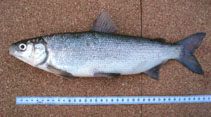 Coregonus sardinella
Photo de Runfola, D.M.
Images | Images Google
Photo de Runfola, D.M.
Classification / Noms Noms communs | Synonymes | Catalog of Fishes(Genre, Espèce) | ITIS | CoL | WoRMS | Cloffa
> Salmoniformes (Salmons) > Salmonidae (Salmonids) > Coregoninae
Etymology: Coregonus: Greek, kore = pupils of the eye + Greek, gonia = angle (Ref. 45335); sardinella: sardinella meaning small sardine (Ref. 1998).
More on author: Valenciennes.
Etymology: Coregonus: Greek, kore = pupils of the eye + Greek, gonia = angle (Ref. 45335); sardinella: sardinella meaning small sardine (Ref. 1998).
More on author: Valenciennes.
Environnement : milieu / zone climatique / profondeur / gamme de distribution Écologie
marin; eau douce; saumâtre pelagic-neritic; anadrome (Ref. 126106). Polar; 78°N - 62°N, 45°E - 95°W
Distribution Territoires | Zones FAO | Écosystèmes | Occurrences | Carte par point | Introductions | Faunafri
North America: Murchison River, Canada to Bristol Bay, Alaska; ascends Yukon River to British Columbia, and Mackenzie River to Fort Simpson (Ref. 5723). Asia: Bering Sea, Chukot land and Kolyma River to Kara River on the northern end of the Urals (Ref. 593). Lakes and lower course of large rivers of Arctic Ocean basin from Pechora drainage to eastern Siberia (Ref. 59043). Belongs to Coregonus artedi complex. Occasionally hybridizes with Coregonus nelsoni (Ref. 27547).
Taille / Poids / Âge
Maturité: Lm ? range ? - ? cm
Max length : 47.0 cm TL mâle / non sexé; (Ref. 5723); common length : 23.0 cm TL mâle / non sexé; (Ref. 1998); poids max. publié: 555.00 g (Ref. 593); âge max. reporté: 26 années (Ref. 1998)
Max length : 47.0 cm TL mâle / non sexé; (Ref. 5723); common length : 23.0 cm TL mâle / non sexé; (Ref. 1998); poids max. publié: 555.00 g (Ref. 593); âge max. reporté: 26 années (Ref. 1998)
Description synthétique Clés d'identification | Morphologie | Morphométrie
Épines dorsales (Total) : 0; Rayons mous dorsaux (Total) : 12 - 14; Épines anales: 0; Rayons mous anaux: 10 - 13; Vertèbres: 58 - 64. Body elongate, somewhat compressed laterally, greatest body depth at front of dorsal fin. Head about 19 - 24 % of total length; eyes large; snout length usually less than eye diameter; mouth moderate, terminal, lower jaw always protruding, maxillary at a distinct angle, extending posteriorly to below anterior half of the eye; a small cluster of teeth present on the tongue. Overall coloration silvery, usually brown to dark green on the back, becoming silvery on sides and below. The small non-anadromous form that remains in fresh water is without spotting on the back and only the pelvic fins have black pigment on the tips., the remaining fins are unpigmented. The larger, anadromous form has dark spots on the head, back, dorsal, and adipose fins, and sometimes, on the pectoral fins; all fins have usually dark pigment on the tips.
Body shape (shape guide): fusiform / normal; Cross section: compressed.
Body shape (shape guide): fusiform / normal; Cross section: compressed.
Adults occur in coastal waters, estuaries, large lakes and rivers (Ref. 5723). Lake-dwelling populations appear to be non-migratory, while those found in streams or brackish water move considerable distances to reach or leave spawning sites (Ref. 27547). Semi-anadromous populations forage in estuaries, lower courses of rivers, backwaters and lakes (Ref. 59043). Nerito-pelagic (Ref. 58426). Feed on planktonic crustaceans and insects (Ref. 1998); also plant material (Ref. 27547) and fishes (Ref. 58426). Do not usually feed during its spawning run (Ref. 28219, 28860, 28861). Migratory forms are observed to live longer than fresh water forms (Ref. 1998). Spawn in deep pools on sand and gravel (Ref. 59043). Flesh is said to be tasty (Ref. 1998).
Cycle de vie et comportement reproducteur Maturité | Reproduction | Frai | Œufs | Fécondité | Larves
Spawning occurs at night, peaking between 8 pm and midnight. A female spawns almost vertically upward, with her ventral side upstream. She is joined by as many as five males who swim vertically and close to her. As the spawners approach the surface, eggs and milt are released. The fish break the surface, fall over backward, and swim back to the bottom of the pool (Ref. 27547).
Référence principale
Téléchargez vos références | Références | Coordinateur | Collaborateurs
Page, L.M. and B.M. Burr, 1991. A field guide to freshwater fishes of North America north of Mexico. Houghton Mifflin Company, Boston. 432 p. (Ref. 5723)
CITES
Not Evaluated
Menace pour l'homme
Harmless
Utilisations par l'homme
Pêcheries: commercial; pêche sportive: oui
FAO - Publication: search | FishSource | Sea Around Us
Plus d'informations
Écologie trophique
Aliments (proies)
Composition du régime alimentaire
Consommation alimentaire
Rations alimentaires
Prédateurs
Aliments (proies)
Composition du régime alimentaire
Consommation alimentaire
Rations alimentaires
Prédateurs
Dynamique des populations
Paramètres de croissance
Âges / tailles maximales
Longueur-poids rel.
Rel. longueur-longueur.
Fréquences de longueurs
Conversion de masse
Recrutement
Abondance
Paramètres de croissance
Âges / tailles maximales
Longueur-poids rel.
Rel. longueur-longueur.
Fréquences de longueurs
Conversion de masse
Recrutement
Abondance
Cycle de vie
Reproduction
Maturité
Maturité/épines rel.
Fécondité
Frai
Agrégats de frai
Œufs
Développement de l'œuf
Larves
Dynamique des populations larvaires
Reproduction
Maturité
Maturité/épines rel.
Fécondité
Frai
Agrégats de frai
Œufs
Développement de l'œuf
Larves
Dynamique des populations larvaires
Anatomie
Surface branchiale
Cerveau
Otolithe
Surface branchiale
Cerveau
Otolithe
Physiologie
Composition corporelle
Nutriments
Consommation d'oxygène
Type de natation
Vitesse de nage
Pigments visuels
Son de poisson
Maladies et parasites
Toxicité (CL50)
Composition corporelle
Nutriments
Consommation d'oxygène
Type de natation
Vitesse de nage
Pigments visuels
Son de poisson
Maladies et parasites
Toxicité (CL50)
Liées à l'homme
Systèmes d'aquaculture
Profils d'aquaculture
Souches
Cas de ciguatera
Timbres, pièces de monnaie, divers
Systèmes d'aquaculture
Profils d'aquaculture
Souches
Cas de ciguatera
Timbres, pièces de monnaie, divers
Outils
E-book | Guide de terrain | Générateur de fréquences de longueur | Outil de dynamique de population | Carte par point |
Capture-MSY |
Articles particuliers
Télécharger en XML
Sources Internet
AFORO (otoliths) | Alien/Invasive Species database | Aquatic Commons | BHL | Cloffa | Websites from users | FishWatcher | CISTI | Catalog of Fishes: Genre, Espèce | DiscoverLife | ECOTOX | FAO - Publication: search | Faunafri | Fishipedia | Fishtrace | GloBI | Google Books | Google Scholar | Google | IGFA World Record | OneZoom | Open Tree of Life | Otolith Atlas of Taiwan Fishes | PubMed | Reef Life Survey | Socotra Atlas | TreeBase | Arbre de Vie | Wikipedia: aller à, chercher | World Records Freshwater Fishing | Zoobank | Zoological Record
Estimations basées sur des modèles
Température préférée (Réf. 123201): -1.8 - 2.7, mean -0.8 °C (based on 1616 cells).
Indice de diversité phylogénétique (Réf. 82804): PD50 = 0.5000 [Uniqueness, from 0.5 = low to 2.0 = high].
Bayesian length-weight: a=0.00437 (0.00374 - 0.00510), b=3.21 (3.17 - 3.25), in cm total length, based on LWR estimates for this species (Ref. 93245).
Niveau trophique (Réf. 69278): 3.2 ±0.2 se; based on diet studies.
Résilience (Réf. 120179): Milieu, temps minimum de doublement de population : 1,4 à 4,4 années (K=0.40; tm=2-4; tmax=11; Fec=2,500).
Prior r = 0.51, 95% CL = 0.34 - 0.76, Based on 2 data-limited stock assessments.
Nutriments (Ref. 124155): Calcium = 20.4 [9.1, 37.8] mg/100g; Iron = 0.52 [0.25, 0.99] mg/100g; Protein = 18.1 [16.9, 19.3] %; Omega3 = 0.696 [0.272, 1.918] g/100g; Selenium = 11.1 [4.1, 30.5] μg/100g; VitaminA = 6.92 [1.15, 41.73] μg/100g; Zinc = 0.521 [0.395, 0.737] mg/100g (wet weight);