



Colossoma macropomum (Cuvier, 1816)
Cachama
Uploaden van uw Foto's en video's
Afbeeldingen | Google afbeelding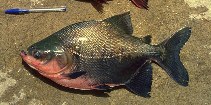 Colossoma macropomum
Afbeelding van Lovshin, L.
Afbeeldingen | Google afbeelding
Afbeelding van Lovshin, L.
Classificatie / Namen Lokale namen | Synoniemen | Catalog of Fishes(Genus, Soort(en)) | ITIS | CoL | WoRMS | Cloffa
> Characiformes (Characins) > Serrasalmidae (Piranhas and pacus) > Colossomatinae
Etymology: Colossoma: Greek, kolos = short, truncated + Greek, soma = body (Ref. 45335).
More on author: Cuvier.
Etymology: Colossoma: Greek, kolos = short, truncated + Greek, soma = body (Ref. 45335).
More on author: Cuvier.
Taxonomic Remarks
See Machado-Allison 1982: 42, Géry 1986: 97 and Machado-Allison 1986: 2 for detailed description. See Goulding & Carvalho 1982 and Araujo Lima & Goulding 1997 for general biology and management. See Loubens & Panfili 1997 for growth biology.
Milieu: milieu / Klimaatzone / Diepte / verspreidingsgebied Ecologie
; zoet water benthopelagisch; pH range: 5.0 - 7.8; dH range: ? - 20; potamodroom (Ref. 138143); diepte 5 - ? m. Tropical; 22°C - 28°C (Ref. 1672); 15°S - 35°S
Verspreiding Gebieden | FAO regio's | Ecosystemen | Voorkomen | Verspreidingskaart | Introducties | Faunafri
South America: Amazon and Orinoco basins as wild form; pisciculture form largely distributed in South America.
Lengte bij maturiteit / Grootte / Gewicht / Leeftijd
Maturiteit: Lm ?, range 24 - ? cm
Max length : 108 cm TL mannelijk / geslacht onbekend; (Ref. 40637); common length : 70.0 cm TL mannelijk / geslacht onbekend; (Ref. 9987); max. gepubliceerd gewicht: 40.0 kg (Ref. 72380)
Max length : 108 cm TL mannelijk / geslacht onbekend; (Ref. 40637); common length : 70.0 cm TL mannelijk / geslacht onbekend; (Ref. 9987); max. gepubliceerd gewicht: 40.0 kg (Ref. 72380)
This species is usually solitary. Adults stay in flooded forests during first 5 months of flooding and consume but fruits and grains. Young and juveniles live in black waters of flood plains until their sexual maturity. Adults feed on zooplankton, insects, snails and decaying plants (Ref. 32894). Used in aquaculture because it can live in mineral poor waters and is very resistant to diseases. Marketed fresh and frozen (Ref. 9987).
Levenscyclus en paargedrag Maturiteit | Voortplanting | Paaien | Eieren | Fecunditeit | Larven
Hoofdreferentie
Upload uw referenties | Referenties | Coördinator | Medewerkers
Géry, J., 1977. Characoids of the world. Neptune City ; Reigate : T.F.H. [etc.]; 672 p. : ill. (chiefly col.) ; 23 cm. (Ref. 598)
Status op de Rode Lijst van het IUCN (Ref. 130435: Version 2025-2 (Global))
Gevoelig (NT) (A2bd); Date assessed: 17 December 2020
CITES
Not Evaluated
Gevaar voor de mens
Traumatogenic
Gebruik door de mens
Visserij: van minder commercieel belang; Aquacultuur: commercieel; sportvis: ja; Aquarium: Publieke aquaria
FAO - Aquacultuursystemen: production searchvisserij: landings search; Publication: search | FishSource |
Meer informatie
Trofische ecologie
Voedsel (prooien)
Dieetsamenstelling
Voedselconsumptie
Voedselrantsoenen
Predatoren
Voedsel (prooien)
Dieetsamenstelling
Voedselconsumptie
Voedselrantsoenen
Predatoren
Populatiedynamica
Groeiparameters
Max. leeftijden / maten
Lengte-gewicht rel.
Lengte-lengte rel.
Lengtefrequenties
Massaconversie
Rekrutering
Abundantie
Groeiparameters
Max. leeftijden / maten
Lengte-gewicht rel.
Lengte-lengte rel.
Lengtefrequenties
Massaconversie
Rekrutering
Abundantie
Levenscyclus
Voortplanting
Maturiteit
Rijpheid/kieuwen rel.
Fecunditeit
Paaien
Paaibestanden
Eieren
Ontwikkeling van de eieren
Larven
Larvale populatiedynamiek
Voortplanting
Maturiteit
Rijpheid/kieuwen rel.
Fecunditeit
Paaien
Paaibestanden
Eieren
Ontwikkeling van de eieren
Larven
Larvale populatiedynamiek
Anatomie
Kieuwoppervlak
Hersenen
Otoliet
Kieuwoppervlak
Hersenen
Otoliet
Fysiologie
Lichaamssamenstelling
Voedingsstoffen
Zuurstofverbruik
Type zwemmen
Zwemsnelheid
Visuele pigmenten
Vis geluid
Ziekten en parasieten
Toxiciteit (LC50)
Lichaamssamenstelling
Voedingsstoffen
Zuurstofverbruik
Type zwemmen
Zwemsnelheid
Visuele pigmenten
Vis geluid
Ziekten en parasieten
Toxiciteit (LC50)
Menselijk gerelateerd
Aquacultuursystemen
Aquacultuurprofielen
Kweeklijnen
Ciguatera gevallen
Postzegels, munten, diversen.
Aquacultuursystemen
Aquacultuurprofielen
Kweeklijnen
Ciguatera gevallen
Postzegels, munten, diversen.
Tools
Speciale rapporten
Bekijk gegevens voor het houden in een aquarium | Bekijk Fact Sheets voor de soort | Bekijk Aquacultuur Fact Sheets
Download XML
Internetbronnen
AFORO (otoliths) | Exoten/Invasieve soorten database | Aquatic Commons | BHL | Cloffa | Websites from users | Bekijk FishWatcher | CISTI | Catalog of Fishes: Genus, Soort(en) | DiscoverLife | ECOTOX | FAO - Aquacultuursystemen: production searchvisserij: landings search; Publication: search | Faunafri | Fishipedia | Fishtrace | GloBI | Google Books | Google Scholar | Google | IGFA World Record | Nationale databanken | OneZoom | Open Tree of Life | Otolith Atlas of Taiwan Fishes | Publieke aquaria | PubMed | Reef Life Survey | Socotra Atlas | TreeBase | Tree of Life | Wikipedia: ga naar, zoek | | Zoological Record
Schattingen op basis van modellen
|
Fylogenetische diversiteitsindex (Ref. 82804) |
PD50 = 1.0000 [Uniqueness, from 0.5 = low to 2.0 = high]. |
| Bayesian length-weight | a=0.02239 (0.01174 - 0.04269), b=2.99 (2.82 - 3.16), in cm total length, based on LWR estimates for this species & (Sub)family-body (Ref. 93245). |
|
Trofisch niveau (Ref. 69278) |
2.0 ±0.0 se; based on diet studies. |
|
Weerstandsvermogen (Ref. 120179) |
Gemiddeld, minimale populatieverdubbelingstijd 1,4-4,4 jaar (K=0.23; Fec=7,000-300,000). |
|
Kwetsbaarheid van de visserij (Ref. 59153) |
Moderate to high vulnerability (47 of 100). 🛈 |
|
Prijsklasse (Ref. 80766) |
Unknown. |
|
Voedingsstoffen (Ref. 124155) |
Calcium = 43.6 [17.8, 103.8] mg/100g; Iron = 1.09 [0.51, 2.44] mg/100g; Protein = 17.6 [15.5, 19.7] %; Omega3 = 0.28 [0.10, 0.78] g/100g; Selenium = 125 [45, 312] μg/100g; VitaminA = 14 [4, 47] μg/100g; Zinc = 1.43 [0.94, 2.22] mg/100g (wet weight); based on nutrient studies. |