



Cyprinodon veronicae Lozano-Vilano & Contreras-Balderas, 1993
Charco Palma pupfish
Hochladen Photos und videos
Bilder | Google Bild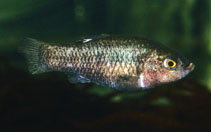 Cyprinodon veronicae
Female Photo von Loiselle, P.V.
Bilder | Google Bild
Female Photo von Loiselle, P.V.
Klassifizierung / Names Namen | Synonyme | Catalog of Fishes(Gattung, Arten) | ITIS | CoL | WoRMS | Cloffa
> Cyprinodontiformes (Rivulines, killifishes and live bearers) > Cyprinodontidae (Pupfishes) > Cyprinodontinae
Etymology: Cyprinodon: Latin, cyprinus = carp + Greek, odous = teeth (Ref. 45335); veronicae: Named for Verónica Contreras Arquieta.
Eponymy: Verónica Contreras Arquieta is the junior author’s daughter and the senior author’s niece. She was honoured for her participation in the collecting trip (1984) during which the pupfish type was taken. (Also see Cecilia) (Ref. 128868), visit book page.
Etymology: Cyprinodon: Latin, cyprinus = carp + Greek, odous = teeth (Ref. 45335); veronicae: Named for Verónica Contreras Arquieta.
Eponymy: Verónica Contreras Arquieta is the junior author’s daughter and the senior author’s niece. She was honoured for her participation in the collecting trip (1984) during which the pupfish type was taken. (Also see Cecilia) (Ref. 128868), visit book page.
Umwelt: Milieu / Klimazone / Tiefenbereich / Verbreitungsgebiet Ökologie
; süßwasser benthopelagisch; standorttreu (Ref. 126106). Tropical
Verbreitung Territorien | FAO Gebiete | Ökosysteme | Vorkommen | Punkt Karte | Einführungen | Faunafri
Central America: Río San Juan system, Mexico.
Größe / Gewicht / Alter
Kurzbeschreibung Bestimmungsschlüssel | Morphologie | Morphometrie
This species is distinguished from its congeners in having the following characters: maxilla short 0.70-0.77 times in anal fin base; head large 2.7-2.9 times in SL; male with 6-7 diffused dark bars along sides, covering only upper half of body; female with an irregular ocellus on dorsal fin, its black spot half-moon shaped, smaller than a pupil; eye 1-1.2 times in anal fin base; postdorsal-postanal 0.9-1.1 times in caudal peduncle length; anal fin usually smaller than its congeners, 3-3.9 times in head length; teeth absent on 4th ceratobranchial; dorsal fin inserted behind pelvic origin; nuptial males violaceous blue (Ref. 26729).
Body shape (shape guide): fusiform / normal.
Body shape (shape guide): fusiform / normal.
The springs at Ojo Charco Azul (= Barreno) are part of the Bolsón de Sandia complex, at 1600 m above sea level, and at the foot of Sierra Montelongo Pedregoso. The area is semiarid, with cacti other succulents; a densely woody area of cedar around the springs, except on the eastern side. Formerly the water was crystal clear at 19-20°C, but recently after depletion, the water is brown. Aquatic vegetation includes Ceratophyllum, Potamogeton, Typha, Eleocharis, Lemna, Utricularia, Scirpus, and Chara; crayfish Cambarellus sp. was observed. The bottom is loamy or muddy (Ref. 26729). Not a seasonal killifish. Is very difficult to maintain in aquarium (Ref. 27139).
Lebenszyklus und Paarungsverhalten Geschlechtsreife | Fortpflanzung | Ablaichen | Eier | Fruchtbarkeit | Larven
Hauptreferenz
Laden Sie Ihre Referenzen hoch | Referenzen | Koordinator : Costa, Wilson J.E.M. | Partner
Lozano-Vilano, M. de L. and S. Conteras-Balderas, 1993. Four new species of Cyprinodon from southern Nuevo León, Mexico, with a key to the C. eximius complex (Teleostei: Cyprinodontidae). Ichthyol. Explor. Freshwat. 4(4):295-308. (Ref. 26729)
IUCN Rote Liste Status (Ref. 130435: Version 2025-2 (Global))
in Freiheit ausgestorben (EW) ; Date assessed: 27 September 2018
CITES
Not Evaluated
Bedrohung für Menschen
Harmless
Nutzung durch Menschen
Fischereien: kommerziell; Aquarium: Kommerziell
FAO - Publication: search | FishSource |
Mehr Information
Trophische Ökologie
Lebensmittel (Beutetiere)
Nahrungszusammensetzung
Nahrungsaufnahme
Lebensmittelrationen
Räuber
Lebensmittel (Beutetiere)
Nahrungszusammensetzung
Nahrungsaufnahme
Lebensmittelrationen
Räuber
Ökologie
Ökologie
Ökologie
Populationsdynamik
Wachstumsparameter
Max. Alter/Größen
Länge-Gewicht-Rel.
Länge-Länge-Verhältnis.
Längenhäufigkeiten
Massenkonvertierung
Rekrutierung
Dichte
Wachstumsparameter
Max. Alter/Größen
Länge-Gewicht-Rel.
Länge-Länge-Verhältnis.
Längenhäufigkeiten
Massenkonvertierung
Rekrutierung
Dichte
Lebenszyklus
Fortpflanzung
Geschlechtsreife
Reifung/Kiemen rel.
Fruchtbarkeit
Ablaichen
Laichaggregationen
Eier
Eientwicklung
Larven
Larven Pop.Dyn.
Fortpflanzung
Geschlechtsreife
Reifung/Kiemen rel.
Fruchtbarkeit
Ablaichen
Laichaggregationen
Eier
Eientwicklung
Larven
Larven Pop.Dyn.
Anatomie
Kiemenoberfläche
Gehirn
Otolith
Kiemenoberfläche
Gehirn
Otolith
Physiologie
Körperliche Zusammensetzung
Nährstoffe
Sauerstoffverbrauch
Schwimmart
Schwimmgeschwindigkeit
Visuelle Pigmente
Fischgeräusche
Krankheiten und Parasiten
Toxizität (LC50s)
Körperliche Zusammensetzung
Nährstoffe
Sauerstoffverbrauch
Schwimmart
Schwimmgeschwindigkeit
Visuelle Pigmente
Fischgeräusche
Krankheiten und Parasiten
Toxizität (LC50s)
Genetik
Genom
Genetik
Heterozygotie
Vererbbarkeit
Genetische Vielfalt
Genom
Genetik
Heterozygotie
Vererbbarkeit
Genetische Vielfalt
Menschenbezogen
Aquakultur-Systeme
Aquakultur Profile
Zuchtlinien
Ciguatera-Fälle
Briefmarken, Münzen, Verschiedenes.
Aquakultur-Systeme
Aquakultur Profile
Zuchtlinien
Ciguatera-Fälle
Briefmarken, Münzen, Verschiedenes.
Tools
E-Book | Feldführer | Bestimmungsschlüssel | Längenhäufigkeits Tool | Lebensdaten Tool | Punkt Karte |
Catch-MSY |
Zusatzinformationen
Download XML
Zusammenfassung | Punktdaten | Namen | Photos
Internet Quellen
AFORO (otoliths) | Aquatic Commons | BHL | Cloffa | Websites from users | FishWatcher Einträge suchen | CISTI | Catalog of Fishes: Gattung, Arten | DiscoverLife | ECOTOX | FAO - Publication: search | Faunafri | Fishipedia | Fishtrace | GloBI | Google Books | Google Scholar | Google | IGFA World Record | OneZoom | Open Tree of Life | Otolith Atlas of Taiwan Fishes | PubMed | Reef Life Survey | Socotra Atlas | TreeBase | Tree of Life | Wikipedia: Gehe zu, Suchen | World Records Freshwater Fishing | Zoobank | Zoologischer Rekord
Schätzungen auf der Grundlage von Modellen
Phylogenetischer Diversitätsindex (Ref. 82804): PD50 = 0.5000 [Uniqueness, from 0.5 = low to 2.0 = high].
Bayesian length-weight: a=0.01349 (0.00599 - 0.03039), b=3.14 (2.95 - 3.33), in cm total length, based on LWR estimates for this (Sub)family-body shape (Ref. 93245).
Trophische Ebene (Ref. 69278): 2.6 ±0.1 se; based on size and trophs of closest relatives