



Beobachtung melden im Fish Watcher
| Native range | All suitable habitat | Point map | Year 2050 |

|
| This map was computer-generated and has not yet been reviewed. |
| Mustelus henlei AquaMaps Data sources: GBIF OBIS |
Hochladen Photos und videos
Bilder | Google Bild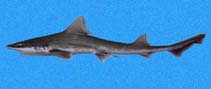 Mustelus henlei
Photo von Robertson, R.
Bilder | Google Bild
Photo von Robertson, R.
Klassifizierung / Names Namen | Synonyme | Catalog of Fishes(Gattung, Arten) | ITIS | CoL | WoRMS | Cloffa
Elasmobranchii (Haie und Rochen) (sharks and rays) > Carcharhiniformes (Ground sharks) > Triakidae (Houndsharks) > Triakinae
Etymology: Mustelus: Latin for weasel, an ancient name for sharks, possibly referring to the pointed snouts, swift movements and/or rapacious feeding behavior of smaller predatory sharks [strictly not tautonymous with Squalus mustelus Linnaeus 1758 since type was designated by the ICZN] (See ETYFish); henlei: In honor of Friedrich Gustav Jacob Henle (1807-1885), German physician, pathologist and anatomist, who, along with Johann Müller, produced the first authoritative work on sharks (1839-1841) (See ETYFish).
Eponymy: Dr Friedrich Gustav Jakob Henle (1809–1885) was a German physician, anatomist and zoologist whose main subjects were ichthyology and human biology. [...] (Ref. 128868), visit book page.
More on author: Gill.
Etymology: Mustelus: Latin for weasel, an ancient name for sharks, possibly referring to the pointed snouts, swift movements and/or rapacious feeding behavior of smaller predatory sharks [strictly not tautonymous with Squalus mustelus Linnaeus 1758 since type was designated by the ICZN] (See ETYFish); henlei: In honor of Friedrich Gustav Jacob Henle (1807-1885), German physician, pathologist and anatomist, who, along with Johann Müller, produced the first authoritative work on sharks (1839-1841) (See ETYFish).
Eponymy: Dr Friedrich Gustav Jakob Henle (1809–1885) was a German physician, anatomist and zoologist whose main subjects were ichthyology and human biology. [...] (Ref. 128868), visit book page.
More on author: Gill.
Umwelt: Milieu / Klimazone / Tiefenbereich / Verbreitungsgebiet Ökologie
seewasser demersal; tiefenbereich 0 - 281 m (Ref. 96339). Subtropical; 48°N - 18°S, 126°W - 72°W (Ref. 55310)
Verbreitung Territorien | FAO Gebiete | Ökosysteme | Vorkommen | Punkt Karte | Einführungen | Faunafri
Eastern Pacific: northern California, USA to the Gulf of California; Ecuador and Peru.
Länge bei der ersten Reifung / Größe / Gewicht / Alter
Geschlechtsreife: Lm 57.0, range 51 - 63 cm
Max length : 100.0 cm TL Männchen/unbestimmt; (Ref. 31395); max. veröff. Alter: 13 Jahre (Ref. 6098)
Max length : 100.0 cm TL Männchen/unbestimmt; (Ref. 31395); max. veröff. Alter: 13 Jahre (Ref. 6098)
Adults are found on the continental shelves from the intertidal region to at least 200 m depth. They feed on crabs, ghost shrimps, mantis shrimps, isopods, squids, polychaete worms, tunicates and small bony fishes. Viviparous (with a yolk-sac placenta), with 3 to 5 young in a litter. Size at birth between 19 and 21 cm. Readily kept in captivity. Utilized for human consumption. Marketed fresh, smoked and frozen (Ref. 9987).
Lebenszyklus und Paarungsverhalten Geschlechtsreife | Fortpflanzung | Ablaichen | Eier | Fruchtbarkeit | Larven
Viviparous with a yolk-sac placenta; with 3 to 5 young in a litter. Size at birth ranges from 19-21 cm (Ref. 244). Distinct pairing with embrace (Ref. 205). Polyandry is a common life history strategy among the elasmobranchs and for M. henlei, the occurrence and frequency of polyandric behavior may vary depending on location and density of breeding individuals (Ref. 95902).
Hauptreferenz
Laden Sie Ihre Referenzen hoch | Referenzen | Koordinator : Compagno, Leonard J.V. | Partner
Compagno, L.J.V., 1984. FAO Species Catalogue. Vol. 4. Sharks of the world. An annotated and illustrated catalogue of shark species known to date. Part 2 - Carcharhiniformes. FAO Fish. Synop. 125(4/2):251-655. Rome: FAO. (Ref. 244)
IUCN Rote Liste Status (Ref. 130435: Version 2025-2 (Global))
nicht bedroht (LC) ; Date assessed: 20 August 2024
CITES
Not Evaluated
Bedrohung für Menschen
Harmless
Nutzung durch Menschen
Fischereien: hoch kommerziell; Sportfisch: ja
FAO - Fischereien: landungen; Publication: search | FishSource | Das Meer um uns herum
Mehr Information
Trophische Ökologie
Lebensmittel (Beutetiere)
Nahrungszusammensetzung
Nahrungsaufnahme
Lebensmittelrationen
Räuber
Lebensmittel (Beutetiere)
Nahrungszusammensetzung
Nahrungsaufnahme
Lebensmittelrationen
Räuber
Populationsdynamik
Wachstumsparameter
Max. Alter/Größen
Länge-Gewicht-Rel.
Länge-Länge-Verhältnis.
Längenhäufigkeiten
Massenkonvertierung
Rekrutierung
Dichte
Wachstumsparameter
Max. Alter/Größen
Länge-Gewicht-Rel.
Länge-Länge-Verhältnis.
Längenhäufigkeiten
Massenkonvertierung
Rekrutierung
Dichte
Lebenszyklus
Fortpflanzung
Geschlechtsreife
Reifung/Kiemen rel.
Fruchtbarkeit
Ablaichen
Laichaggregationen
Eier
Eientwicklung
Larven
Larven Pop.Dyn.
Fortpflanzung
Geschlechtsreife
Reifung/Kiemen rel.
Fruchtbarkeit
Ablaichen
Laichaggregationen
Eier
Eientwicklung
Larven
Larven Pop.Dyn.
Anatomie
Kiemenoberfläche
Gehirn
Otolith
Kiemenoberfläche
Gehirn
Otolith
Physiologie
Körperliche Zusammensetzung
Nährstoffe
Sauerstoffverbrauch
Schwimmart
Schwimmgeschwindigkeit
Visuelle Pigmente
Fischgeräusche
Krankheiten und Parasiten
Toxizität (LC50s)
Körperliche Zusammensetzung
Nährstoffe
Sauerstoffverbrauch
Schwimmart
Schwimmgeschwindigkeit
Visuelle Pigmente
Fischgeräusche
Krankheiten und Parasiten
Toxizität (LC50s)
Menschenbezogen
Aquakultur-Systeme
Aquakultur Profile
Zuchtlinien
Ciguatera-Fälle
Briefmarken, Münzen, Verschiedenes.
Aquakultur-Systeme
Aquakultur Profile
Zuchtlinien
Ciguatera-Fälle
Briefmarken, Münzen, Verschiedenes.
Tools
Zusatzinformationen
Download XML
Zusammenfassung | Punktdaten | Namen | Photos
Internet Quellen
AFORO (otoliths) | Aquatic Commons | BHL | Cloffa | Websites from users | FishWatcher Einträge suchen | CISTI | Catalog of Fishes: Gattung, Arten | DiscoverLife | ECOTOX | FAO - Fischereien: landungen; Publication: search | Faunafri | Fishipedia | Fishtrace | GloBI | Google Books | Google Scholar | Google | IGFA World Record | OceanAdapt | OneZoom | Open Tree of Life | Otolith Atlas of Taiwan Fishes | PubMed | Reef Life Survey | Socotra Atlas | TreeBase | Tree of Life | Wikipedia: Gehe zu, Suchen | World Records Freshwater Fishing | Zoologischer Rekord
Schätzungen auf der Grundlage von Modellen
Bevorzugte Temperatur (Ref. 123201): 9.7 - 23.5, mean 15.4 °C (based on 100 cells).
Phylogenetischer Diversitätsindex (Ref. 82804): PD50 = 0.5000 [Uniqueness, from 0.5 = low to 2.0 = high].
Bayesian length-weight: a=0.00229 (0.00107 - 0.00491), b=3.14 (2.97 - 3.31), in cm total length, based on LWR estimates for this Genus-body shape (Ref. 93245).
Trophische Ebene (Ref. 69278): 3.6 ±0.4 se; based on diet studies.
Widerstandsfähigkeit (Ref. 120179): niedrig, Verdopplung der Population dauert 4,5 - 14 Jahre. (rm=0.127; K=0.26; tm=2-6; tmax=15; Fec=3).
Nährstoffe (Ref. 124155): Calcium = 20.8 [5.7, 103.5] mg/100g; Iron = 0.509 [0.159, 1.911] mg/100g; Protein = 21.7 [19.4, 24.0] %; Omega3 = 0.147 [0.061, 0.347] g/100g; Selenium = 42.3 [12.2, 148.1] μg/100g; VitaminA = 6.83 [2.38, 18.97] μg/100g; Zinc = 0.616 [0.272, 1.231] mg/100g (wet weight);