



Ichthyomyzon unicuspis Hubbs & Trautman, 1937
Silver lamprey
Sube tu fotos y Vídeos
Imágenes | Google image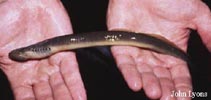 Ichthyomyzon unicuspis
Foto de Lyons, J.
Imágenes | Google image
Foto de Lyons, J.
Clasificación / Nombres Nombres comunes | Sinónimos | Catalog of Fishes(Género, Especie) | ITIS | CoL | WoRMS | Cloffa
> Petromyzontiformes (Lampreys) > Petromyzontidae (Northern lampreys) > Petromyzontinae
Etymology: Ichthyomyzon: ichthys, fish; myzon (Gr.), to suck (borrowed from Petromyzon), i.e., a sucking fish, referring to their suctorial behavior (See ETYFish); unicuspis: unus (L.), one; cuspis (L.), point, referring to single (unicuspid) cusps of circumoral teeth of adults (compared with bicuspid circumoral teeth of congeners) (See ETYFish).
More on authors: Hubbs & Trautman.
Etymology: Ichthyomyzon: ichthys, fish; myzon (Gr.), to suck (borrowed from Petromyzon), i.e., a sucking fish, referring to their suctorial behavior (See ETYFish); unicuspis: unus (L.), one; cuspis (L.), point, referring to single (unicuspid) cusps of circumoral teeth of adults (compared with bicuspid circumoral teeth of congeners) (See ETYFish).
More on authors: Hubbs & Trautman.
Taxonomic Remarks
Hubbs and Trautman (1937) suggested that one adult specimen from Green Bay, near Gladstone, Lake Michigan Basin, might be a hybrid between I. unicuspis and I. castaneus and another from the Scioto River, Ohio River Basin, might be a hybrid between I. unicuspis and I. bdellium. Starrett et al. (1960) suggested that an adult specimen from the Mississippi River, at Moline, Illinois might be a hybrid between I. castaneus and I. unicuspis (Ref.89241).
Entorno: milieu / zona climática / rango de profundidad / gama de distribución Ecología
; agua dulce demersal; potamodromo (Ref. 1998); rango de profundidad ? - 31 m (Ref. 89241). Temperate; 59°N - 30°N
Distribución Territorios | Áreas FAO | Ecosistemas | Ocurrencias, apariciones | Mapa de puntos | Introducciones | Faunafri
North America: St. Lawrence-Great Lakes basin from Quebec to southwest Ontario and south through upper Mississippi and Ohio river basins to Tennessee; Hudson Bay basin in Manitoba; Missouri River in Nebraska and Mississippi River in Mississippi. Readily distinguishable from the sea lamprey by its single dorsal fin.
Longitud en la primera madurez / Tamaño / Peso / Edad
Madurez: Lm 10.0 range ? - ? cm
Max length : 39.2 cm TL macho / no sexado; (Ref. 89241); common length : 20.1 cm TL macho / no sexado; (Ref. 12193); edad máxima reportada: 8 años (Ref. 12193)
Max length : 39.2 cm TL macho / no sexado; (Ref. 89241); common length : 20.1 cm TL macho / no sexado; (Ref. 12193); edad máxima reportada: 8 años (Ref. 12193)
Descripción breve Claves de identificación | Morfología | Morfometría
Adults: 8.5-39.2 cm TL and wet weight 34-133 g for individuals 25.0-39.2 cm TL. Body proportions, as percentage of TL (based on 43 specimens measuring 8.5-27.0 cm TL): prebranchial length, 11.4-15.9; branchial length, 8.7-10.8 [8.0-12.2 according to Hubbs and Trautman (1937)]; trunk length, 42.4-49.2; tail length, 25.8-35.0; eye length, 0.7-2.5; disc length, 5.9-12.4. Urogenital papilla length, as a percentage of branchial length, in 7 spawning males measuring 18.5-27.9 cm TL, 5.3-7.7. Trunk myomeres, 47-57. Dentition: supraoral lamina, 1-4 unicuspid teeth, but usually 2; infraoral lamina, 5-12 unicuspid teeth, usually 7-8; 3-6 endolaterals on each side, usually 4; endolateral formula, typically 1-1-1-1; 0-2 bicuspid endolaterals in total, usually 0, the other endolaterals unicuspid; 2-4 rows of anterials; first row of anterials, 1-3 unicuspid teeth; 4-8 rows of exolaterals on each side; 3 rows of posterials; first row of posterials, 8-10 unicuspid teeth; crest of transverse lingual lamina moderately to strongly w-shaped, rarely weakly w-shaped, with about 35 short unicuspid teeth, the median one not enlarged; longitudinal lingual laminae each with 33-40 unicuspid teeth. Well-developed marginal membrane. Velar tentacles, 2-6, smooth. Body coloration (live) a light yellow tan and (preserved) usually yellowish, darker on the dorsal surface, gradually becoming lighter towards the ventral surface with mottling of these shades on the sides; occasionally grayish. Spent individuals blue-back. Lateral line neuromasts darkly pigmented at least by 14.6 cm TL. Extent of caudal fin pigmentation,75% or more. Caudal fin shape, rounded. Oral fimbriae, 81-108. Oral papillae, 15-25 (Ref. 89241).
Body shape (shape guide): eel-like.
Body shape (shape guide): eel-like.
Generally associated with warm-water habitats and tolerant of variation in terms of discharge (summer flows 0.06-34 m3/s), water temperature, and substrate. Adults occur principally in the mainstems of large streams. It can also occur in small to large lakes. In Lake Huron, has been collected at depths between 26 and 31 m. Spawning adults are found in streams or lakes (Ref. 89241). Ammocoetes occur in sandy or muddy pools and backwaters. Feeding adults are usually found attached to other fishes in large rivers, lakes, and impoundments. They migrate upriver to spawn in gravel riffles and runs. (Ref. 3221, 10294). Described as anadromous in Ref. 51243. Larval stage lasts for about 4 to 7 years (Ref. 1998, 10294). Metamorphosis occurs in November, in Michigan. Duration of adult stage 12-13 months in Québec (Ref. 89241). Adults are parasitic for 1 to 2 years. Semelparous (Ref. 1998). In Ohio, the spawning period is from 26 April to 2 June. In Michigan, the spawning period is from 23 May to 26 June, at water temperatures between 12.8-22.8 ˚C, with peak spawning activity in early June. Nests are built in streams having 3.5-30 m width, 10-61 cm depth, and 0.1-4.2 m3/s flow. A nest can be 30-cm in diameter, open on the downstream side, 8-15 cm deep, and it can also contain sticks and twigs. Up to ten spawning lampreys have been found in a nest. Fecundity, 10,800 eggs/female. Spawning occurs during daylight hours and into dusk. There are reported occurrences in Michigan of communal spawning of Silver Lamprey with Northern Brook Lamprey (Pine River), of Silver Lamprey with Sea Lamprey (Carp Lake, Devils, East Au Gres, and Rifle rivers), and of Silver Lamprey, with Sea Lamprey, and American Brook Lamprey (Carp Lake River). In the Laurentian Great Lakes Basin, it has been negatively affected by control measures directed towards Petromyzon marinus, except for the chemosterilization of males, which affects only the latter species (Ref. 89241).
Ciclo vital y comportamiento de apareamiento Madurez | Reproducción | Puesta | Huevos | Fecundidad | Larva
Semelparous (Ref. 1998).
Referencia principal
Suba sus referencias | Referencias | Coordinador | Colaboradores
McClanes, A.J. (ed.), 1974. Field guide to freshwater fishes of North America. Holt, Rinehart and Winston, New York. 212 p. (Ref. 3221)
Situación en la Lista Roja de la UICN (Ref. 130435: Version 2025-2 (Global))
Least Concern (LC) ; Date assessed: 22 February 2012
CITES
Not Evaluated
Amenaza para el ser humano
Harmless
Usos humanos
Carnada: occasionally
FAO - Publication: search | FishSource |
Más información
Ecología Trófica
Alimentos (presas)
Composición de la dieta
consumo de alimento
Raciones de comida
Despredadores
Alimentos (presas)
Composición de la dieta
consumo de alimento
Raciones de comida
Despredadores
Dinámica de la población
Coeficiente del crecimiento para
Edades / tallas máximas
Longitud-peso rel.
Longitud-longitud rel.
Longitud-frecuencias
Conversión de masas
Reclutamiento
Abundancia
Coeficiente del crecimiento para
Edades / tallas máximas
Longitud-peso rel.
Longitud-longitud rel.
Longitud-frecuencias
Conversión de masas
Reclutamiento
Abundancia
Ciclo de vida
Reproducción
Madurez
Madurez/Gills rel.
Fecundidad
Puesta
Agregaciones de desove
Huevos
Desarrollo de los huevos
Larva
Dinámica larvaria
Reproducción
Madurez
Madurez/Gills rel.
Fecundidad
Puesta
Agregaciones de desove
Huevos
Desarrollo de los huevos
Larva
Dinámica larvaria
Distribución
Territorios
Áreas FAO
Ecosistemas
Ocurrencias, apariciones
Introducciones
BRUVS - Vídeos
Territorios
Áreas FAO
Ecosistemas
Ocurrencias, apariciones
Introducciones
BRUVS - Vídeos
Fisiología
Composición corporal
Nutrientes
Consumo del oxígeno
Tipo de natación
Velocidad de natación
Pigmentos visuales
Sonido de peces
Enfermedades y parásitos
Toxicidad (CL50)
Composición corporal
Nutrientes
Consumo del oxígeno
Tipo de natación
Velocidad de natación
Pigmentos visuales
Sonido de peces
Enfermedades y parásitos
Toxicidad (CL50)
Genética
Genoma
Genética
Heterocigosidad
heritabilidad
Diversidad genética
Genoma
Genética
Heterocigosidad
heritabilidad
Diversidad genética
Relacionados con el ser humano
Sistemas de acuicultura
Perfiles de acuicultura
Razas
Ciguatera cases
Sellos, monedas, varios
Sistemas de acuicultura
Perfiles de acuicultura
Razas
Ciguatera cases
Sellos, monedas, varios
Herramientas
Libro electrónico | Guía de campo | Claves de identificación | Asistente para frecuencias de tallas | Herramienta de ciclo de vida | Mapa de puntos |
Catch-MSY |
Informes especiales
Comprobar el mantenimiento del acuario | Buscar fichas sobre especies | Consulte las hojas informativas sobre acuicultura
Descargar XML
Fuentes de Internet
AFORO (otoliths) | Alien/Invasive Species database | Aquatic Commons | BHL | Cloffa | Websites from users | Check FishWatcher | CISTI | Catalog of Fishes: Género, Especie | DiscoverLife | ECOTOX | FAO - Publication: search | Faunafri | Fishipedia | Fishtrace | GloBI | Google Books | Google Scholar | Google | IGFA World Record | OneZoom | Open Tree of Life | Otolith Atlas of Taiwan Fishes | PubMed | Reef Life Survey | Socotra Atlas | TreeBase | Árbol de la vida | Wikipedia: Go, búsqueda | World Records Freshwater Fishing | Zoobank | Expediente Zoológico
Estimaciones basadas en modelos
Índice de diversidad filogenética (Referencia 82804): PD50 = 0.5156 [Uniqueness, from 0.5 = low to 2.0 = high].
Bayesian length-weight: a=0.00105 (0.00040 - 0.00275), b=3.03 (2.80 - 3.26), in cm total length, based on LWR estimates for this (Sub)family-body shape (Ref. 93245).
Nivel trófico (Referencia 69278): 4.5 ±0.80 se; based on food items.
Resiliencia (Referencia 120179): Bajo, población duplicada en un tiempo mínimo de 4.5-14 años (tmax=8; tm=6; Fec=10,800).