



Ichthyomyzon unicuspis Hubbs & Trautman, 1937
Silver lamprey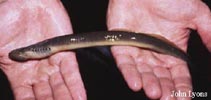
分类 / 名称 俗名 | 同种异名 | Catalog of Fishes(属, 种) | ITIS | CoL | WoRMS | Cloffa
Petromyzonti > Petromyzontiformes (Lampreys) > Petromyzontidae (Northern lampreys) > Petromyzontinae
Etymology: Ichthyomyzon: ichthys, fish; myzon (Gr.), to suck (borrowed from Petromyzon), i.e., a sucking fish, referring to their suctorial behavior (See ETYFish); unicuspis: unus (L.), one; cuspis (L.), point, referring to single (unicuspid) cusps of circumoral teeth of adults (compared with bicuspid circumoral teeth of congeners) (See ETYFish).
More on authors: Hubbs & Trautman.
Etymology: Ichthyomyzon: ichthys, fish; myzon (Gr.), to suck (borrowed from Petromyzon), i.e., a sucking fish, referring to their suctorial behavior (See ETYFish); unicuspis: unus (L.), one; cuspis (L.), point, referring to single (unicuspid) cusps of circumoral teeth of adults (compared with bicuspid circumoral teeth of congeners) (See ETYFish).
More on authors: Hubbs & Trautman.
Taxonomic Remarks
Hubbs and Trautman (1937) suggested that one adult specimen from Green Bay, near Gladstone, Lake Michigan Basin, might be a hybrid between I. unicuspis and I. castaneus and another from the Scioto River, Ohio River Basin, might be a hybrid between I. unicuspis and I. bdellium. Starrett et al. (1960) suggested that an adult specimen from the Mississippi River, at Moline, Illinois might be a hybrid between I. castaneus and I. unicuspis (Ref.89241).
环境:氛围 / 气候带 / 深度上下限 / 分布范围 生态学
分布 领土 | FAO区域 | 生态系 | 标本纪录 | 分布图 | 简介 | Faunafri
North America: St. Lawrence-Great Lakes basin from Quebec to southwest Ontario and south through upper Mississippi and Ohio river basins to Tennessee; Hudson Bay basin in Manitoba; Missouri River in Nebraska and Mississippi River in Mississippi. Readily distinguishable from the sea lamprey by its single dorsal fin.
北美洲: 密西西比流域與五大湖到哈得遜灣與聖勞倫斯河。 用它的單一背鰭可輕易地與海洋八目鰻區別。
北美洲: 密西西比流域與五大湖到哈得遜灣與聖勞倫斯河。 用它的單一背鰭可輕易地與海洋八目鰻區別。
首次成熟时的长度 / 大小 / 重量 / 年龄
成熟度: Lm 10.0 range ? - ? cm
Max length : 39.2 cm TL 雄鱼/尚未辨别雌雄; (Ref. 89241); common length : 20.1 cm TL 雄鱼/尚未辨别雌雄; (Ref. 12193); 最大年龄: 8 年 (Ref. 12193)
Max length : 39.2 cm TL 雄鱼/尚未辨别雌雄; (Ref. 89241); common length : 20.1 cm TL 雄鱼/尚未辨别雌雄; (Ref. 12193); 最大年龄: 8 年 (Ref. 12193)
简单描述 检索表 | 型态特徵 | 形态测量图
Adults: 8.5-39.2 cm TL and wet weight 34-133 g for individuals 25.0-39.2 cm TL. Body proportions, as percentage of TL (based on 43 specimens measuring 8.5-27.0 cm TL): prebranchial length, 11.4-15.9; branchial length, 8.7-10.8 [8.0-12.2 according to Hubbs and Trautman (1937)]; trunk length, 42.4-49.2; tail length, 25.8-35.0; eye length, 0.7-2.5; disc length, 5.9-12.4. Urogenital papilla length, as a percentage of branchial length, in 7 spawning males measuring 18.5-27.9 cm TL, 5.3-7.7. Trunk myomeres, 47-57. Dentition: supraoral lamina, 1-4 unicuspid teeth, but usually 2; infraoral lamina, 5-12 unicuspid teeth, usually 7-8; 3-6 endolaterals on each side, usually 4; endolateral formula, typically 1-1-1-1; 0-2 bicuspid endolaterals in total, usually 0, the other endolaterals unicuspid; 2-4 rows of anterials; first row of anterials, 1-3 unicuspid teeth; 4-8 rows of exolaterals on each side; 3 rows of posterials; first row of posterials, 8-10 unicuspid teeth; crest of transverse lingual lamina moderately to strongly w-shaped, rarely weakly w-shaped, with about 35 short unicuspid teeth, the median one not enlarged; longitudinal lingual laminae each with 33-40 unicuspid teeth. Well-developed marginal membrane. Velar tentacles, 2-6, smooth. Body coloration (live) a light yellow tan and (preserved) usually yellowish, darker on the dorsal surface, gradually becoming lighter towards the ventral surface with mottling of these shades on the sides; occasionally grayish. Spent individuals blue-back. Lateral line neuromasts darkly pigmented at least by 14.6 cm TL. Extent of caudal fin pigmentation,75% or more. Caudal fin shape, rounded. Oral fimbriae, 81-108. Oral papillae, 15-25 (Ref. 89241).
Body shape (shape guide): eel-like.
Body shape (shape guide): eel-like.
Generally associated with warm-water habitats and tolerant of variation in terms of discharge (summer flows 0.06-34 m3/s), water temperature, and substrate. Adults occur principally in the mainstems of large streams. It can also occur in small to large lakes. In Lake Huron, has been collected at depths between 26 and 31 m. Spawning adults are found in streams or lakes (Ref. 89241). Ammocoetes occur in sandy or muddy pools and backwaters. Feeding adults are usually found attached to other fishes in large rivers, lakes, and impoundments. They migrate upriver to spawn in gravel riffles and runs. (Ref. 3221, 10294). Described as anadromous in Ref. 51243. Larval stage lasts for about 4 to 7 years (Ref. 1998, 10294). Metamorphosis occurs in November, in Michigan. Duration of adult stage 12-13 months in Québec (Ref. 89241). Adults are parasitic for 1 to 2 years. Semelparous (Ref. 1998). In Ohio, the spawning period is from 26 April to 2 June. In Michigan, the spawning period is from 23 May to 26 June, at water temperatures between 12.8-22.8 ˚C, with peak spawning activity in early June. Nests are built in streams having 3.5-30 m width, 10-61 cm depth, and 0.1-4.2 m3/s flow. A nest can be 30-cm in diameter, open on the downstream side, 8-15 cm deep, and it can also contain sticks and twigs. Up to ten spawning lampreys have been found in a nest. Fecundity, 10,800 eggs/female. Spawning occurs during daylight hours and into dusk. There are reported occurrences in Michigan of communal spawning of Silver Lamprey with Northern Brook Lamprey (Pine River), of Silver Lamprey with Sea Lamprey (Carp Lake, Devils, East Au Gres, and Rifle rivers), and of Silver Lamprey, with Sea Lamprey, and American Brook Lamprey (Carp Lake River). In the Laurentian Great Lakes Basin, it has been negatively affected by control measures directed towards Petromyzon marinus, except for the chemosterilization of males, which affects only the latter species (Ref. 89241).
非寄生的成鱼通常被发现在大河,湖与圈围水域吸附于其它的鱼。 成鱼移动上流区域产卵于碎石激流与小支流中。 Ammocoetes 出现在沙或泥泞的深潭与滞水区。
非寄生的成鱼通常被发现在大河,湖与圈围水域吸附于其它的鱼。 成鱼移动上流区域产卵于碎石激流与小支流中。 Ammocoetes 出现在沙或泥泞的深潭与滞水区。
生命周期和交配行为 成熟度 | 繁殖 | 产卵场 | 卵 | 孕卵数 | 仔鱼
Semelparous (Ref. 1998).北美洲: 密西西比流域與五大湖到哈得遜灣與聖勞倫斯河。 用它的單一背鰭可輕易地與海洋八目鰻區別。
主要参考文献
上传您的参考资料 | 参考文献 | 合作者 | 合作者
McClanes, A.J. (ed.), 1974. Field guide to freshwater fishes of North America. Holt, Rinehart and Winston, New York. 212 p. (Ref. 3221)
CITES
Not Evaluated
对人类的威胁
无害处的
人类利用
诱饵: occasionally
FAO - Publication: search | FishSource |
更多信息
工具
特别资料
下载 XML
网络资源
AFORO (otoliths) | Alien/Invasive Species database | Aquatic Commons | BHL | Cloffa | Websites from users | 核实 FishWatcher | CISTI | Catalog of Fishes: 属, 种 | DiscoverLife | ECOTOX | FAO - Publication: search | Faunafri | Fishipedia | Fishtrace | GloBI | Google Books | Google Scholar | Google | IGFA World Record | OneZoom | Open Tree of Life | Otolith Atlas of Taiwan Fishes | PubMed | Reef Life Survey | Socotra Atlas | TreeBase | 树状分类阶层 | Wikipedia: 转至, 搜寻 | World Records Freshwater Fishing | Zoobank | 动物学的记录
基于模型的估算
系统发育多样性指数 (参考文献 82804): PD50 = 0.5156 [Uniqueness, from 0.5 = low to 2.0 = high].
Bayesian length-weight: a=0.00105 (0.00040 - 0.00275), b=3.03 (2.80 - 3.26), in cm total length, based on LWR estimates for this (Sub)family-body shape (Ref. 93245).
营养阶层 (参考文献 69278): 4.5 ±0.80 se; based on food items.
回复力 (参考文献 120179): 低的, 最小族群倍增时间4.5 - 14 年 (tmax=8; tm=6; Fec=10,800).