



Chrysichthys auratus (Geoffroy Saint-Hilaire, 1809)
Golden Nile catfish
Sube tu fotos y Vídeos
Imágenes | Google image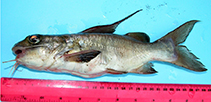 Chrysichthys auratus
Foto de KMFRI
Imágenes | Google image
Foto de KMFRI
Clasificación / Nombres Nombres comunes | Sinónimos | Catalog of Fishes(Género, Especie) | ITIS | CoL | WoRMS | Cloffa
> Siluriformes (Catfishes) > Claroteidae (Claroteid catfishes)
Etymology: Chrysichthys: Greek, chrysos = golden + Greek, ichthys = fish (Ref. 45335).
Etymology: Chrysichthys: Greek, chrysos = golden + Greek, ichthys = fish (Ref. 45335).
Entorno: milieu / zona climática / rango de profundidad / gama de distribución Ecología
; agua dulce; salobre demersal; potamodromo (Ref. 51243). Tropical; 26°C - 31°C (Ref. 27935); 36°N - 2°N, 16°W - 34°E (Ref. 7324)
Distribución Territorios | Áreas FAO | Ecosistemas | Ocurrencias, apariciones | Mapa de puntos | Introducciones | Faunafri
Africa: known from most of the West African hydrographic basins, except in the coastal areas between Gambia and Liberia, where it is replaced by Chrysichthys maurus (Ref. 7324, 57126). Present from southern Liberia to Cabinda (Angola) (Ref. 57126), and widespread throughout Lower Guinea (Ref. 81642). Also reported from the Chad (Ref. 3236, 57126) and Nile (Ref. 3236, 2988, 28663, 78586) basins.
Longitud en la primera madurez / Tamaño / Peso / Edad
Madurez: Lm 11.0, range 8 - 19 cm
Max length : 57.0 cm TL macho / no sexado; (Ref. 41031); 35.0 cm SL (female); peso máximo publicado: 0.00 g
Max length : 57.0 cm TL macho / no sexado; (Ref. 41031); 35.0 cm SL (female); peso máximo publicado: 0.00 g
Descripción breve Claves de identificación | Morfología | Morfometría
Espinas dorsales (total) : 2; Radios blandos dorsales (total) : 5 - 6; Espinas anales: 0. Diagnosis: 1st branched dorsal-fin ray longest, nearly always extended into a long filament that may reach, or even exceed, the base of the caudal fin; in some individuals or populations (Mafou on the upper Niger; rivers Cross, Ogowe, Nyong; Sanaga estuary) this filament is strongly reduced, but the first branched ray remains the longest (Ref. 57126, 81642). In other populations this filament is particularly elongate (Sanaga mainstream and coastal rivers of Cabinda)(Ref. 81642). Usually 8 branched rays in pectoral fins (Ref. 57126, 81642), rarely 7 or 9 (Ref. 57126, 81642), 2nd and 3rd rays sometimes filamentous (Ref. 57126). Exhibits pronounced intraspecific variability, and a clinal series can be demonstrated in the size of the adipose fin and the number of gill rakers (Ref. 81642). Either 9-13 gill rakers on lower limb of first gill arch and base of adipose fin longer than dorsal-fin base (Nilo-Sudanese region = populations from Nile, Chad, Senegal and the upper courses of the Niger, Comoé, Benue and Volta), or 12-15 lower gill rakers and base of adipose fin shorter than, or equal to, dorsal-fin base (coastal zones from Liberia to Cabinda); populations from the middle and lower courses of coastal rivers in this region are more or less intermediate in regard to these characters (Ref. 57126, 81642). Pronounced dimorphism between mature males in reproductive activity and immature males (Ref. 57126, 81642).
Body shape (shape guide): elongated.
Body shape (shape guide): elongated.
In those parts where Chrysichthys maurus and Chrysichthys auratus overlap (from Liberia to Ghana, to the east of the Volta), C. auratus does not enter rivers, but remains in estuaries and lagoons, where both species are sympatric; in the coastal region, C. auratus has been reported as C. filamentosus (Ref. 57126). Found in lakes and coastal rivers (Ref. 3236) and appears to tolerate a certain amount of salt (Ref. 78218). Occurs usually over soft, slightly muddy substrates or substrates with heavy layers of leafy detritus in deep, relatively quiet waters (Ref. 6868). Feeds on mollusks and small crustaceans (Branchiopods, Copepods, Ostracoda) which it digs from the substrate (Ref. 27935), and also on insects (Ref. 28714) and fish (Ref. 28714, 78218).
Ciclo vital y comportamiento de apareamiento Madurez | Reproducción | Puesta | Huevos | Fecundidad | Larva
Referencia principal
Suba sus referencias | Referencias | Coordinador | Colaboradores
Risch, L.M., 2003. Claroteidae. p. 60-96 In C. Lévêque, D. Paugy and G.G. Teugels (eds.) Faune des poissons d'eaux douce et saumâtres de l'Afrique de l'Ouest, Tome 2. Coll. Faune et Flore tropicales 40. Musée Royal de l'Afrique Centrale, Tervuren, Belgique, Museum National d'Histoire Naturalle, Paris, France and Institut de Recherche pour le Développement, Paris, France. 815 p. (Ref. 57126)
Situación en la Lista Roja de la UICN (Ref. 130435: Version 2025-2 (Global))
Least Concern (LC) ; Date assessed: 30 April 2019
CITES
Not Evaluated
Amenaza para el ser humano
Harmless
Usos humanos
Pesquerías: comercial
FAO - Publication: search | FishSource |
Más información
Ecología Trófica
Alimentos (presas)
Composición de la dieta
consumo de alimento
Raciones de comida
Despredadores
Alimentos (presas)
Composición de la dieta
consumo de alimento
Raciones de comida
Despredadores
Dinámica de la población
Coeficiente del crecimiento para
Edades / tallas máximas
Longitud-peso rel.
Longitud-longitud rel.
Longitud-frecuencias
Conversión de masas
Reclutamiento
Abundancia
Coeficiente del crecimiento para
Edades / tallas máximas
Longitud-peso rel.
Longitud-longitud rel.
Longitud-frecuencias
Conversión de masas
Reclutamiento
Abundancia
Ciclo de vida
Reproducción
Madurez
Madurez/Gills rel.
Fecundidad
Puesta
Agregaciones de desove
Huevos
Desarrollo de los huevos
Larva
Dinámica larvaria
Reproducción
Madurez
Madurez/Gills rel.
Fecundidad
Puesta
Agregaciones de desove
Huevos
Desarrollo de los huevos
Larva
Dinámica larvaria
Distribución
Territorios
Áreas FAO
Ecosistemas
Ocurrencias, apariciones
Introducciones
BRUVS - Vídeos
Territorios
Áreas FAO
Ecosistemas
Ocurrencias, apariciones
Introducciones
BRUVS - Vídeos
Anatomía
Superficie branquial
Cerebro
Otolito
Superficie branquial
Cerebro
Otolito
Fisiología
Composición corporal
Nutrientes
Consumo del oxígeno
Tipo de natación
Velocidad de natación
Pigmentos visuales
Sonido de peces
Enfermedades y parásitos
Toxicidad (CL50)
Composición corporal
Nutrientes
Consumo del oxígeno
Tipo de natación
Velocidad de natación
Pigmentos visuales
Sonido de peces
Enfermedades y parásitos
Toxicidad (CL50)
Relacionados con el ser humano
Sistemas de acuicultura
Perfiles de acuicultura
Razas
Ciguatera cases
Sellos, monedas, varios
Sistemas de acuicultura
Perfiles de acuicultura
Razas
Ciguatera cases
Sellos, monedas, varios
Herramientas
Libro electrónico | Guía de campo | Claves de identificación | Asistente para frecuencias de tallas | Herramienta de ciclo de vida | Mapa de puntos |
Catch-MSY |
Informes especiales
Comprobar el mantenimiento del acuario | Buscar fichas sobre especies | Consulte las hojas informativas sobre acuicultura
Descargar XML
Fuentes de Internet
AFORO (otoliths) | Aquatic Commons | BHL | Cloffa | Websites from users | Check FishWatcher | CISTI | Catalog of Fishes: Género, Especie | DiscoverLife | ECOTOX | FAO - Publication: search | Faunafri | Fishipedia | Fishtrace | GloBI | Google Books | Google Scholar | Google | IGFA World Record | OneZoom | Open Tree of Life | Otolith Atlas of Taiwan Fishes | PubMed | Reef Life Survey | Socotra Atlas | TreeBase | Árbol de la vida | Wikipedia: Go, búsqueda | World Records Freshwater Fishing | Expediente Zoológico
Estimaciones basadas en modelos
Índice de diversidad filogenética (Referencia 82804): PD50 = 0.5000 [Uniqueness, from 0.5 = low to 2.0 = high].
Bayesian length-weight: a=0.01023 (0.00784 - 0.01335), b=2.96 (2.90 - 3.02), in cm total length, based on LWR estimates for this species (Ref. 93245).
Nivel trófico (Referencia 69278): 3.7 ±0.55 se; based on food items.
Generation time: 6.9 ( na - na) years. Estimated as median ln(3)/K based on 2 growth studies.
Resiliencia (Referencia 120179): Medio, población duplicada en un tiempo mínimo de 1.4-4.4 años (K=0.16; Fec > 1,000).