



Chrysichthys auratus (Geoffroy Saint-Hilaire, 1809)
Golden Nile catfish
Hochladen Photos und videos
Bilder | Google Bild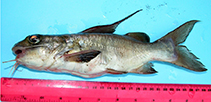 Chrysichthys auratus
Photo von KMFRI
Bilder | Google Bild
Photo von KMFRI
Klassifizierung / Names Namen | Synonyme | Catalog of Fishes(Gattung, Arten) | ITIS | CoL | WoRMS | Cloffa
> Siluriformes (Catfishes) > Claroteidae (Claroteid catfishes)
Etymology: Chrysichthys: Greek, chrysos = golden + Greek, ichthys = fish (Ref. 45335).
Etymology: Chrysichthys: Greek, chrysos = golden + Greek, ichthys = fish (Ref. 45335).
Umwelt: Milieu / Klimazone / Tiefenbereich / Verbreitungsgebiet Ökologie
; süßwasser; brackwasser demersal; potamodrom (Ref. 51243). Tropical; 26°C - 31°C (Ref. 27935); 36°N - 2°N, 16°W - 34°E (Ref. 7324)
Verbreitung Territorien | FAO Gebiete | Ökosysteme | Vorkommen | Punkt Karte | Einführungen | Faunafri
Africa: known from most of the West African hydrographic basins, except in the coastal areas between Gambia and Liberia, where it is replaced by Chrysichthys maurus (Ref. 7324, 57126). Present from southern Liberia to Cabinda (Angola) (Ref. 57126), and widespread throughout Lower Guinea (Ref. 81642). Also reported from the Chad (Ref. 3236, 57126) and Nile (Ref. 3236, 2988, 28663, 78586) basins.
Länge bei der ersten Reifung / Größe / Gewicht / Alter
Geschlechtsreife: Lm 11.0, range 8 - 19 cm
Max length : 57.0 cm TL Männchen/unbestimmt; (Ref. 41031); 35.0 cm SL (female); max. veröff. Gewicht: 0.00 g
Max length : 57.0 cm TL Männchen/unbestimmt; (Ref. 41031); 35.0 cm SL (female); max. veröff. Gewicht: 0.00 g
Kurzbeschreibung Bestimmungsschlüssel | Morphologie | Morphometrie
Rückenflossenstacheln (insgesamt) : 2; Rückenflossenweichstrahlen (insgesamt) : 5 - 6; Afterflossenstacheln: 0. Diagnosis: 1st branched dorsal-fin ray longest, nearly always extended into a long filament that may reach, or even exceed, the base of the caudal fin; in some individuals or populations (Mafou on the upper Niger; rivers Cross, Ogowe, Nyong; Sanaga estuary) this filament is strongly reduced, but the first branched ray remains the longest (Ref. 57126, 81642). In other populations this filament is particularly elongate (Sanaga mainstream and coastal rivers of Cabinda)(Ref. 81642). Usually 8 branched rays in pectoral fins (Ref. 57126, 81642), rarely 7 or 9 (Ref. 57126, 81642), 2nd and 3rd rays sometimes filamentous (Ref. 57126). Exhibits pronounced intraspecific variability, and a clinal series can be demonstrated in the size of the adipose fin and the number of gill rakers (Ref. 81642). Either 9-13 gill rakers on lower limb of first gill arch and base of adipose fin longer than dorsal-fin base (Nilo-Sudanese region = populations from Nile, Chad, Senegal and the upper courses of the Niger, Comoé, Benue and Volta), or 12-15 lower gill rakers and base of adipose fin shorter than, or equal to, dorsal-fin base (coastal zones from Liberia to Cabinda); populations from the middle and lower courses of coastal rivers in this region are more or less intermediate in regard to these characters (Ref. 57126, 81642). Pronounced dimorphism between mature males in reproductive activity and immature males (Ref. 57126, 81642).
Body shape (shape guide): elongated.
Body shape (shape guide): elongated.
In those parts where Chrysichthys maurus and Chrysichthys auratus overlap (from Liberia to Ghana, to the east of the Volta), C. auratus does not enter rivers, but remains in estuaries and lagoons, where both species are sympatric; in the coastal region, C. auratus has been reported as C. filamentosus (Ref. 57126). Found in lakes and coastal rivers (Ref. 3236) and appears to tolerate a certain amount of salt (Ref. 78218). Occurs usually over soft, slightly muddy substrates or substrates with heavy layers of leafy detritus in deep, relatively quiet waters (Ref. 6868). Feeds on mollusks and small crustaceans (Branchiopods, Copepods, Ostracoda) which it digs from the substrate (Ref. 27935), and also on insects (Ref. 28714) and fish (Ref. 28714, 78218).
Lebenszyklus und Paarungsverhalten Geschlechtsreife | Fortpflanzung | Ablaichen | Eier | Fruchtbarkeit | Larven
Hauptreferenz
Laden Sie Ihre Referenzen hoch | Referenzen | Koordinator | Partner
Risch, L.M., 2003. Claroteidae. p. 60-96 In C. Lévêque, D. Paugy and G.G. Teugels (eds.) Faune des poissons d'eaux douce et saumâtres de l'Afrique de l'Ouest, Tome 2. Coll. Faune et Flore tropicales 40. Musée Royal de l'Afrique Centrale, Tervuren, Belgique, Museum National d'Histoire Naturalle, Paris, France and Institut de Recherche pour le Développement, Paris, France. 815 p. (Ref. 57126)
IUCN Rote Liste Status (Ref. 130435: Version 2025-2 (Global))
nicht bedroht (LC) ; Date assessed: 30 April 2019
CITES
Not Evaluated
Bedrohung für Menschen
Harmless
Nutzung durch Menschen
Fischereien: kommerziell
FAO - Publication: search | FishSource |
Mehr Information
Trophische Ökologie
Lebensmittel (Beutetiere)
Nahrungszusammensetzung
Nahrungsaufnahme
Lebensmittelrationen
Räuber
Lebensmittel (Beutetiere)
Nahrungszusammensetzung
Nahrungsaufnahme
Lebensmittelrationen
Räuber
Populationsdynamik
Wachstumsparameter
Max. Alter/Größen
Länge-Gewicht-Rel.
Länge-Länge-Verhältnis.
Längenhäufigkeiten
Massenkonvertierung
Rekrutierung
Dichte
Wachstumsparameter
Max. Alter/Größen
Länge-Gewicht-Rel.
Länge-Länge-Verhältnis.
Längenhäufigkeiten
Massenkonvertierung
Rekrutierung
Dichte
Lebenszyklus
Fortpflanzung
Geschlechtsreife
Reifung/Kiemen rel.
Fruchtbarkeit
Ablaichen
Laichaggregationen
Eier
Eientwicklung
Larven
Larven Pop.Dyn.
Fortpflanzung
Geschlechtsreife
Reifung/Kiemen rel.
Fruchtbarkeit
Ablaichen
Laichaggregationen
Eier
Eientwicklung
Larven
Larven Pop.Dyn.
Anatomie
Kiemenoberfläche
Gehirn
Otolith
Kiemenoberfläche
Gehirn
Otolith
Physiologie
Körperliche Zusammensetzung
Nährstoffe
Sauerstoffverbrauch
Schwimmart
Schwimmgeschwindigkeit
Visuelle Pigmente
Fischgeräusche
Krankheiten und Parasiten
Toxizität (LC50s)
Körperliche Zusammensetzung
Nährstoffe
Sauerstoffverbrauch
Schwimmart
Schwimmgeschwindigkeit
Visuelle Pigmente
Fischgeräusche
Krankheiten und Parasiten
Toxizität (LC50s)
Menschenbezogen
Aquakultur-Systeme
Aquakultur Profile
Zuchtlinien
Ciguatera-Fälle
Briefmarken, Münzen, Verschiedenes.
Aquakultur-Systeme
Aquakultur Profile
Zuchtlinien
Ciguatera-Fälle
Briefmarken, Münzen, Verschiedenes.
Tools
E-Book | Feldführer | Bestimmungsschlüssel | Längenhäufigkeits Tool | Lebensdaten Tool | Punkt Karte |
Catch-MSY |
Zusatzinformationen
Download XML
Zusammenfassung | Punktdaten | Namen | Photos
Internet Quellen
AFORO (otoliths) | Aquatic Commons | BHL | Cloffa | Websites from users | FishWatcher Einträge suchen | CISTI | Catalog of Fishes: Gattung, Arten | DiscoverLife | ECOTOX | FAO - Publication: search | Faunafri | Fishipedia | Fishtrace | GloBI | Google Books | Google Scholar | Google | IGFA World Record | OneZoom | Open Tree of Life | Otolith Atlas of Taiwan Fishes | PubMed | Reef Life Survey | Socotra Atlas | TreeBase | Tree of Life | Wikipedia: Gehe zu, Suchen | World Records Freshwater Fishing | Zoologischer Rekord
Schätzungen auf der Grundlage von Modellen
Phylogenetischer Diversitätsindex (Ref. 82804): PD50 = 0.5000 [Uniqueness, from 0.5 = low to 2.0 = high].
Bayesian length-weight: a=0.01023 (0.00784 - 0.01335), b=2.96 (2.90 - 3.02), in cm total length, based on LWR estimates for this species (Ref. 93245).
Trophische Ebene (Ref. 69278): 3.7 ±0.55 se; based on food items.
Generation time: 6.9 ( na - na) years. Estimated as median ln(3)/K based on 2 growth studies.
Widerstandsfähigkeit (Ref. 120179): mittel, Verdopplung der Population dauert 1,4 - 4,4 Jahre. (K=0.16; Fec > 1,000).