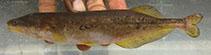
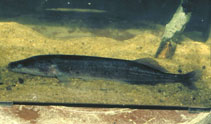
Mormyrops anguilloides, Cornish jack : fisheries, gamefish

Mormyrops anguilloides (Linnaeus, 1758)

Cornish jack
Hochladen Photos und videos
Bilder | Google Bild

Klassifizierung / Names Namen | Synonyme | Catalog of Fishes(Gattung, Arten) | ITIS | CoL | WoRMS | Cloffa

> Osteoglossiformes (Bony tongues) > Mormyridae (Elephantfishes)
Etymology: Mormyrops: Greek, mormyros = a fish (Sparus sp) + Greek, ops = appearance (Ref. 45335).
More on author: Linnaeus.

Umwelt: Milieu / Klimazone / Tiefenbereich / Verbreitungsgebiet Ökologie

; süßwasser demersal; potamodrom (Ref. 51243). Tropical; 22°C - 24°C (Ref. 12468); 10°S - 21°S

Verbreitung Territorien | FAO Gebiete | Ökosysteme | Vorkommen | Punkt Karte | Einführungen | Faunafri

Africa: a very wide distribution area which includes most of the West African river basins (Ref. 81274), the White Nile, Uebi Shebeli and Juba (Ref. 3203), and the Congo River basin (Ref. 52193). In southern Africa, restricted to the middle and lower Zambezi, Buzi and Pungwe (Ref. 52193). Also known from Lake Malawi, Lake Tanganyika and Lake Albert [former Lake Mobuto] (Ref. 3203, 52193).

Länge bei der ersten Reifung / Größe / Gewicht / Alter

Geschlechtsreife: Lm 32.5  range ? - ? cm
Max length : 150 cm TL Männchen/unbestimmt; (Ref. 2915); max. veröff. Gewicht: 15.0 kg (Ref. 52193)

Kurzbeschreibung Bestimmungsschlüssel | Morphologie | Morphometrie

Rückenflossenstacheln (insgesamt) : 0; Rückenflossenweichstrahlen (insgesamt) : 21 - 33; Afterflossenstacheln: 0; Afterflossenweichstrahlen: 38 - 51. Diagnosis: head depressed (Ref. 13337, 52193). Body elongated (Ref. 2915, 13337, 52193), shallow (Ref. 28714), ratio standard length/body depth 4.9-7.5 (Ref. 81274). Mouth large (Ref. 13337, 52193) and terminal (Ref. 13337, 28714, 52193, 81274), with 16-28 teeth in upper, and 14-28 in lower jaw (the number of teeth increases with size) (Ref. 81274). Chin (mental swelling) absent (Ref. 52193). Origin of dorsal fin behind origin of anal fin, nearer caudal fin base than tip of snout (Ref. 4903, 52193). Dorsal fin shorter than anal fin; mouth width subequal to snout length (Ref. 52193). Snout long (Ref. 52193), rounded, its length 1/5-1/4 that of the head (Ref. 4903), almost as broad as head (Ref. 2915, 81274). 21-33 dorsal- and 38-50 anal-fin rays (Ref. 52193, 81274). Head 3.4-5.1 times in standard length; interorbital space relatively broad, ratio head length/interorbital width 2.9-6.8; wide ranges for most of the meristic characters are caused by the existence of geographical clines (Ref. 2915, 81274).
Body shape (shape guide): elongated; Cross section: compressed.

Biologie     Fachlexikon (Englisch) (z.B. epibenthic)

Juveniles occur in marginal habitats, adults prefer deep quiet water between boulders and below overhangs, away from strong currents; also occurs beneath Salvinia mats and in river estuaries in Lake Kariba; juveniles prey on invertebrates, mainly shrimps and insect larvae (Ref. 7248, 52193). Adults/larger individuals are piscivorous (Ref. 28714), feeding on small cichlids, minnows and labeos (Ref. Ref. 7248, 52193). May live for 8 years or more; breeds in summer during the rainy season; mature females carry 25000 or more eggs (Ref. 7248, 52193). A fractional spawner (Ref. 10606, 10605). Affinities: M. breviceps.

Lebenszyklus und Paarungsverhalten Geschlechtsreife | Fortpflanzung | Ablaichen | Eier | Fruchtbarkeit | Larven

Hauptreferenz Laden Sie Ihre Referenzen hoch | Referenzen | Koordinator | Partner

Bigorne, R., 1990. Mormyridae. p. 122-184. In C. Lévêque, D. Paugy and G.G. Teugels (eds.) Faune des poissons d'eaux saumâtres d'Afrique de l'Ouest. tome 1. Faune Trop. 28. Musée Royal de l'Afrique Centrale, Tervuren, and ORSTOM, Paris. (Ref. 2915)

IUCN Rote Liste Status (Ref. 130435: Version 2025-2 (Global))

  nicht bedroht (LC) ; Date assessed: 20 June 2018

CITES

Not Evaluated

CMS (Ref. 116361)

Not Evaluated

Bedrohung für Menschen

  Harmless


Nutzung durch Menschen

Fischereien: kommerziell; Sportfisch: ja
FAO - Publication: search | FishSource |

Mehr Information

Trophische Ökologie
Lebensmittel (Beutetiere)
Nahrungszusammensetzung
Nahrungsaufnahme
Lebensmittelrationen
Räuber
Ökologie
Ökologie
Populationsdynamik
Wachstumsparameter
Max. Alter/Größen
Länge-Gewicht-Rel.
Länge-Länge-Verhältnis.
Längenhäufigkeiten
Massenkonvertierung
Rekrutierung
Dichte
Lebenszyklus
Fortpflanzung
Geschlechtsreife
Reifung/Kiemen rel.
Fruchtbarkeit
Ablaichen
Laichaggregationen
Eier
Eientwicklung
Larven
Larven Pop.Dyn.
Verbreitung
Territorien
FAO Gebiete
Ökosysteme
Vorkommen
Einführungen
BRUVS - Videos
Anatomie
Kiemenoberfläche
Gehirn
Otolith
Physiologie
Körperliche Zusammensetzung
Nährstoffe
Sauerstoffverbrauch
Schwimmart
Schwimmgeschwindigkeit
Visuelle Pigmente
Fischgeräusche
Krankheiten und Parasiten
Toxizität (LC50s)
Genetik
Genom
Genetik
Heterozygotie
Vererbbarkeit
Genetische Vielfalt
Menschenbezogen
Aquakultur-Systeme
Aquakultur Profile
Zuchtlinien
Ciguatera-Fälle
Briefmarken, Münzen, Verschiedenes.
Aufsuchen
Partner
Referenzen
Referenzen

Tools

Zusatzinformationen

Download XML

Internet Quellen

AFORO (otoliths) | Aquatic Commons | BHL | Cloffa | Websites from users | FishWatcher Einträge suchen | CISTI | Catalog of Fishes: Gattung, Arten | DiscoverLife | ECOTOX | FAO - Publication: search | Faunafri | Fishipedia | Fishtrace | GloBI | Google Books | Google Scholar | Google | IGFA World Record | OneZoom | Open Tree of Life | Otolith Atlas of Taiwan Fishes | Öffentliche Aquarien | PubMed | Reef Life Survey | Socotra Atlas | TreeBase | Tree of Life | Wikipedia: Gehe zu, Suchen | World Records Freshwater Fishing | Zoologischer Rekord

Schätzungen auf der Grundlage von Modellen

Phylogenetischer Diversitätsindex (Ref. 82804):  PD50 = 0.5000   [Uniqueness, from 0.5 = low to 2.0 = high].
Bayesian length-weight: a=0.00562 (0.00420 - 0.00752), b=2.99 (2.91 - 3.07), in cm total length, based on LWR estimates for this species (Ref. 93245).
Trophische Ebene (Ref. 69278):  3.8   ±0.61 se; based on food items.
Widerstandsfähigkeit (Ref. 120179):  niedrig, Verdopplung der Population dauert 4,5 - 14 Jahre. (K=0.08-0.33; tm > 8).
Anfälligkeit der Fischerei (Ref. 59153):  Moderate to high vulnerability (47 of 100). 🛈
Preiskategorie (Ref. 80766):   Unknown.
Nährstoffe (Ref. 124155):  Calcium = 89 [41, 209] mg/100g; Iron = 1.32 [0.61, 2.81] mg/100g; Protein = 17.7 [15.3, 20.1] %; Omega3 = 0.285 [0.119, 0.717] g/100g; Selenium = 117 [42, 282] μg/100g; VitaminA = 21 [7, 66] μg/100g; Zinc = 0.934 [0.594, 1.879] mg/100g (wet weight);