



Neoarius midgleyorum (Kailola & Pierce, 1988)
Silver cobbler
Envoyez vos Photos et vidéos
Images Google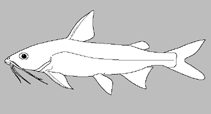 No image available for this species;
drawing shows typical species in Ariidae.
Images Google
drawing shows typical species in Ariidae.
Classification / Noms Noms communs | Synonymes | Catalog of Fishes(Genre, Espèce) | ITIS | CoL | WoRMS | Cloffa
> Siluriformes (Catfishes) > Ariidae (Sea catfishes) > Ariinae
Eponymy: Dr Stephen Hamar Midgley (1918–2014) was an amateur ichthyologist and limnologist whose honorary doctorate was awarded by the University of Queensland (1994). [...] (Ref. 128868), visit book page.
Eponymy: Dr Stephen Hamar Midgley (1918–2014) was an amateur ichthyologist and limnologist whose honorary doctorate was awarded by the University of Queensland (1994). [...] (Ref. 128868), visit book page.
Environnement : milieu / zone climatique / profondeur / gamme de distribution Écologie
; eau douce; saumâtre benthopélagique. Tropical
Distribution Territoires | Zones FAO | Écosystèmes | Occurrences | Carte par point | Introductions | Faunafri
Oceania: northern Australia.
Taille / Poids / Âge
Maturité: Lm ? range ? - ? cm
Max length : 140 cm SL mâle / non sexé; (Ref. 44894); common length : 50.0 cm SL mâle / non sexé; (Ref. 44894)
Max length : 140 cm SL mâle / non sexé; (Ref. 44894); common length : 50.0 cm SL mâle / non sexé; (Ref. 44894)
Description synthétique Clés d'identification | Morphologie | Morphométrie
Rayons mous anaux: 16 - 19; Vertèbres: 55 - 57. Eye size 12.9-21.8% HL. Because of its similarity to A. paucus, the remaining diagnosis refers to both A. midgleyi and A. paucus: a sleek body; strong jaws; jaws upturned slightly at symphyses, mouth broad; snout truncate in profile; head oblong, its width averaging 66% HL. Supraoccipital process narrow with parallel margins. Numerous fine, sharp teeth on palate in transverse band of four oblong groups. No rakers on posterior aspect of gill arches. Barbels thin and short, rarely reaching beyond pectoral fin base and less than 25% SL (Ref. 40908).
Inhabits in lakes, billabongs, rivers and to a lesser extent brackish estuaries and the tidal portion of rivers. Found in clear or turbid fresh water reservoirs and waterholes. Water is typically warm (23-35°C), with pH between 7.0-8.7 (Ref. 44894). Feeds mainly on fishes, prawns and crayfish. Various arthropods are also consumed. Breeds early in the wet season, sometimes extending into the late wet (November to March). Eggs are incubated orally by the male for 5-6 weeks; brooding males form groups in deeper water. Juveniles grow quickly, attaining 20-30 centimeters by the end of the first year, and sexual maturity is reached after 3 years. An excellent eating fish, rapidly growing in popularity (Ref. 44894).
Cycle de vie et comportement reproducteur Maturité | Reproduction | Frai | Œufs | Fécondité | Larves
Référence principale
Téléchargez vos références | Références | Coordinateur : Ferraris, Jr., Carl J. | Collaborateurs
Allen, G.R., 1989. Freshwater fishes of Australia. T.F.H. Publications, Inc., Neptune City, New Jersey. (Ref. 5259)
Statut dans la liste rouge de l'IUCN (Ref. 130435: Version 2025-2 (Global))
Préoccupation mineure (LC) ; Date assessed: 12 February 2019
CITES
Not Evaluated
Menace pour l'homme
Traumatogenic (Ref. 58010)
Utilisations par l'homme
FAO - Publication: search | FishSource |
Plus d'informations
Écologie trophique
Aliments (proies)
Composition du régime alimentaire
Consommation alimentaire
Rations alimentaires
Prédateurs
Aliments (proies)
Composition du régime alimentaire
Consommation alimentaire
Rations alimentaires
Prédateurs
Dynamique des populations
Paramètres de croissance
Âges / tailles maximales
Longueur-poids rel.
Rel. longueur-longueur.
Fréquences de longueurs
Conversion de masse
Recrutement
Abondance
Paramètres de croissance
Âges / tailles maximales
Longueur-poids rel.
Rel. longueur-longueur.
Fréquences de longueurs
Conversion de masse
Recrutement
Abondance
Cycle de vie
Reproduction
Maturité
Maturité/épines rel.
Fécondité
Frai
Agrégats de frai
Œufs
Développement de l'œuf
Larves
Dynamique des populations larvaires
Reproduction
Maturité
Maturité/épines rel.
Fécondité
Frai
Agrégats de frai
Œufs
Développement de l'œuf
Larves
Dynamique des populations larvaires
Anatomie
Surface branchiale
Cerveau
Otolithe
Surface branchiale
Cerveau
Otolithe
Physiologie
Composition corporelle
Nutriments
Consommation d'oxygène
Type de natation
Vitesse de nage
Pigments visuels
Son de poisson
Maladies et parasites
Toxicité (CL50)
Composition corporelle
Nutriments
Consommation d'oxygène
Type de natation
Vitesse de nage
Pigments visuels
Son de poisson
Maladies et parasites
Toxicité (CL50)
Génétique
génôme
Génétique
Hétérozygotie
Héritabilité
Diversité génétique
génôme
Génétique
Hétérozygotie
Héritabilité
Diversité génétique
Liées à l'homme
Systèmes d'aquaculture
Profils d'aquaculture
Souches
Cas de ciguatera
Timbres, pièces de monnaie, divers
Systèmes d'aquaculture
Profils d'aquaculture
Souches
Cas de ciguatera
Timbres, pièces de monnaie, divers
Outils
E-book | Guide de terrain | Générateur de fréquences de longueur | Outil de dynamique de population | Carte par point |
Capture-MSY |
Articles particuliers
Télécharger en XML
Sources Internet
AFORO (otoliths) | Aquatic Commons | BHL | Cloffa | Websites from users | FishWatcher | CISTI | Catalog of Fishes: Genre, Espèce | DiscoverLife | ECOTOX | FAO - Publication: search | Faunafri | Fishipedia | Fishtrace | GloBI | Google Books | Google Scholar | Google | IGFA World Record | OneZoom | Open Tree of Life | Otolith Atlas of Taiwan Fishes | PubMed | Reef Life Survey | Socotra Atlas | TreeBase | Arbre de Vie | Wikipedia: aller à, chercher | World Records Freshwater Fishing | Zoological Record
Estimations basées sur des modèles
Indice de diversité phylogénétique (Réf. 82804): PD50 = 0.5312 [Uniqueness, from 0.5 = low to 2.0 = high].
Bayesian length-weight: a=0.00468 (0.00245 - 0.00892), b=3.13 (2.96 - 3.30), in cm total length, based on LWR estimates for this (Sub)family-body shape (Ref. 93245).
Niveau trophique (Réf. 69278): 4.1 ±0.61 se; based on food items.
Résilience (Réf. 120179): Très faible, temps minimum de doublement de population supérieur à 14 ans (Preliminary K or Fecundity.).