



Neoarius midgleyorum (Kailola & Pierce, 1988)
Silver cobbler
Uploaden van uw Foto's en video's
Google afbeelding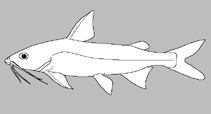 No image available for this species;
drawing shows typical species in Ariidae.
Google afbeelding
drawing shows typical species in Ariidae.
Classificatie / Namen Lokale namen | Synoniemen | Catalog of Fishes(Genus, Soort(en)) | ITIS | CoL | WoRMS | Cloffa
> Siluriformes (Catfishes) > Ariidae (Sea catfishes) > Ariinae
Eponymy: Dr Stephen Hamar Midgley (1918–2014) was an amateur ichthyologist and limnologist whose honorary doctorate was awarded by the University of Queensland (1994). [...] (Ref. 128868), visit book page.
Eponymy: Dr Stephen Hamar Midgley (1918–2014) was an amateur ichthyologist and limnologist whose honorary doctorate was awarded by the University of Queensland (1994). [...] (Ref. 128868), visit book page.
Milieu: milieu / Klimaatzone / Diepte / verspreidingsgebied Ecologie
; zoet water; brak water benthopelagisch. Tropical
Verspreiding Gebieden | FAO regio's | Ecosystemen | Voorkomen | Verspreidingskaart | Introducties | Faunafri
Oceania: northern Australia.
Grootte / Gewicht / Leeftijd
Maturiteit: Lm ? range ? - ? cm
Max length : 140 cm SL mannelijk / geslacht onbekend; (Ref. 44894); common length : 50.0 cm SL mannelijk / geslacht onbekend; (Ref. 44894)
Max length : 140 cm SL mannelijk / geslacht onbekend; (Ref. 44894); common length : 50.0 cm SL mannelijk / geslacht onbekend; (Ref. 44894)
Korte beschrijving Determinatiesleutels | Morfologie | Morfometrie
Anale zachte stralen: 16 - 19; Wervels: 55 - 57. Eye size 12.9-21.8% HL. Because of its similarity to A. paucus, the remaining diagnosis refers to both A. midgleyi and A. paucus: a sleek body; strong jaws; jaws upturned slightly at symphyses, mouth broad; snout truncate in profile; head oblong, its width averaging 66% HL. Supraoccipital process narrow with parallel margins. Numerous fine, sharp teeth on palate in transverse band of four oblong groups. No rakers on posterior aspect of gill arches. Barbels thin and short, rarely reaching beyond pectoral fin base and less than 25% SL (Ref. 40908).
Inhabits in lakes, billabongs, rivers and to a lesser extent brackish estuaries and the tidal portion of rivers. Found in clear or turbid fresh water reservoirs and waterholes. Water is typically warm (23-35°C), with pH between 7.0-8.7 (Ref. 44894). Feeds mainly on fishes, prawns and crayfish. Various arthropods are also consumed. Breeds early in the wet season, sometimes extending into the late wet (November to March). Eggs are incubated orally by the male for 5-6 weeks; brooding males form groups in deeper water. Juveniles grow quickly, attaining 20-30 centimeters by the end of the first year, and sexual maturity is reached after 3 years. An excellent eating fish, rapidly growing in popularity (Ref. 44894).
Levenscyclus en paargedrag Maturiteit | Voortplanting | Paaien | Eieren | Fecunditeit | Larven
Hoofdreferentie
Upload uw referenties | Referenties | Coördinator : Ferraris, Jr., Carl J. | Medewerkers
Allen, G.R., 1989. Freshwater fishes of Australia. T.F.H. Publications, Inc., Neptune City, New Jersey. (Ref. 5259)
Status op de Rode Lijst van het IUCN (Ref. 130435: Version 2025-2 (Global))
Niet bedreigd (LC) ; Date assessed: 12 February 2019
CITES
Not Evaluated
Gevaar voor de mens
Traumatogenic (Ref. 58010)
Gebruik door de mens
FAO - Publication: search | FishSource |
Meer informatie
Trofische ecologie
Voedsel (prooien)
Dieetsamenstelling
Voedselconsumptie
Voedselrantsoenen
Predatoren
Voedsel (prooien)
Dieetsamenstelling
Voedselconsumptie
Voedselrantsoenen
Predatoren
Populatiedynamica
Groeiparameters
Max. leeftijden / maten
Lengte-gewicht rel.
Lengte-lengte rel.
Lengtefrequenties
Massaconversie
Rekrutering
Abundantie
Groeiparameters
Max. leeftijden / maten
Lengte-gewicht rel.
Lengte-lengte rel.
Lengtefrequenties
Massaconversie
Rekrutering
Abundantie
Levenscyclus
Voortplanting
Maturiteit
Rijpheid/kieuwen rel.
Fecunditeit
Paaien
Paaibestanden
Eieren
Ontwikkeling van de eieren
Larven
Larvale populatiedynamiek
Voortplanting
Maturiteit
Rijpheid/kieuwen rel.
Fecunditeit
Paaien
Paaibestanden
Eieren
Ontwikkeling van de eieren
Larven
Larvale populatiedynamiek
Anatomie
Kieuwoppervlak
Hersenen
Otoliet
Kieuwoppervlak
Hersenen
Otoliet
Fysiologie
Lichaamssamenstelling
Voedingsstoffen
Zuurstofverbruik
Type zwemmen
Zwemsnelheid
Visuele pigmenten
Vis geluid
Ziekten en parasieten
Toxiciteit (LC50)
Lichaamssamenstelling
Voedingsstoffen
Zuurstofverbruik
Type zwemmen
Zwemsnelheid
Visuele pigmenten
Vis geluid
Ziekten en parasieten
Toxiciteit (LC50)
Genetica
genoom
Genetica
Heterozygositeit
Erfelijkheid
Genetische diversiteit
genoom
Genetica
Heterozygositeit
Erfelijkheid
Genetische diversiteit
Menselijk gerelateerd
Aquacultuursystemen
Aquacultuurprofielen
Kweeklijnen
Ciguatera gevallen
Postzegels, munten, diversen.
Aquacultuursystemen
Aquacultuurprofielen
Kweeklijnen
Ciguatera gevallen
Postzegels, munten, diversen.
Tools
Speciale rapporten
Bekijk gegevens voor het houden in een aquarium | Bekijk Fact Sheets voor de soort | Bekijk Aquacultuur Fact Sheets
Download XML
Internetbronnen
AFORO (otoliths) | Aquatic Commons | BHL | Cloffa | Websites from users | Bekijk FishWatcher | CISTI | Catalog of Fishes: Genus, Soort(en) | DiscoverLife | ECOTOX | FAO - Publication: search | Faunafri | Fishipedia | Fishtrace | GloBI | Google Books | Google Scholar | Google | IGFA World Record | OneZoom | Open Tree of Life | Otolith Atlas of Taiwan Fishes | PubMed | Reef Life Survey | Socotra Atlas | TreeBase | Tree of Life | Wikipedia: ga naar, zoek | World Records Freshwater Fishing | Zoological Record
Schattingen op basis van modellen
Fylogenetische diversiteitsindex (Ref. 82804): PD50 = 0.5312 [Uniqueness, from 0.5 = low to 2.0 = high].
Bayesian length-weight: a=0.00468 (0.00245 - 0.00892), b=3.13 (2.96 - 3.30), in cm total length, based on LWR estimates for this (Sub)family-body shape (Ref. 93245).
Trofisch niveau (Ref. 69278): 4.1 ±0.61 se; based on food items.
Weerstandsvermogen (Ref. 120179): Zeer laag, minimale populatieverdubbelingstijd meer dan 14 jaar (Preliminary K or Fecundity.).