



Malapterurus electricus (Gmelin, 1789)
Electric catfish
Adicionar o seu Fotografias e vídeos
Fotografias | Selos, moedas, diversos. | Imagem do Google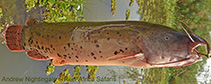 Malapterurus electricus
Fotografia de Nightingale, A.
Fotografias | Selos, moedas, diversos. | Imagem do Google
Fotografia de Nightingale, A.
Classificação / Nomes Nomes comuns | Sinónimos | Catalog of Fishes(Género, Espécies) | ITIS | CoL | WoRMS | Cloffa
> Siluriformes (Catfishes) > Malapteruridae (Electric catfishes)
Etymology: Malapterurus: Greek, mala = a lot of + Greek, pteron = fin + Greek, oura = tail (Ref. 45335); electricus: The electric discharging capacity of this electric catfish is described by the specific epithet (Ref. 44050).
More on author: Gmelin.
Etymology: Malapterurus: Greek, mala = a lot of + Greek, pteron = fin + Greek, oura = tail (Ref. 45335); electricus: The electric discharging capacity of this electric catfish is described by the specific epithet (Ref. 44050).
More on author: Gmelin.
Ambiente: milieu / zona climática / intervalo de profundidade / gama de distribuição Ecologia
; Água doce bentopelágico; pH range: 7.0 - 8.0; dH range: ? - 20; potamódromo (Ref. 51243). Tropical; 23°C - 30°C (Ref. 1672); 35°N - 30°S
Distribuição Territórios | Áreas FAO | Ecossistemas | Ocorrências | Mapa dos pontos | Introduções | Faunafri
Africa: typical Sudanian distribution; in much of the Nile system (exclusive of Lake Victoria), Lake Turkana, Lake Chad and Senegal basins, throughout the Niger system and smaller southward flowing basins in west Africa, from Bandama through Volta rivers in Ivory Coast and Ghana (Ref. 44050). Absent from Congo basin; reports from Congo basin refer to any of the other species in this system (see Ref. 44050 for details).
Tamanho / Peso / Idade
Maturidade: Lm ? range ? - ? cm
Max length : 122 cm SL macho/indeterminado; (Ref. 3850); peso máx. Publicado: 20.0 kg (Ref. 3799); Idade máx. registada: 10 anos (Ref. 7248)
Max length : 122 cm SL macho/indeterminado; (Ref. 3850); peso máx. Publicado: 20.0 kg (Ref. 3799); Idade máx. registada: 10 anos (Ref. 7248)
Descrição breve Chaves de identificação | Morfologia | Morfometria
Espinhos dorsais (total) : 0; Raios dorsais moles (total) : 0; Espinhos anais: 0; Raios anais moles: 9 - 11; Vértebras: 38 - 41. Diagnosis: tooth patches narrow; pectoral fin placed near body mid-depth; 7-8 branched caudal fin rays (Ref. 44050). 9-11 anal-fin rays, usually 10-11; 38-41 total vertebrae, usually 39-41 (Ref. 57130). Caudal saddle and bar pattern not present in adults (Ref. 57130), poorly developed in all ages (Ref. 44050). Flank and dorsum in adults and young marked with large blotches (some up to 4-5 times eye diameter); caudal fin of adults generally same color as flank ground color or slightly darker, larger specimens usually with spots or blotches in caudal fin (Ref. 44050, 57130).
Body shape (shape guide): fusiform / normal; Cross section: circular.
Body shape (shape guide): fusiform / normal; Cross section: circular.
Occur among rocks or roots. Favors sluggish or standing water. Active at night, feeding mainly on fish stunned by electric shocks. Described as a nocturnal piscivore that breeds during periods of high water; rarely feeds on molluscs (Ref. 44050). The electric organ, capable of discharging 300-400 V, is derived from pectoral muscle and surrounds almost the entire body. It is used both for prey capture and defense. Electric organ discharge (EOD) is intermittent and the amplitude increases with size of the fish (Ref. 10011). Responds immediately to cyclic light changes, exhibiting maximum EOD activity shortly after sunset and lowest activity just after sunrise (Ref. 10798). Its EOD duration decreased from 1.5 to 0.3 ms in response to increased temperature from 15 to 30°C (Ref. 10838). Adults form pairs and breed in excavated cavities or holes (Ref. 7248). Maximum size in Lake Chad reported as 1125mm SL, but most museum specimens much smaller (maximum 400mm SL, Nile River)(Ref. 57130).
Ciclo de vida e comportamento de acasalamento Maturidade | Reprodução | Desova | Ovos | Fecundidade | Larvas
It is assumed that the male tends the clutch. Others report that the male takes the eggs into his mouth. It is also unknown how the fry is immune to the electric shocks by the parents (Ref. 1672).
Referência principal
Carregar as suas referências | Referências | Coordenador | Colaboradores
Roberts, T.R., 2000. A review of the African electric catfish family Malapteruridae, with descriptions of new species. Occas. Pap. Ichthyol. 1:1-15. (Ref. 34006)
Categoria na Lista Vermelha da IUCN (Ref. 130435: Version 2025-2 (Global))
Preocupação menor (LC) ; Date assessed: 04 March 2025
CITES
Not Evaluated
Ameaça para o homem
Other (Ref. 4967)
Utilização humana
Pescarias: pescarias de subsistência; peixe desportivo: sim
FAO - Publication: search | FishSource |
Mais informação
Ecologia Trófica
Produtos alimentares (presas)
Composição da dieta
Consumo alimentar
Rações alimentares
Predadores
Produtos alimentares (presas)
Composição da dieta
Consumo alimentar
Rações alimentares
Predadores
Dinâmica das populações
Parâmetros de crescimento
Idades / tamanhos máximos
Comprimento-peso rel.
Comprimento-comprimento rel.
Frequência de comprimento
Conversão de massa
Recrutamento
Abundância
Parâmetros de crescimento
Idades / tamanhos máximos
Comprimento-peso rel.
Comprimento-comprimento rel.
Frequência de comprimento
Conversão de massa
Recrutamento
Abundância
Ciclo de vida
Reprodução
Maturidade
Maturidade/Rel. das guelras
Fecundidade
Desova
Agregações de desova
Ovos
Desenvolvimento dos ovos
Larvas
Dinâmica larvar
Reprodução
Maturidade
Maturidade/Rel. das guelras
Fecundidade
Desova
Agregações de desova
Ovos
Desenvolvimento dos ovos
Larvas
Dinâmica larvar
Anatomia
Área branquial
Cérebro
Otólitos
Área branquial
Cérebro
Otólitos
Fisiologia
Composição corporal
Nutrientes
Consumo de oxigénio
Tipo de natação
Velocidade de natação
Pigmentos visuais
Som de peixe
Doenças e Parasitas
Toxicidade (LC50s)
Composição corporal
Nutrientes
Consumo de oxigénio
Tipo de natação
Velocidade de natação
Pigmentos visuais
Som de peixe
Doenças e Parasitas
Toxicidade (LC50s)
Relacionado com o ser humano
Sistemas de aquacultura
Perfis para aquacultura
Estirpes
Casos de Ciguatera
Selos, moedas, diversos.
Sistemas de aquacultura
Perfis para aquacultura
Estirpes
Casos de Ciguatera
Selos, moedas, diversos.
Ferramentas
Questionário orgânico | E-book | Guia de campo | Chaves de identificação | Ferramenta auxiliar de frequências de comprimento | Ferramenta sobre a história de vida | Mapa dos pontos |
Captura-MSY |
Relatórios especiais
Descarregue XML
Fontes da internet
AFORO (otoliths) | Alien/Invasive Species database | Aquatic Commons | BHL | Cloffa | Websites from users | Consultar FishWatcher | CISTI | Catalog of Fishes: Género, Espécies | DiscoverLife | ECOTOX | FAO - Publication: search | Faunafri | Fishipedia | Fishtrace | GloBI | Google Books | Google Scholar | Google | IGFA World Record | OneZoom | Open Tree of Life | Otolith Atlas of Taiwan Fishes | PubMed | Reef Life Survey | Socotra Atlas | TreeBase | Árvore da vida | Wikipedia: ir para, procurar | | Registo zoológico
Estimativas baseadas em modelos
|
Índice de diversidade filogenética (Ref. 82804) |
PD50 = 0.5000 [Uniqueness, from 0.5 = low to 2.0 = high]. |
| Bayesian length-weight | a=0.01175 (0.00859 - 0.01606), b=2.96 (2.87 - 3.05), in cm total length, based on LWR estimates for this species (Ref. 93245). |
|
Nível Trófico (Ref. 69278) |
2.9 ±0.38 se; based on food items. |
|
Resiliência (Ref. 120179) |
Baixo, tempo mínimo de duplicação da população 4,5 - 14 anos (tmax=10; Fec < 1,000). |
|
Vulnerabilidade da pesca (Ref. 59153) |
High to very high vulnerability (74 of 100). 🛈 |
|
Categoria de preço (Ref. 80766) |
Unknown. |
|
Nutrientes (Ref. 124155) |
Calcium = 48.9 [27.2, 92.2] mg/100g; Iron = 1.14 [0.65, 2.02] mg/100g; Protein = 16.4 [15.2, 17.6] %; Omega3 = 0.382 [0.141, 1.050] g/100g; Selenium = 119 [46, 264] μg/100g; VitaminA = 34.3 [11.4, 99.9] μg/100g; Zinc = 1.24 [0.82, 1.79] mg/100g (wet weight); |