



Oreochromis alcalicus (Hilgendorf, 1905)
Common Natron tilapia
Ladda upp din foton och Videor
Bilder | Google image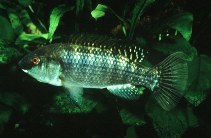 Oreochromis alcalicus
Male Bild av Seegers, L.
Bilder | Google image
Male Bild av Seegers, L.
Klassificering / Namn Populärnamn | synonymer | Catalog of Fishes(Släkte, Arter) | ITIS | CoL | WoRMS | Cloffa
> Cichliformes (Cichlids, convict blennies) > Cichlidae (Cichlids) > Pseudocrenilabrinae
Etymology: Oreochromis: Latin, aurum = gold + Greek, chromis = a fish, perhaps a perch (Ref. 45335).
More on author: Hilgendorf.
Etymology: Oreochromis: Latin, aurum = gold + Greek, chromis = a fish, perhaps a perch (Ref. 45335).
More on author: Hilgendorf.
Miljö: miljö / Klimatzon / djupintervall / distributionsområde Ekologi
; sötvatten bentopelagisk. Tropical; 2°S - 3°S
Utbredning Territorier | FAO områden | Ekosystem | Förekomster | Prickkarta | Utplanteringar | Faunafri
Storlek / Vikt / Ålder
Kort beskrivning Bestämningsnycklar | Morfologi | Morfometri
Taggstrålar i ryggfenan (totalt) : 9 - 13; Mjukstrålar i ryggfenan (totalt) : 11 - 15; Taggstrålar i analfenan: 3; Mjukstrålar i analfenan: 9 - 11; Ryggkotor: 27 - 30. Diagnosis: A small elongated species with a terminal mouth (Ref. 118638). Mature males have dark-edged dorsal and anal fins, iridescent blue-white spots on flanks, white lower lips, and a spotted caudal fin with a pink edge; they appear to be colour polymorphic, with some males having yellow bellies and throats, while others are blue white: both morphs can be found in the same location and the colours are stable in aquarium-held specimens, suggesting it is a true polymorphism and not related to reproductive state (Ref. 118638). Females and non-territorial males are sandy-coloured, pale ventrally, sometimes with faint vertical bars (Ref. 118638).
Body shape (shape guide): short and / or deep; Cross section: compressed.
Body shape (shape guide): short and / or deep; Cross section: compressed.
Occurs at a temperature range of 30-32°C (Ref. 2). It feeds actively in the early morning; mainly on algae as well as copepods and dipterous larvae (Ref. 2). A maternal mouthbrooder: males excavate pits in the substrate in shallow water (Ref. 2, 118638). The species is occasionally caught as a food fish in its natural range; although it attains a small size, its tolerance of hostile environments may make it suitable for culture in high salinity environments; potential as an aquarium fish (Ref. 118638). Classed as endangered, due to its restricted distribution (Ref. 118638).
Livscykel och parningsbeteende Könsmognad | Reproduktion | Lek | Ägg | Fekunditet | Larver
Early in the morning before taking possession of their pits, the males feed on slimy algal growths-noisily; sexual activity is greater after noon than before; young male may build a small pit around that of a larger male and mate there with a small female (Ref. 2). Males prepare and guard nests, while females migrate from one nest to another; males guard the nest against juveniles of their own species and other species which feed on the fertilized eggs which fall from the mouth of the female mouth brooder (Ref. 11288). Also Ref. 118638.
Huvudreferens
Ladda upp dina referenser | referenser | Koordinator : Kullander, Sven O. | Medarbetare
Seegers, L. and H. Tichy, 1999. The Oreochromis alcalicus flock (Teleostei: Cichlidae) from lakes Natron and Magadi, Tanzania and Kenya, with descriptions of two new species. Ichthyol. Explor. Freshwat. 10(2):97-146. (Ref. 32272)
Status på IUCN:s rödlista (Ref. 130435: Version 2025-2 (Global))
Endangered (EN) (B1ab(i,ii,iii)+2ab(i,ii,iii)); Date assessed: 31 January 2006
CITES
Not Evaluated
Hot mot människor
Harmless
Mänskliga användningsområden
FAO - Publication: search | FishSource |
Ytterligare information
Populationsdynamik
Tillväxtparametrar
Max. åldrar / storlekar
Längd-vikt rel.
Längd-längd rel.
Längd-frekvenser
Massakonvertering
Rekrytering
Abundans
Tillväxtparametrar
Max. åldrar / storlekar
Längd-vikt rel.
Längd-längd rel.
Längd-frekvenser
Massakonvertering
Rekrytering
Abundans
Livscykel
Reproduktion
Könsmognad
Mognad/Gills rel.
Fekunditet
Lek
Lekande aggregat
Ägg
Utveckling av ägg
Larver
Larvdynamik
Reproduktion
Könsmognad
Mognad/Gills rel.
Fekunditet
Lek
Lekande aggregat
Ägg
Utveckling av ägg
Larver
Larvdynamik
Anatomi
Gälyta
Hjärna
Otolit
Gälyta
Hjärna
Otolit
Fysiologi
Kroppssammansättning
Näringsämnen
Syreförbrukning
Typ av simning
Simhastighet
Visuella pigment
Ljud från fisk
Sjukdomar & Parasiter
Toxicitet (LC50)
Kroppssammansättning
Näringsämnen
Syreförbrukning
Typ av simning
Simhastighet
Visuella pigment
Ljud från fisk
Sjukdomar & Parasiter
Toxicitet (LC50)
Människorelaterad
Vattenbrukssystem
Vattenbruksprofiler
Avelslinjer
Ciguatera-fall
Frimärken, mynt, diverse.
Vattenbrukssystem
Vattenbruksprofiler
Avelslinjer
Ciguatera-fall
Frimärken, mynt, diverse.
Verktyg
Organisk frågesport | E-bok | Fälthandbok | Bestämningsnycklar | Längdfördelnings-verktyg | Livshistorie-verktyg | Prickkarta |
Fångst-MSY |
Särskilda rapporter
Kontrollera för underhåll av akvarium | Kontrollera om det finns faktablad om arter | Kontrollera om det finns faktablad om vattenbruk
Ladda ner XML
Internet-källor
AFORO (otoliths) | Aquatic Commons | BHL | Cloffa | Websites from users | Check FishWatcher | CISTI | Catalog of Fishes: Släkte, Arter | DiscoverLife | ECOTOX | FAO - Publication: search | Faunafri | Fishipedia | Fishtrace | GloBI | Google Books | Google Scholar | Google | IGFA World Record | OneZoom | Open Tree of Life | Otolith Atlas of Taiwan Fishes | PubMed | Reef Life Survey | Socotra Atlas | TreeBase | Tree of Life | Wikipedia: Go, sök | World Records Freshwater Fishing | Zoologiskt register
Uppskattningar baserade på modeller
Index för fylogenetisk mångfald (Ref. 82804): PD50 = 0.5000 [Uniqueness, from 0.5 = low to 2.0 = high].
Bayesian length-weight: a=0.01905 (0.00846 - 0.04293), b=3.01 (2.82 - 3.20), in cm total length, based on LWR estimates for this (Sub)family-body shape (Ref. 93245).
Trofisk nivå (Ref. 69278): 2.7 ±0.21 se; based on food items.
Resiliens (Ref. 120179): Hög, lägsta populationsfördubblingstid mindre än 15 månader (Preliminary K or Fecundity.).