



Oreochromis alcalicus (Hilgendorf, 1905)
Common Natron tilapia
Carregue seu(sua) Fotos e vídeos
Fotos | Imagem do Google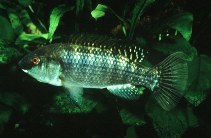 Oreochromis alcalicus
Male Foto de Seegers, L.
Fotos | Imagem do Google
Male Foto de Seegers, L.
Classificação / Nomes Nomes comuns | Sinônimos | Catalog of Fishes(Gênero, Espécies) | ITIS | CoL | WoRMS | Cloffa
> Cichliformes (Cichlids, convict blennies) > Cichlidae (Cichlids) > Pseudocrenilabrinae
Etymology: Oreochromis: Latin, aurum = gold + Greek, chromis = a fish, perhaps a perch (Ref. 45335).
More on author: Hilgendorf.
Etymology: Oreochromis: Latin, aurum = gold + Greek, chromis = a fish, perhaps a perch (Ref. 45335).
More on author: Hilgendorf.
Meio ambiente: milieu / Zona climática / intervalo de profundidade / faixa de distribuição Ecologia
; Água doce bentopelágico. Tropical; 2°S - 3°S
Distribuição Territórios | Áreas da FAO | Ecossistemas | Ocorrências | Mapa de pontos | Introduções | Faunafri
Tamanho / Peso / Idade
Descrição suscinta Chaves de identificação | Morfologia | Morfometria
Espinhos dorsais (total) : 9 - 13; Raios dorsais (total) : 11 - 15; Espinhos anais: 3; Raios anais : 9 - 11; Vértebras: 27 - 30. Diagnosis: A small elongated species with a terminal mouth (Ref. 118638). Mature males have dark-edged dorsal and anal fins, iridescent blue-white spots on flanks, white lower lips, and a spotted caudal fin with a pink edge; they appear to be colour polymorphic, with some males having yellow bellies and throats, while others are blue white: both morphs can be found in the same location and the colours are stable in aquarium-held specimens, suggesting it is a true polymorphism and not related to reproductive state (Ref. 118638). Females and non-territorial males are sandy-coloured, pale ventrally, sometimes with faint vertical bars (Ref. 118638).
Body shape (shape guide): short and / or deep; Cross section: compressed.
Body shape (shape guide): short and / or deep; Cross section: compressed.
Occurs at a temperature range of 30-32°C (Ref. 2). It feeds actively in the early morning; mainly on algae as well as copepods and dipterous larvae (Ref. 2). A maternal mouthbrooder: males excavate pits in the substrate in shallow water (Ref. 2, 118638). The species is occasionally caught as a food fish in its natural range; although it attains a small size, its tolerance of hostile environments may make it suitable for culture in high salinity environments; potential as an aquarium fish (Ref. 118638). Classed as endangered, due to its restricted distribution (Ref. 118638).
Ciclo de vida ou comportamento de acasalamento Maturidade | Reprodução | Desova | Ovos | Fecundidade | Larvas
Early in the morning before taking possession of their pits, the males feed on slimy algal growths-noisily; sexual activity is greater after noon than before; young male may build a small pit around that of a larger male and mate there with a small female (Ref. 2). Males prepare and guard nests, while females migrate from one nest to another; males guard the nest against juveniles of their own species and other species which feed on the fertilized eggs which fall from the mouth of the female mouth brooder (Ref. 11288). Also Ref. 118638.
Referência principal
Carregar suas referências | Referências | Coordenador : Kullander, Sven O. | Colaboradores
Seegers, L. and H. Tichy, 1999. The Oreochromis alcalicus flock (Teleostei: Cichlidae) from lakes Natron and Magadi, Tanzania and Kenya, with descriptions of two new species. Ichthyol. Explor. Freshwat. 10(2):97-146. (Ref. 32272)
Status na Lista Vermelha da UICN (Ref. 130435: Version 2025-2 (Global))
Em perigo (EN) (B1ab(i,ii,iii)+2ab(i,ii,iii)); Date assessed: 31 January 2006
CITES
Not Evaluated
Ameaça para os humanos
Harmless
Uso pelos humanos
FAO - Publication: search | FishSource |
Mais informação
Ecologia Trófica
Itens alimentares (presas)
Composição da dieta
Consumo alimentar
Rações alimentares
Predadores
Itens alimentares (presas)
Composição da dieta
Consumo alimentar
Rações alimentares
Predadores
Dinâmica populacional
Parâmetros de crescimento
Idade máxima / tamanhos
Relação comprimento-peso.
Relação comprimento-comprimento.
Frequências de comprimento
Conversão de massa
Recrutamento
Abundância
Parâmetros de crescimento
Idade máxima / tamanhos
Relação comprimento-peso.
Relação comprimento-comprimento.
Frequências de comprimento
Conversão de massa
Recrutamento
Abundância
Ciclo de vida
Reprodução
Maturidade
Maturidade/Rel. das guelras
Fecundidade
Desova
Agregações de desova
Ovos
Desenvolvimento dos ovos
Larvas
Dinâmica larval
Reprodução
Maturidade
Maturidade/Rel. das guelras
Fecundidade
Desova
Agregações de desova
Ovos
Desenvolvimento dos ovos
Larvas
Dinâmica larval
Anatomia
Área branquial
Cérebro
Otólito
Área branquial
Cérebro
Otólito
Fisiologia
Composição corporal
Nutrientes
Consumo de oxigênio
Tipo de natação
Velocidade de natação
Pigmentos visuais
Som de peixe
Doenças e Parasitas
Toxicidade (LC50s)
Composição corporal
Nutrientes
Consumo de oxigênio
Tipo de natação
Velocidade de natação
Pigmentos visuais
Som de peixe
Doenças e Parasitas
Toxicidade (LC50s)
Relacionado a humanos
Sistemas de aquicultura
Perfis para aquacultura
Estirpes
Casos de Ciguatera
Selos, moedas, diversos.
Sistemas de aquicultura
Perfis para aquacultura
Estirpes
Casos de Ciguatera
Selos, moedas, diversos.
Ferramentas
Questionário orgânico | Livro eletrônico | Guia de campo | Chaves de identificação | Ferramenta auxiliar de frequências de comprimento | Ferramenta sobre a história de vida | Mapa de pontos |
Catch-MSY |
Relatórios especiais
Checar Manutenção em Aquário | Checar Planilhas de Fatos sobre as Espécies | Checar Planilhas de Fatos sobre Aquicultura
Baixar XML
Fontes da internet
AFORO (otoliths) | Aquatic Commons | BHL | Cloffa | Websites from users | Checar Observador de Peixes (FishWatcher) | CISTI | Catalog of Fishes: Gênero, Espécies | DiscoverLife | ECOTOX | FAO - Publication: search | Faunafri | Fishipedia | Fishtrace | GloBI | Google Books | Google Scholar | Google | IGFA World Record | OneZoom | Open Tree of Life | Otolith Atlas of Taiwan Fishes | PubMed | Reef Life Survey | Socotra Atlas | TreeBase | Árvore da vida | Wikipedia: Ir para, procura | World Records Freshwater Fishing | Registro zoológico
Estimativas baseadas em modelos
Índice de diversidade filogenética (Ref. 82804): PD50 = 0.5000 [Uniqueness, from 0.5 = low to 2.0 = high].
Bayesian length-weight: a=0.01905 (0.00846 - 0.04293), b=3.01 (2.82 - 3.20), in cm total length, based on LWR estimates for this (Sub)family-body shape (Ref. 93245).
Nível Trófico (Ref. 69278): 2.7 ±0.21 se; based on food items.
Resiliência (Ref. 120179): Elevada, tempo mínimo de duplicação da população menor que 15 meses (Preliminary K or Fecundity.).