



Hippocampus guttulatus Cuvier, 1829
Long-snouted seahorse
Añada su observación en Fish Watcher
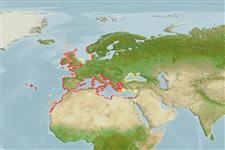
| Native range | All suitable habitat | Point map | Year 2050 |
|
| This map was computer-generated and has not yet been reviewed. |
| Hippocampus guttulatus AquaMaps Data sources: GBIF OBIS |
Sube tu fotos y Vídeos
Imágenes | Vídeos | Sellos, monedas, varios | Google image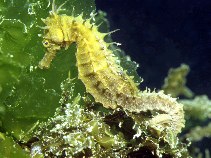 Hippocampus guttulatus
Foto de Patzner, R.
Imágenes | Vídeos | Sellos, monedas, varios | Google image
Foto de Patzner, R.
Clasificación / Nombres Nombres comunes | Sinónimos | Catalog of Fishes(Género, Especie) | ITIS | CoL | WoRMS | Cloffa
> Syngnathiformes (Pipefishes and seahorses) > Syngnathidae (Pipefishes and seahorses) > Syngnathinae
Etymology: Hippocampus: Greek, ippos = horse + Greek,kampe = curvature (Ref. 45335).
More on author: Cuvier.
Etymology: Hippocampus: Greek, ippos = horse + Greek,kampe = curvature (Ref. 45335).
More on author: Cuvier.
Entorno: milieu / zona climática / rango de profundidad / gama de distribución Ecología
marino; salobre demersal; no migratorio; rango de profundidad 0 - 30 m (Ref. 128812). Temperate; 63°N - 20°N, 32°W - 36°E
Distribución Territorios | Áreas FAO | Ecosistemas | Ocurrencias, apariciones | Mapa de puntos | Introducciones | Faunafri
Eastern Atlantic: British Isles and the Netherlands to Morocco, Canary Islands (Ref. 4509), Madeira, and the Azores, including the Mediterranean (Ref. 89253) and the Black Sea (Ref. 89255).
Longitud en la primera madurez / Tamaño / Peso / Edad
Madurez: Lm 12.5 range ? - ? cm
Max length : 21.5 cm SL macho / no sexado; (Ref. 79902); 18.0 cm OT (female)
Max length : 21.5 cm SL macho / no sexado; (Ref. 79902); 18.0 cm OT (female)
Descripción breve Claves de identificación | Morfología | Morfometría
Espinas dorsales (total) : 0; Radios blandos dorsales (total) : 17 - 20. Description (based on 46 specimens): Adult height: 8.5-18.0cm. Rings: 11 + 37-39 (35-40). Snout length: 2.3-2.8 in head length. Dorsal fin rays: 19-20 (17-20) covering 2+1 rings. Pectoral fin rays: 16-18. Coronet: small but distinct, with 5 rounded knobs or blunt points; horizontal plate in front of coronet as high as coronet itself, with a more or less prominent spine at its front edge; coronet not joined smoothly to neck. Spines: medium to well-developed with blunt tips. Other distinctive characters: prominent rounded eye spines; often with a mane of thick skin fronds on neck and head. Color pattern: from dark green to brown (Refs. 52034, 89230); prominent white spots on body (often with a dark ring around them) which tend to coalesce into horizontal wavy lines103; may be variously mottled or with pale ‘saddles’ across dorsolateral surface.
Body shape (shape guide): other.
Body shape (shape guide): other.
Commonly referred to as Hippocampus ramulosus. Occurs mostly in shallow inshore waters including littoral lagoons (Ref. 9937) among algae and eel grass (Zostera or Posidonia), or among rocks and in gravel bottoms (Ref. 52034). Juveniles were observed to recruit to vegetated habitats at 8.8- 10.4 cm length (Ref. 79902). Adults (from 12.5 cm length) appear to maintain very restricted home ranges (19.9 ± 12.4 m2) over multiple years making limited daily movements. (Ref. 79902). May move to deeper waters during winter (Ref. 53712). Like other seahorse species, adult dispersals over large distances is probably caused by strong wave action and currents during storms or when it anchors itself to floating debris (Ref. 52034). Is thought to live for 4-7 years (Ref. 79902). Because of its early age at maturity, rapid growth rate, short generation time and multiple breeding cycles during each spawning season, resilience is thought to be high (Ref. 88171). However, in tropical areas where seagrass beds are regularly exploited for other species of seahorses for the aquarium trade, traditional medicine, etc., populations have been quickly eradicated (Ref. 89253). Can be maintained in an aquarium environment if trained to feed on dead animals (Ref. 88171). Length type OT refers to height (= TL - head length), Ref. 30915.
Ciclo vital y comportamiento de apareamiento Madurez | Reproducción | Puesta | Huevos | Fecundidad | Larva
Ovoviviparous. During the mating season, mature males and females have been observed to change hue, i.e., become brighter, when courting (Refs. 52034, 89259). Female deposits her eggs on the brood pouch of the male which is found under the tail (Ref. 205). Gestation usually lasts 21 days (Ref. 89322) and brood sizes up to 581 have been reported (Refs. 53712, 79902, 89322). Young are expelled from the pouch measuring 1.5 cm after 3 weeks of incubation. Size at birth ranges from 0.6-1.4 cm length (Ref. 79902). Newly hatched young are planktonic for at least 8 weeks (Ref. 53712).
Referencia principal
Suba sus referencias | Referencias | Coordinador | Colaboradores
Lourie, S.A., R.A. Pollom and S.J. Foster, 2016. A global revision of the seahorses Hippocampus Rafinesque 1810 (Actinopterygii: Syngnathiformes): taxonomy and biogeography with recommendations for further research. Zootaxa 4146(1):1-66. (Ref. 115213)
Situación en la Lista Roja de la UICN (Ref. 130435: Version 2025-2 (Global))
Data deficient (DD) ; Date assessed: 05 December 2016
Amenaza para el ser humano
Harmless
Usos humanos
Pesquerías: escaso valor comercial; Acuario: Comercial
FAO - Publication: search | FishSource |
Más información
Ecología Trófica
Alimentos (presas)
Composición de la dieta
consumo de alimento
Raciones de comida
Despredadores
Alimentos (presas)
Composición de la dieta
consumo de alimento
Raciones de comida
Despredadores
Dinámica de la población
Coeficiente del crecimiento para
Edades / tallas máximas
Longitud-peso rel.
Longitud-longitud rel.
Longitud-frecuencias
Conversión de masas
Reclutamiento
Abundancia
Coeficiente del crecimiento para
Edades / tallas máximas
Longitud-peso rel.
Longitud-longitud rel.
Longitud-frecuencias
Conversión de masas
Reclutamiento
Abundancia
Ciclo de vida
Reproducción
Madurez
Madurez/Gills rel.
Fecundidad
Puesta
Agregaciones de desove
Huevos
Desarrollo de los huevos
Larva
Dinámica larvaria
Reproducción
Madurez
Madurez/Gills rel.
Fecundidad
Puesta
Agregaciones de desove
Huevos
Desarrollo de los huevos
Larva
Dinámica larvaria
Distribución
Territorios
Áreas FAO
Ecosistemas
Ocurrencias, apariciones
Introducciones
BRUVS - Vídeos
Territorios
Áreas FAO
Ecosistemas
Ocurrencias, apariciones
Introducciones
BRUVS - Vídeos
Anatomía
Superficie branquial
Cerebro
Otolito
Superficie branquial
Cerebro
Otolito
Fisiología
Composición corporal
Nutrientes
Consumo del oxígeno
Tipo de natación
Velocidad de natación
Pigmentos visuales
Sonido de peces
Enfermedades y parásitos
Toxicidad (CL50)
Composición corporal
Nutrientes
Consumo del oxígeno
Tipo de natación
Velocidad de natación
Pigmentos visuales
Sonido de peces
Enfermedades y parásitos
Toxicidad (CL50)
Relacionados con el ser humano
Sistemas de acuicultura
Perfiles de acuicultura
Razas
Ciguatera cases
Sellos, monedas, varios
Sistemas de acuicultura
Perfiles de acuicultura
Razas
Ciguatera cases
Sellos, monedas, varios
Herramientas
Cuestionario orgánico | Libro electrónico | Guía de campo | Claves de identificación | Asistente para frecuencias de tallas | Herramienta de ciclo de vida | Mapa de puntos |
Catch-MSY |
Informes especiales
Comprobar el mantenimiento del acuario | Buscar fichas sobre especies | Consulte las hojas informativas sobre acuicultura
Descargar XML
Fuentes de Internet
AFORO (otoliths) | Aquatic Commons | BHL | Cloffa | Websites from users | Check FishWatcher | CISTI | Catalog of Fishes: Género, Especie | DiscoverLife | DORIS | ECOTOX | FAO - Publication: search | Faunafri | Fishipedia | Fishtrace | GloBI | Google Books | Google Scholar | Google | IGFA World Record | Bases de datos nacionales | OneZoom | Open Tree of Life | Otolith Atlas of Taiwan Fishes | Acuarios públicos | PubMed | Reef Life Survey | Socotra Atlas | TreeBase | Árbol de la vida | Wikipedia: Go, búsqueda | World Records Freshwater Fishing | Zoobank | Expediente Zoológico
Estimaciones basadas en modelos
Temperatura preferida (Referencia 123201): 12.3 - 21, mean 18.6 °C (based on 619 cells).
Índice de diversidad filogenética (Referencia 82804): PD50 = 0.5000 [Uniqueness, from 0.5 = low to 2.0 = high].
Bayesian length-weight: a=0.00316 (0.00183 - 0.00546), b=2.93 (2.77 - 3.09), in cm total length, based on LWR estimates for this species & (Sub)family-body (Ref. 93245).
Nivel trófico (Referencia 69278): 3.5 ±0.4 se; based on diet studies.
Generation time: 1.9 ( na - na) years. Estimated as median ln(3)/K based on 1 growth studies.
Resiliencia (Referencia 120179): Medio, población duplicada en un tiempo mínimo de 1.4-4.4 años (Fec=581).
Nutrientes (Ref. 124155): Calcium = 49.7 [10.3, 150.8] mg/100g; Iron = 0.442 [0.173, 1.344] mg/100g; Protein = 3.26 [0.00, 7.03] %; Omega3 = 0.478 [0.213, 1.148] g/100g; Selenium = 6.31 [1.02, 18.72] μg/100g; VitaminA = 16.6 [5.7, 47.2] μg/100g; Zinc = 0.803 [0.391, 1.518] mg/100g (wet weight);