



Hippocampus guttulatus Cuvier, 1829
Long-snouted seahorse
Ajouter votre observation dans Fish Watcher
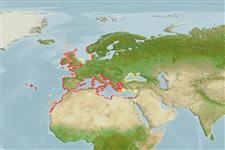
| Native range | All suitable habitat | Point map | Year 2050 |
|
| This map was computer-generated and has not yet been reviewed. |
| Hippocampus guttulatus AquaMaps Data sources: GBIF OBIS |
Envoyez vos Photos et vidéos
Images | vidéos | Timbres, pièces de monnaie, divers | Images Google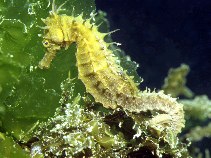 Hippocampus guttulatus
Photo de Patzner, R.
Images | vidéos | Timbres, pièces de monnaie, divers | Images Google
Photo de Patzner, R.
Classification / Noms Noms communs | Synonymes | Catalog of Fishes(Genre, Espèce) | ITIS | CoL | WoRMS | Cloffa
> Syngnathiformes (Pipefishes and seahorses) > Syngnathidae (Pipefishes and seahorses) > Syngnathinae
Etymology: Hippocampus: Greek, ippos = horse + Greek,kampe = curvature (Ref. 45335).
More on author: Cuvier.
Etymology: Hippocampus: Greek, ippos = horse + Greek,kampe = curvature (Ref. 45335).
More on author: Cuvier.
Environnement : milieu / zone climatique / profondeur / gamme de distribution Écologie
marin; saumâtre démersal; non migrateur; profondeur 0 - 30 m (Ref. 128812). Temperate; 63°N - 20°N, 32°W - 36°E
Distribution Territoires | Zones FAO | Écosystèmes | Occurrences | Carte par point | Introductions | Faunafri
Eastern Atlantic: British Isles and the Netherlands to Morocco, Canary Islands (Ref. 4509), Madeira, and the Azores, including the Mediterranean (Ref. 89253) and the Black Sea (Ref. 89255).
Longueur à la première maturité / Taille / Poids / Âge
Maturité: Lm 12.5 range ? - ? cm
Max length : 21.5 cm SL mâle / non sexé; (Ref. 79902); 18.0 cm OT (female)
Max length : 21.5 cm SL mâle / non sexé; (Ref. 79902); 18.0 cm OT (female)
Description synthétique Clés d'identification | Morphologie | Morphométrie
Épines dorsales (Total) : 0; Rayons mous dorsaux (Total) : 17 - 20. Description (based on 46 specimens): Adult height: 8.5-18.0cm. Rings: 11 + 37-39 (35-40). Snout length: 2.3-2.8 in head length. Dorsal fin rays: 19-20 (17-20) covering 2+1 rings. Pectoral fin rays: 16-18. Coronet: small but distinct, with 5 rounded knobs or blunt points; horizontal plate in front of coronet as high as coronet itself, with a more or less prominent spine at its front edge; coronet not joined smoothly to neck. Spines: medium to well-developed with blunt tips. Other distinctive characters: prominent rounded eye spines; often with a mane of thick skin fronds on neck and head. Color pattern: from dark green to brown (Refs. 52034, 89230); prominent white spots on body (often with a dark ring around them) which tend to coalesce into horizontal wavy lines103; may be variously mottled or with pale ‘saddles’ across dorsolateral surface.
Body shape (shape guide): other.
Body shape (shape guide): other.
Commonly referred to as Hippocampus ramulosus. Occurs mostly in shallow inshore waters including littoral lagoons (Ref. 9937) among algae and eel grass (Zostera or Posidonia), or among rocks and in gravel bottoms (Ref. 52034). Juveniles were observed to recruit to vegetated habitats at 8.8- 10.4 cm length (Ref. 79902). Adults (from 12.5 cm length) appear to maintain very restricted home ranges (19.9 ± 12.4 m2) over multiple years making limited daily movements. (Ref. 79902). May move to deeper waters during winter (Ref. 53712). Like other seahorse species, adult dispersals over large distances is probably caused by strong wave action and currents during storms or when it anchors itself to floating debris (Ref. 52034). Is thought to live for 4-7 years (Ref. 79902). Because of its early age at maturity, rapid growth rate, short generation time and multiple breeding cycles during each spawning season, resilience is thought to be high (Ref. 88171). However, in tropical areas where seagrass beds are regularly exploited for other species of seahorses for the aquarium trade, traditional medicine, etc., populations have been quickly eradicated (Ref. 89253). Can be maintained in an aquarium environment if trained to feed on dead animals (Ref. 88171). Length type OT refers to height (= TL - head length), Ref. 30915.
Cycle de vie et comportement reproducteur Maturité | Reproduction | Frai | Œufs | Fécondité | Larves
Ovoviviparous. During the mating season, mature males and females have been observed to change hue, i.e., become brighter, when courting (Refs. 52034, 89259). Female deposits her eggs on the brood pouch of the male which is found under the tail (Ref. 205). Gestation usually lasts 21 days (Ref. 89322) and brood sizes up to 581 have been reported (Refs. 53712, 79902, 89322). Young are expelled from the pouch measuring 1.5 cm after 3 weeks of incubation. Size at birth ranges from 0.6-1.4 cm length (Ref. 79902). Newly hatched young are planktonic for at least 8 weeks (Ref. 53712).
Référence principale
Téléchargez vos références | Références | Coordinateur | Collaborateurs
Lourie, S.A., R.A. Pollom and S.J. Foster, 2016. A global revision of the seahorses Hippocampus Rafinesque 1810 (Actinopterygii: Syngnathiformes): taxonomy and biogeography with recommendations for further research. Zootaxa 4146(1):1-66. (Ref. 115213)
Statut dans la liste rouge de l'IUCN (Ref. 130435: Version 2025-2 (Global))
Données manquantes (DD) ; Date assessed: 05 December 2016
Menace pour l'homme
Harmless
Utilisations par l'homme
Pêcheries: intérêt commercial mineur; Aquarium: Commercial
FAO - Publication: search | FishSource |
Plus d'informations
Écologie trophique
Aliments (proies)
Composition du régime alimentaire
Consommation alimentaire
Rations alimentaires
Prédateurs
Aliments (proies)
Composition du régime alimentaire
Consommation alimentaire
Rations alimentaires
Prédateurs
Dynamique des populations
Paramètres de croissance
Âges / tailles maximales
Longueur-poids rel.
Rel. longueur-longueur.
Fréquences de longueurs
Conversion de masse
Recrutement
Abondance
Paramètres de croissance
Âges / tailles maximales
Longueur-poids rel.
Rel. longueur-longueur.
Fréquences de longueurs
Conversion de masse
Recrutement
Abondance
Anatomie
Surface branchiale
Cerveau
Otolithe
Surface branchiale
Cerveau
Otolithe
Physiologie
Composition corporelle
Nutriments
Consommation d'oxygène
Type de natation
Vitesse de nage
Pigments visuels
Son de poisson
Maladies et parasites
Toxicité (CL50)
Composition corporelle
Nutriments
Consommation d'oxygène
Type de natation
Vitesse de nage
Pigments visuels
Son de poisson
Maladies et parasites
Toxicité (CL50)
Liées à l'homme
Systèmes d'aquaculture
Profils d'aquaculture
Souches
Cas de ciguatera
Timbres, pièces de monnaie, divers
Systèmes d'aquaculture
Profils d'aquaculture
Souches
Cas de ciguatera
Timbres, pièces de monnaie, divers
Outils
Quiz bio | E-book | Guide de terrain | Clés d'identification | Générateur de fréquences de longueur | Outil de dynamique de population | Carte par point |
Capture-MSY |
Articles particuliers
Télécharger en XML
Sources Internet
AFORO (otoliths) | Aquatic Commons | BHL | Cloffa | Websites from users | FishWatcher | CISTI | Catalog of Fishes: Genre, Espèce | DiscoverLife | DORIS | ECOTOX | FAO - Publication: search | Faunafri | Fishipedia | Fishtrace | GloBI | Google Books | Google Scholar | Google | IGFA World Record | Bases de données nationales | OneZoom | Open Tree of Life | Otolith Atlas of Taiwan Fishes | Aquariums publics | PubMed | Reef Life Survey | Socotra Atlas | TreeBase | Arbre de Vie | Wikipedia: aller à, chercher | World Records Freshwater Fishing | Zoobank | Zoological Record
Estimations basées sur des modèles
Température préférée (Réf. 123201): 12.3 - 21, mean 18.6 °C (based on 619 cells).
Indice de diversité phylogénétique (Réf. 82804): PD50 = 0.5000 [Uniqueness, from 0.5 = low to 2.0 = high].
Bayesian length-weight: a=0.00316 (0.00183 - 0.00546), b=2.93 (2.77 - 3.09), in cm total length, based on LWR estimates for this species & (Sub)family-body (Ref. 93245).
Niveau trophique (Réf. 69278): 3.5 ±0.4 se; based on diet studies.
Generation time: 1.9 ( na - na) years. Estimated as median ln(3)/K based on 1 growth studies.
Résilience (Réf. 120179): Milieu, temps minimum de doublement de population : 1,4 à 4,4 années (Fec=581).
Nutriments (Ref. 124155): Calcium = 49.7 [10.3, 150.8] mg/100g; Iron = 0.442 [0.173, 1.344] mg/100g; Protein = 3.26 [0.00, 7.03] %; Omega3 = 0.478 [0.213, 1.148] g/100g; Selenium = 6.31 [1.02, 18.72] μg/100g; VitaminA = 16.6 [5.7, 47.2] μg/100g; Zinc = 0.803 [0.391, 1.518] mg/100g (wet weight);