This website uses cookies to enhance your browsing experience and ensure the functionality of our site. For more detailed information about the types of cookies we use and how we protect your privacy, please visit our Privacy Information page.
×
Cookie Settings
This website uses different types of cookies to enhance your experience. Please select your preferences below:
> Eupercaria/misc (Various families in series Eupercaria) > Lutjanidae (Snappers) > Lutjaninae
Etymology: Lutjanus:Malay, ikan lutjan, name of a fish. Eponymy: Dr Patrick Russell (1727–1805) was a British surgeon and naturalist. [...] (Ref. 128868), visit book page. More on author: Bleeker.
Environnement : milieu / zone climatique / profondeur / gamme de distribution Écologie
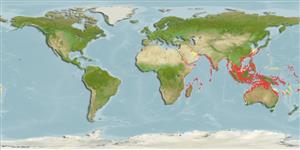
marin; saumâtre récifal; profondeur 3 - 80 m (Ref. 9710), usually 20 - 50 m (Ref. 48635). Tropical; 31°N - 38°S, 31°E - 178°W (Ref. 55)
Western Pacific: Indian Ocean distribution provisionally included as records of L. indicus; species needs to be reassessed, preferably utilising genetic analysis.
Longueur à la première maturité / Taille / Poids / Âge
Maturité: Lm?, range 29 - ? cm Max length : 50.0 cm TL mâle / non sexé; (Ref. 469); common length : 30.0 cm TL mâle / non sexé; (Ref. 55)
Épines dorsales (Total) : 10; Rayons mous dorsaux (Total) : 14; Épines anales: 3; Rayons mous anaux: 8. This species is distinguished by the following characters: body moderately deep to somewhat slender, greatest body depth 2.6-2.8 in SL; preopercular notch and knob poorly developed; vomerine tooth patch triangular or diamond-shaped, with a medial posterior extension; tongue with a patch of granular teeth; gill rakers of first gill arch 6-7 + 7-11 = 13-18 (including rudiments); caudal fin truncate or slightly emarginate; scale rows on back rising obliquely above lateral line. Colour generally pink to whitish with a silvery sheen; a black spot, mainly above lateral line, below anterior rays of soft dorsal fin (adults from the Indian Ocean usually with 7-8 narrow golden brown stripes on sides); juveniles whitish with black stripes on sides and most Indo-Pacific fish with a pale-edged round black spot on upper back (Ref 9821, 90102).
Body shape (shape guide): fusiform / normal; Cross section: oval.
Adults inhabit offshore coral reefs and also inshore rocky and coral reefs (Ref. 30573), at moderate depths, usually over 20 m, and is more common in about 50 m depth (Ref. 48635). Juveniles frequent mangrove estuaries and lower reaches of freshwater streams (Ref. 30573, 48635). They feed on benthic invertebrates and fish (Ref. 5213). Sold in Hong Kong live fish markets (Ref. 27253). A common market fish throughout its range; also a component of artisanal fisheries. Caught with handlines, traps, and bottom trawls and marketed mostly fresh (Ref. 9821).
Allen, G.R., 1985. FAO Species Catalogue. Vol. 6. Snappers of the world. An annotated and illustrated catalogue of lutjanid species known to date. FAO Fish. Synop. 125(6):208 p. Rome: FAO. (Ref. 55)
Statut dans la liste rouge de l'IUCN (Ref. 130435: Version 2025-2 (Global))
Cycle de vie Reproduction Maturité Maturité/épines rel. Fécondité Frai Agrégats de frai Œufs Développement de l'œuf Larves Dynamique des populations larvaires
Physiologie Composition corporelle Nutriments Consommation d'oxygène Type de natation Vitesse de nage Pigments visuels Son de poisson Maladies et parasites Toxicité (CL50)
Température préférée (Réf. 123201): 24.4 - 29.1, mean 28 °C (based on 1448 cells).
Indice de diversité phylogénétique (Réf. 82804): PD50 = 0.5000 [Uniqueness, from 0.5 = low to 2.0 = high].
Bayesian length-weight: a=0.01349 (0.00874 - 0.02081), b=2.98 (2.86 - 3.10), in cm total length, based on LWR estimates for this species & Genus-body shape (Ref. 93245).
Niveau trophique (Réf. 69278): 4.1 ±0.4 se; based on diet studies.
Résilience (Réf. 120179): Milieu, temps minimum de doublement de population : 1,4 à 4,4 années (Assuming tm<5).
Vulnérabilité de la pêche (Ref. 59153): Moderate vulnerability (40 of 100). 🛈