



Ilisha megaloptera (Swainson, 1838)
Bigeye ilisha
Ajouter votre observation dans Fish Watcher
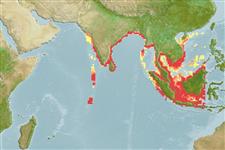
| Native range | All suitable habitat | Point map | Year 2050 |
|
| This map was computer-generated and has not yet been reviewed. |
| Ilisha megaloptera AquaMaps Data sources: GBIF OBIS |
Envoyez vos Photos et vidéos
Images | Images Google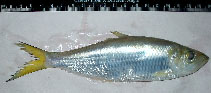 Ilisha megaloptera
Photo de Devarapalli, P.
Images | Images Google
Photo de Devarapalli, P.
Classification / Noms Noms communs | Synonymes | Catalog of Fishes(Genre, Espèce) | ITIS | CoL | WoRMS | Cloffa
> Clupeiformes (Herrings) > Pristigasteridae (Pristigasterids)
Etymology: Ilisha: An Indian name.
More on author: Swainson.
Etymology: Ilisha: An Indian name.
More on author: Swainson.
Environnement : milieu / zone climatique / profondeur / gamme de distribution Écologie
marin; eau douce; saumâtre pelagic-neritic; anadrome (Ref. 51243); profondeur 0 - 50 m (Ref. 188). Tropical; 24°N - 10°S, 70°E - 118°E (Ref. 188)
Distribution Territoires | Zones FAO | Écosystèmes | Occurrences | Carte par point | Introductions | Faunafri
Indo-Pacific: Indian Ocean (Bombay to Bay of Bengal and Andaman coast of Thailand), Java Sea (off Java, Singapore). Sarawak, `Cochinchina' and Macao specimens (Ref. 6393) should be rechecked.
Taille / Poids / Âge
Description synthétique Clés d'identification | Morphologie | Morphométrie
Épines dorsales (Total) : 0; Épines anales: 0; Rayons mous anaux: 38 - 53. Body rather deep, belly with 19 to 23 + 8 to 12, total 28 to 35 (usually 30 to 34) scutes. Eye large, lower jaw strongly projecting. Dorsal fin origin near midpoint of body; anal fin origin below hind part of dorsal fin base. Swim bladder with a single long tube passing back down right side of body above anal fin base. No toothed hypo-maxilla.
Body shape (shape guide): fusiform / normal; Cross section: compressed.
Body shape (shape guide): fusiform / normal; Cross section: compressed.
An inshore species, but apparently occurs also in rivers (Ganges at Allahabad and rivers of eastern Uttar Pradesh, but not in Velar estuary). Ascends into the upper end of the tidal zone (Ref. 12693). Feeds on fishes, crustaceans, amphipods, occasionally polychaetes, tunicates and small amounts of algae and diatoms.
Cycle de vie et comportement reproducteur Maturité | Reproduction | Frai | Œufs | Fécondité | Larves
Référence principale
Téléchargez vos références | Références | Coordinateur | Collaborateurs
Whitehead, P.J.P., 1985. FAO Species Catalogue. Vol. 7. Clupeoid fishes of the world (suborder Clupeoidei). An annotated and illustrated catalogue of the herrings, sardines, pilchards, sprats, shads, anchovies and wolf-herrings. FAO Fish. Synop. 125(7/1):1-303. Rome: FAO. (Ref. 188)
Statut dans la liste rouge de l'IUCN (Ref. 130435: Version 2025-2 (Global))
Préoccupation mineure (LC) ; Date assessed: 28 February 2017
CITES
Not Evaluated
Menace pour l'homme
Harmless
Utilisations par l'homme
Pêcheries: commercial
FAO - Publication: search | FishSource |
Plus d'informations
Écologie trophique
Aliments (proies)
Composition du régime alimentaire
Consommation alimentaire
Rations alimentaires
Prédateurs
Aliments (proies)
Composition du régime alimentaire
Consommation alimentaire
Rations alimentaires
Prédateurs
Dynamique des populations
Paramètres de croissance
Âges / tailles maximales
Longueur-poids rel.
Rel. longueur-longueur.
Fréquences de longueurs
Conversion de masse
Recrutement
Abondance
Paramètres de croissance
Âges / tailles maximales
Longueur-poids rel.
Rel. longueur-longueur.
Fréquences de longueurs
Conversion de masse
Recrutement
Abondance
Cycle de vie
Reproduction
Maturité
Maturité/épines rel.
Fécondité
Frai
Agrégats de frai
Œufs
Développement de l'œuf
Larves
Dynamique des populations larvaires
Reproduction
Maturité
Maturité/épines rel.
Fécondité
Frai
Agrégats de frai
Œufs
Développement de l'œuf
Larves
Dynamique des populations larvaires
Anatomie
Surface branchiale
Cerveau
Otolithe
Surface branchiale
Cerveau
Otolithe
Physiologie
Composition corporelle
Nutriments
Consommation d'oxygène
Type de natation
Vitesse de nage
Pigments visuels
Son de poisson
Maladies et parasites
Toxicité (CL50)
Composition corporelle
Nutriments
Consommation d'oxygène
Type de natation
Vitesse de nage
Pigments visuels
Son de poisson
Maladies et parasites
Toxicité (CL50)
Génétique
génôme
Génétique
Hétérozygotie
Héritabilité
Diversité génétique
génôme
Génétique
Hétérozygotie
Héritabilité
Diversité génétique
Liées à l'homme
Systèmes d'aquaculture
Profils d'aquaculture
Souches
Cas de ciguatera
Timbres, pièces de monnaie, divers
Systèmes d'aquaculture
Profils d'aquaculture
Souches
Cas de ciguatera
Timbres, pièces de monnaie, divers
Outils
E-book | Guide de terrain | Générateur de fréquences de longueur | Outil de dynamique de population | Carte par point |
Capture-MSY |
Articles particuliers
Télécharger en XML
Sources Internet
AFORO (otoliths) | Aquatic Commons | BHL | Cloffa | Websites from users | FishWatcher | CISTI | Catalog of Fishes: Genre, Espèce | DiscoverLife | ECOTOX | FAO - Publication: search | Faunafri | Fishipedia | Fishtrace | GloBI | Google Books | Google Scholar | Google | IGFA World Record | OneZoom | Open Tree of Life | Otolith Atlas of Taiwan Fishes | PubMed | Reef Life Survey | Socotra Atlas | TreeBase | Arbre de Vie | Wikipedia: aller à, chercher | | Zoological Record
Estimations basées sur des modèles
|
Indice de diversité phylogénétique (Réf. 82804) |
PD50 = 0.5000 [Uniqueness, from 0.5 = low to 2.0 = high]. |
| Bayesian length-weight | a=0.00832 (0.00549 - 0.01260), b=2.96 (2.84 - 3.08), in cm total length, based on LWR estimates for this species & Genus-body shape (Ref. 93245). |
|
Niveau trophique (Réf. 69278) |
3.0 ±0.37 se; based on food items. |
|
Résilience (Réf. 120179) |
Milieu, temps minimum de doublement de population : 1,4 à 4,4 années (Preliminary K or Fecundity.). |
|
Vulnérabilité de la pêche (Ref. 59153) |
Moderate vulnerability (36 of 100). 🛈 |
|
Catégorie de prix (Ref. 80766) |
High. |
|
Nutriments (Ref. 124155) |
Calcium = 132 [81, 261] mg/100g; Iron = 1.39 [0.82, 2.19] mg/100g; Protein = 19.2 [17.8, 20.6] %; Omega3 = 0.362 [0.193, 0.677] g/100g; Selenium = 41.4 [22.1, 83.1] μg/100g; VitaminA = 17.9 [7.0, 42.7] μg/100g; Zinc = 1.68 [1.23, 2.33] mg/100g (wet weight); |