



Epinephelus itajara (Lichtenstein, 1822)
Atlantic goliath grouper
Añada su observación en Fish Watcher
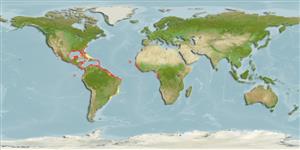
| Native range | All suitable habitat | Point map | Year 2050 |
|
| This map was computer-generated and has not yet been reviewed. |
| Epinephelus itajara AquaMaps Data sources: GBIF OBIS |
Sube tu fotos y Vídeos
Imágenes | Vídeos | Sonidos | Sellos, monedas, varios | Google image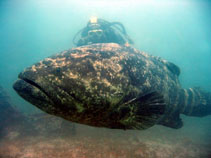 Epinephelus itajara
Foto de Bertoncini, A.A.
Imágenes | Vídeos | Sonidos | Sellos, monedas, varios | Google image
Foto de Bertoncini, A.A.
Clasificación / Nombres Nombres comunes | Sinónimos | Catalog of Fishes(Género, Especie) | ITIS | CoL | WoRMS | Cloffa
> Perciformes/Serranoidei (Groupers) > Epinephelidae (Groupers)
Etymology: Epinephelus: Greek, epinephelos = cloudy (Ref. 45335).
Etymology: Epinephelus: Greek, epinephelos = cloudy (Ref. 45335).
Entorno: milieu / zona climática / rango de profundidad / gama de distribución Ecología
marino; salobre asociado a arrecife; rango de profundidad 0 - 100 m (Ref. 9710), usually ? - 46 m (Ref. 55295). Subtropical; 36°N - 33°S, 121°W - 12°E (Ref. 55295)
Distribución Territorios | Áreas FAO | Ecosistemas | Ocurrencias, apariciones | Mapa de puntos | Introducciones | Faunafri
Western Atlantic: Florida, USA to southern Brazil, including the Gulf of Mexico and the Caribbean. Eastern Atlantic: Senegal to Congo (reported as Epinephelus esonue, Ref. 2739, 6809); rare in Canary Islands (Ref. 6808). Eastern Pacific (Gulf of California to Peru) species refers to Epinephelus quinquefasciatus. Discrete populations of E. itajara exist in the western Atlantic (Ref. 89627).
Longitud en la primera madurez / Tamaño / Peso / Edad
Madurez: Lm 128.0 range ? - ? cm
Max length : 250 cm TL macho / no sexado; (Ref. 26550); common length : 150 cm TL macho / no sexado; (Ref. 5217); peso máximo publicado: 455.0 kg (Ref. 4841); edad máxima reportada: 37 años (Ref. 4841)
Max length : 250 cm TL macho / no sexado; (Ref. 26550); common length : 150 cm TL macho / no sexado; (Ref. 5217); peso máximo publicado: 455.0 kg (Ref. 4841); edad máxima reportada: 37 años (Ref. 4841)
Descripción breve Claves de identificación | Morfología | Morfometría
Espinas dorsales (total) : 11; Radios blandos dorsales (total) : 15 - 16; Espinas anales: 3; Radios blandos anales: 8. Distinguished by the following characteristics: brownish yellow, grey or greenish body color; head and dorsal part of body and fins with small black spots; body robust and elongate; body depth contained 2.7-3.4 times in SL; HL 2.3-2.9 in SL; extremely broad head; flat interorbital; rounded preopercle, finely serrate; round nostrils, subequal; maxilla scaly, reaching well past eye; 3-5 rows of subequal teeth on midlateral part of lower jaw; absence of canines at front jaw (Ref. 89707); further characterized by having opercle with 3 flat spines, middle one the largest. Pelvic fins smaller than the pectorals. Bases of soft dorsal and anal fins covered with scales and thick skin. Juveniles tawny with irregular vertical bands.
Body shape (shape guide): fusiform / normal; Cross section: compressed.
Body shape (shape guide): fusiform / normal; Cross section: compressed.
A solitary species (Ref. 26340) occurring in shallow, inshore areas. Found on rock, coral, or mud bottoms (Ref. 5217). Juveniles found in mangrove areas and brackish estuaries (Ref. 5217). Large adults may be found in estuaries (Ref. 5217). Adults appear to occupy limited home ranges with little inter-reef movement. Feeds primarily on crustaceans, particularly spiny lobsters as well as turtles and fishes, including stingrays. Territorial near its refuge cave or wreck where it may show a threat display with open mouth and quivering body. Larger individuals have been known to stalk and attacks divers. Over-fished, primarily by spear fishing (Ref. 9710). Marketed fresh and salted. Meat is of excellent quality. Important game fish (Ref. 9342). Reported to reach weights of more than 315 kg (Ref. 26938).
Ciclo vital y comportamiento de apareamiento Madurez | Reproducción | Puesta | Huevos | Fecundidad | Larva
Referencia principal
Suba sus referencias | Referencias | Coordinador | Colaboradores
Heemstra, P.C. and J.E. Randall, 1993. FAO Species Catalogue. Vol. 16. Groupers of the world (family Serranidae, subfamily Epinephelinae). An annotated and illustrated catalogue of the grouper, rockcod, hind, coral grouper and lyretail species known to date. Rome: FAO. FAO Fish. Synop. 125(16):382 p. (Ref. 5222)
Situación en la Lista Roja de la UICN (Ref. 130435: Version 2025-2 (Global))
Vulnerable (VU) (A2bcd); Date assessed: 20 November 2016
CITES
Not Evaluated
Amenaza para el ser humano
Traumatogenic (Ref. 4716)
Usos humanos
Pesquerías: escaso valor comercial; pesca deportiva: si
FAO - Publication: search | FishSource | Sea Around Us
Más información
Ecología Trófica
Alimentos (presas)
Composición de la dieta
consumo de alimento
Raciones de comida
Despredadores
Alimentos (presas)
Composición de la dieta
consumo de alimento
Raciones de comida
Despredadores
Dinámica de la población
Coeficiente del crecimiento para
Edades / tallas máximas
Longitud-peso rel.
Longitud-longitud rel.
Longitud-frecuencias
Conversión de masas
Reclutamiento
Abundancia
Coeficiente del crecimiento para
Edades / tallas máximas
Longitud-peso rel.
Longitud-longitud rel.
Longitud-frecuencias
Conversión de masas
Reclutamiento
Abundancia
Ciclo de vida
Reproducción
Madurez
Madurez/Gills rel.
Fecundidad
Puesta
Agregaciones de desove
Huevos
Desarrollo de los huevos
Larva
Dinámica larvaria
Reproducción
Madurez
Madurez/Gills rel.
Fecundidad
Puesta
Agregaciones de desove
Huevos
Desarrollo de los huevos
Larva
Dinámica larvaria
Distribución
Territorios
Áreas FAO
Ecosistemas
Ocurrencias, apariciones
Introducciones
BRUVS - Vídeos
Territorios
Áreas FAO
Ecosistemas
Ocurrencias, apariciones
Introducciones
BRUVS - Vídeos
Fisiología
Composición corporal
Nutrientes
Consumo del oxígeno
Tipo de natación
Velocidad de natación
Pigmentos visuales
Sonido de peces
Enfermedades y parásitos
Toxicidad (CL50)
Composición corporal
Nutrientes
Consumo del oxígeno
Tipo de natación
Velocidad de natación
Pigmentos visuales
Sonido de peces
Enfermedades y parásitos
Toxicidad (CL50)
Relacionados con el ser humano
Sistemas de acuicultura
Perfiles de acuicultura
Razas
Ciguatera cases
Sellos, monedas, varios
Sistemas de acuicultura
Perfiles de acuicultura
Razas
Ciguatera cases
Sellos, monedas, varios
Herramientas
Cuestionario orgánico | Libro electrónico | Guía de campo | Claves de identificación | Asistente para frecuencias de tallas | Herramienta de ciclo de vida | Mapa de puntos |
Catch-MSY |
Informes especiales
Comprobar el mantenimiento del acuario | Buscar fichas sobre especies | Consulte las hojas informativas sobre acuicultura
Descargar XML
Fuentes de Internet
AFORO (otoliths) | Aquatic Commons | BHL | Cloffa | Websites from users | Check FishWatcher | CISTI | Catalog of Fishes: Género, Especie | DiscoverLife | ECOTOX | FAO - Publication: search | Faunafri | Fishipedia | Fishtrace | GloBI | GoMexSI (interaction data) | Google Books | Google Scholar | Google | IGFA World Record | Bases de datos nacionales | OneZoom | Open Tree of Life | OsteoBase: skull, spine | Otolith Atlas of Taiwan Fishes | Acuarios públicos | PubMed | Reef Life Survey | Socotra Atlas | TreeBase | Árbol de la vida | Wikipedia: Go, búsqueda | World Records Freshwater Fishing | Expediente Zoológico
Estimaciones basadas en modelos
Temperatura preferida (Referencia 123201): 22.8 - 28, mean 26.3 °C (based on 532 cells).
Índice de diversidad filogenética (Referencia 82804): PD50 = 0.5000 [Uniqueness, from 0.5 = low to 2.0 = high].
Bayesian length-weight: a=0.01072 (0.00626 - 0.01833), b=3.04 (2.90 - 3.18), in cm total length, based on LWR estimates for this species & Genus-body shape (Ref. 93245).
Nivel trófico (Referencia 69278): 4.1 ±0.0 se; based on diet studies.
Generation time: 8.7 ( na - na) years. Estimated as median ln(3)/K based on 1 growth studies.
Resiliencia (Referencia 120179): Bajo, población duplicada en un tiempo mínimo de 4.5-14 años (K=0.13; tm=5.5-6.5).
Nutrientes (Ref. 124155): Calcium = 7.75 [2.67, 16.99] mg/100g; Iron = 0.365 [0.171, 0.783] mg/100g; Protein = 19.9 [18.3, 21.5] %; Omega3 = 0.169 [0.084, 0.334] g/100g; Selenium = 25.9 [11.7, 60.3] μg/100g; VitaminA = 40.7 [8.5, 195.4] μg/100g; Zinc = 0.626 [0.390, 0.977] mg/100g (wet weight);