



Polyacanthonotus rissoanus (De Filippi & Verany, 1857)
Smallmouth spiny eel
Hochladen Photos und videos
Bilder | Google Bild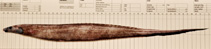 Polyacanthonotus rissoanus
Photo von DESCNA
Bilder | Google Bild
Photo von DESCNA
Klassifizierung / Names Namen | Synonyme | Catalog of Fishes(Gattung, Arten) | ITIS | CoL | WoRMS | Cloffa
> Notacanthiformes (Halosaurs and deep-sea spiny eels) > Notacanthidae (Deep-sea spiny eels)
Etymology: Polyacanthonotus: Greek, poly = a lot of + Greek, akantha = thorn + Greek,noton = back (Ref. 45335).
Eponymy: Professor Giovanni Antonio Risso (1777–1845) (aka Joseph Antoine Risso) was an Italian-French naturalist and the first to describe deep-sea fishes as distinctive fauna and describe depth zonation with different species living in discrete depth [...] (Ref. 128868), visit book page.
Etymology: Polyacanthonotus: Greek, poly = a lot of + Greek, akantha = thorn + Greek,noton = back (Ref. 45335).
Eponymy: Professor Giovanni Antonio Risso (1777–1845) (aka Joseph Antoine Risso) was an Italian-French naturalist and the first to describe deep-sea fishes as distinctive fauna and describe depth zonation with different species living in discrete depth [...] (Ref. 128868), visit book page.
Umwelt: Milieu / Klimazone / Tiefenbereich / Verbreitungsgebiet Ökologie
seewasser bathydemersal; tiefenbereich 500 - 2875 m (Ref. 6594), usually 540 - 2875 m (Ref. 117245). Deep-water; 3°C - 11°C (Ref. 117245); 74°N - 35°S, 76°W - 36°E
Verbreitung Territorien | FAO Gebiete | Ökosysteme | Vorkommen | Punkt Karte | Einführungen | Faunafri
Eastern Atlantic: Baffin Bay-Davis Strait Offshore, Ireland to South Africa, including the Mediterranean Sea. Reported from Iceland (Ref. 12462). Western Atlantic: Davis Strait to Cape Hatteras, North Carolina in the USA.
Größe / Gewicht / Alter
Kurzbeschreibung Bestimmungsschlüssel | Morphologie | Morphometrie
Rückenflossenstacheln (insgesamt) : 26 - 36; Rückenflossenweichstrahlen (insgesamt) : 0. Same body coloration as P. africanus but lateral line lighter and less distinct (Ref. 6584). Maxilla fails to extend back to the posterior of nostril. Small mouth, short preoral snout. Light tan with black tips (Ref. 37108).
Body shape (shape guide): eel-like.
Body shape (shape guide): eel-like.
Maximum depth from Ref. 117245. Epibenthic and feeds on coelenterates, worms and crustaceans (Ref. 58426).
Lebenszyklus und Paarungsverhalten Geschlechtsreife | Fortpflanzung | Ablaichen | Eier | Fruchtbarkeit | Larven
Hauptreferenz
Laden Sie Ihre Referenzen hoch | Referenzen | Koordinator | Partner
Sulak, K.J., 1986. Notacanthidae. p. 195-196. In M.M. Smith and P.C. Heemstra (eds.) Smiths' sea fishes. Springer-Verlag, Berlin. (Ref. 6594)
CITES
Not Evaluated
Bedrohung für Menschen
Harmless
Nutzung durch Menschen
Fischereien: nicht kommerziell
FAO - Publication: search | FishSource |
Mehr Information
Trophische Ökologie
Lebensmittel (Beutetiere)
Nahrungszusammensetzung
Nahrungsaufnahme
Lebensmittelrationen
Räuber
Lebensmittel (Beutetiere)
Nahrungszusammensetzung
Nahrungsaufnahme
Lebensmittelrationen
Räuber
Populationsdynamik
Wachstumsparameter
Max. Alter/Größen
Länge-Gewicht-Rel.
Länge-Länge-Verhältnis.
Längenhäufigkeiten
Massenkonvertierung
Rekrutierung
Dichte
Wachstumsparameter
Max. Alter/Größen
Länge-Gewicht-Rel.
Länge-Länge-Verhältnis.
Längenhäufigkeiten
Massenkonvertierung
Rekrutierung
Dichte
Lebenszyklus
Fortpflanzung
Geschlechtsreife
Reifung/Kiemen rel.
Fruchtbarkeit
Ablaichen
Laichaggregationen
Eier
Eientwicklung
Larven
Larven Pop.Dyn.
Fortpflanzung
Geschlechtsreife
Reifung/Kiemen rel.
Fruchtbarkeit
Ablaichen
Laichaggregationen
Eier
Eientwicklung
Larven
Larven Pop.Dyn.
Anatomie
Kiemenoberfläche
Gehirn
Otolith
Kiemenoberfläche
Gehirn
Otolith
Physiologie
Körperliche Zusammensetzung
Nährstoffe
Sauerstoffverbrauch
Schwimmart
Schwimmgeschwindigkeit
Visuelle Pigmente
Fischgeräusche
Krankheiten und Parasiten
Toxizität (LC50s)
Körperliche Zusammensetzung
Nährstoffe
Sauerstoffverbrauch
Schwimmart
Schwimmgeschwindigkeit
Visuelle Pigmente
Fischgeräusche
Krankheiten und Parasiten
Toxizität (LC50s)
Genetik
Genom
Genetik
Heterozygotie
Vererbbarkeit
Genetische Vielfalt
Genom
Genetik
Heterozygotie
Vererbbarkeit
Genetische Vielfalt
Menschenbezogen
Aquakultur-Systeme
Aquakultur Profile
Zuchtlinien
Ciguatera-Fälle
Briefmarken, Münzen, Verschiedenes.
Aquakultur-Systeme
Aquakultur Profile
Zuchtlinien
Ciguatera-Fälle
Briefmarken, Münzen, Verschiedenes.
Tools
E-Book | Feldführer | Bestimmungsschlüssel | Längenhäufigkeits Tool | Lebensdaten Tool | Punkt Karte |
Catch-MSY |
Zusatzinformationen
Download XML
Zusammenfassung | Punktdaten | Namen | Photos
Internet Quellen
AFORO (otoliths) | Aquatic Commons | BHL | Cloffa | Websites from users | FishWatcher Einträge suchen | CISTI | Catalog of Fishes: Gattung, Arten | DiscoverLife | ECOTOX | FAO - Publication: search | Faunafri | Fishipedia | Fishtrace | GloBI | Google Books | Google Scholar | Google | IGFA World Record | Nationale Datenbanken | OneZoom | Open Tree of Life | Otolith Atlas of Taiwan Fishes | PubMed | Reef Life Survey | Socotra Atlas | TreeBase | Tree of Life | Wikipedia: Gehe zu, Suchen | World Records Freshwater Fishing | Zoologischer Rekord
Schätzungen auf der Grundlage von Modellen
Bevorzugte Temperatur (Ref. 123201): 3.3 - 13, mean 4.6 °C (based on 398 cells).
Phylogenetischer Diversitätsindex (Ref. 82804): PD50 = 0.5626 [Uniqueness, from 0.5 = low to 2.0 = high].
Bayesian length-weight: a=0.00102 (0.00046 - 0.00225), b=3.06 (2.88 - 3.24), in cm total length, based on all LWR estimates for this body shape (Ref. 93245).
Trophische Ebene (Ref. 69278): 3.5 ±0.42 se; based on food items.
Widerstandsfähigkeit (Ref. 120179): sehr niedrig, Verdopplung der Population dauert mehr als 14 Jahre. (Preliminary K or Fecundity.).
Nährstoffe (Ref. 124155): Calcium = 29.5 [6.8, 122.8] mg/100g; Iron = 0.473 [0.154, 1.263] mg/100g; Protein = 1.43 [0.00, 5.32] %; Omega3 = 0.391 [0.142, 1.126] g/100g; Selenium = 10.3 [3.2, 43.0] μg/100g; VitaminA = 40.3 [6.9, 239.0] μg/100g; Zinc = 0.692 [0.342, 1.504] mg/100g (wet weight);