



Ajouter votre observation dans Fish Watcher
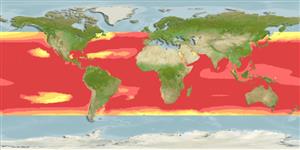
| Native range | All suitable habitat | Point map | Year 2050 |
|
| This map was computer-generated and has not yet been reviewed. |
| Thunnus obesus AquaMaps Data sources: GBIF OBIS |
Envoyez vos Photos et vidéos
Images | Timbres, pièces de monnaie, divers | Images Google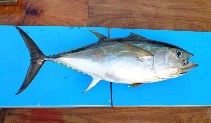 Thunnus obesus
Photo de Chow, S.
Images | Timbres, pièces de monnaie, divers | Images Google
Photo de Chow, S.
Classification / Noms Noms communs | Synonymes | Catalog of Fishes(Genre, Espèce) | ITIS | CoL | WoRMS | Cloffa
> Scombriformes (Mackerels) > Scombridae (Mackerels, tunas, bonitos) > Scombrinae
Etymology: Thunnus: Greek, thynnos = tunna (Ref. 45335).
More on author: Lowe.
Etymology: Thunnus: Greek, thynnos = tunna (Ref. 45335).
More on author: Lowe.
Environnement : milieu / zone climatique / profondeur / gamme de distribution Écologie
marin pelagic-oceanic; océanodrome (Ref. 71039); profondeur 0 - 1500 m (Ref. 117020), usually 0 - 500 m (Ref. 117020). Subtropical; 13°C - 29°C (Ref. 168); 52°N - 48°S, 180°W - 180°E
Distribution Territoires | Zones FAO | Écosystèmes | Occurrences | Carte par point | Introductions | Faunafri
Atlantic, Indian and Pacific: in tropical and subtropical waters. Absent in the Mediterranean. Highly migratory species.
Longueur à la première maturité / Taille / Poids / Âge
Maturité: Lm 112.5, range 100 - 125 cm
Max length : 250 cm TL mâle / non sexé; (Ref. 27000); common length : 180 cm FL mâle / non sexé; (Ref. 168); poids max. publié: 210.0 kg (Ref. 9987); âge max. reporté: 17 années (Ref. 137697)
Max length : 250 cm TL mâle / non sexé; (Ref. 27000); common length : 180 cm FL mâle / non sexé; (Ref. 168); poids max. publié: 210.0 kg (Ref. 9987); âge max. reporté: 17 années (Ref. 137697)
Description synthétique Clés d'identification | Morphologie | Morphométrie
Épines dorsales (Total) : 13 - 14; Rayons mous dorsaux (Total) : 14 - 15; Épines anales: 0; Rayons mous anaux: 14; Vertèbres: 39. This large species is distinguished by the following characters: robust, fusiform body, slightly compressed from side to side; total gill rakers on first gill arch 23-31; dorsal fins separated only by a narrow interspace, the second followed by 8-10 finlets; anal fin followed by 7-10 finlets; pectoral fins moderately long (22 to 31% of fork length) in large specimens (over 110 cm FL), but very long (as long as in Thunnus alalunga) in smaller specimens; 2 flaps (interpelvic process) between pelvic fins; very small scales on body; corselet of larger and thicker scales developed, but not very distinct; caudal peduncle very slender, with a strong lateral keel between 2 smaller keels; ventral surface of liver striated; swimbladder present. Colour of back metallic dark blue, lower sides and belly whitish; a lateral iridescent blue band runs along sides in live specimens; first dorsal fin deep yellow, second dorsal and anal fins light yellow, finlets bright yellow edged with black (Ref. 9684).
Body shape (shape guide): fusiform / normal; Cross section: oval.
Body shape (shape guide): fusiform / normal; Cross section: oval.
Occur in areas where water temperatures range from 13°-29°C, but the optimum is between 17° and 22°C. Variation in occurrence is closely related to seasonal and climatic changes in surface temperature and thermocline. Juveniles and small adults school at the surface in mono-species groups or mixed with other tunas, may be associated with floating objects. Adults stay in deeper waters (Ref. 5377). Eggs and larvae are pelagic (Ref. 6390). Feed on a wide variety of fishes, cephalopods and crustaceans during the day and at night (Ref. 9340). Meat is highly prized and processed into sashimi in Japan. Marketed mainly canned or frozen (Ref. 9684), but also sold fresh (Ref. 9340).
Cycle de vie et comportement reproducteur Maturité | Reproduction | Frai | Œufs | Fécondité | Larves
Are multiple spawners that may spawn every 1 or 2 days over several months (Ref. 30330). They spawn over periods of the full moon (Ref. 6390). Spawn throughout the year in tropical waters (Ref. 6390).
Référence principale
Téléchargez vos références | Références | Coordinateur : Collette, Bruce B. | Collaborateurs
Collette, B.B. and C.E. Nauen, 1983. FAO Species Catalogue. Vol. 2. Scombrids of the world. An annotated and illustrated catalogue of tunas, mackerels, bonitos and related species known to date. Rome: FAO. FAO Fish. Synop. 125(2):137 p. (Ref. 168)
Statut dans la liste rouge de l'IUCN (Ref. 130435: Version 2025-2 (Global))
Vulnérable (VU) (A2bd); Date assessed: 15 January 2021
CITES
Not Evaluated
Menace pour l'homme
Harmless
Utilisations par l'homme
Pêcheries: hautement commercial; pêche sportive: oui
FAO - pêcheries: débarquements, Résumé espèce; Publication: search | FIRMS - Stock assessments | FishSource | Sea Around Us
Plus d'informations
Écologie trophique
Aliments (proies)
Composition du régime alimentaire
Consommation alimentaire
Rations alimentaires
Prédateurs
Aliments (proies)
Composition du régime alimentaire
Consommation alimentaire
Rations alimentaires
Prédateurs
Dynamique des populations
Paramètres de croissance
Âges / tailles maximales
Longueur-poids rel.
Rel. longueur-longueur.
Fréquences de longueurs
Conversion de masse
Recrutement
Abondance
Paramètres de croissance
Âges / tailles maximales
Longueur-poids rel.
Rel. longueur-longueur.
Fréquences de longueurs
Conversion de masse
Recrutement
Abondance
Cycle de vie
Reproduction
Maturité
Maturité/épines rel.
Fécondité
Frai
Agrégats de frai
Œufs
Développement de l'œuf
Larves
Dynamique des populations larvaires
Reproduction
Maturité
Maturité/épines rel.
Fécondité
Frai
Agrégats de frai
Œufs
Développement de l'œuf
Larves
Dynamique des populations larvaires
Physiologie
Composition corporelle
Nutriments
Consommation d'oxygène
Type de natation
Vitesse de nage
Pigments visuels
Son de poisson
Maladies et parasites
Toxicité (CL50)
Composition corporelle
Nutriments
Consommation d'oxygène
Type de natation
Vitesse de nage
Pigments visuels
Son de poisson
Maladies et parasites
Toxicité (CL50)
Liées à l'homme
Systèmes d'aquaculture
Profils d'aquaculture
Souches
Cas de ciguatera
Timbres, pièces de monnaie, divers
Systèmes d'aquaculture
Profils d'aquaculture
Souches
Cas de ciguatera
Timbres, pièces de monnaie, divers
Outils
E-book | Guide de terrain | Clés d'identification | Générateur de fréquences de longueur | Outil de dynamique de population | Carte par point |
Capture-MSY |
Articles particuliers
Télécharger en XML
Sources Internet
AFORO (otoliths) | Aquatic Commons | BHL | Cloffa | Websites from users | FishWatcher | CISTI | Catalog of Fishes: Genre, Espèce | DiscoverLife | ECOTOX | FAO - pêcheries: débarquements, Résumé espèce; Publication: search | Faunafri | Fishipedia | Fishtrace | GloBI | Google Books | Google Scholar | Google | IGFA World Record | Bases de données nationales | OneZoom | Open Tree of Life | Otolith Atlas of Taiwan Fishes | PubMed | Reef Life Survey | Socotra Atlas | TreeBase | Arbre de Vie | Wikipedia: aller à, chercher | World Records Freshwater Fishing | Zoological Record
Estimations basées sur des modèles
Température préférée (Réf. 123201): 16.8 - 28.6, mean 26.6 °C (based on 3638 cells).
Indice de diversité phylogénétique (Réf. 82804): PD50 = 0.5039 [Uniqueness, from 0.5 = low to 2.0 = high].
Bayesian length-weight: a=0.01318 (0.01043 - 0.01666), b=3.03 (2.99 - 3.07), in cm total length, based on LWR estimates for this species (Ref. 93245).
Niveau trophique (Réf. 69278): 4.5 ±0.0 se; based on diet studies.
Generation time: 6.6 (4.4 - 10.4) years. Estimated as median ln(3)/K based on 12 growth studies.
Résilience (Réf. 120179): Milieu, temps minimum de doublement de population : 1,4 à 4,4 années (K=0.11-0.23; tm=3; tmax=11; Fec=2 million).
Prior r = 0.52, 95% CL = 0.34 - 0.77, Based on 10 full stock assessments.
Nutriments (Ref. 124155): Calcium = 22.1 [12.0, 42.2] mg/100g; Iron = 2.65 [1.06, 6.93] mg/100g; Protein = 24 [23, 25] %; Omega3 = 0.453 [0.273, 0.754] g/100g; Selenium = 54.7 [17.4, 171.5] μg/100g; VitaminA = 19.6 [2.7, 180.1] μg/100g; Zinc = 0.278 [0.153, 0.561] mg/100g (wet weight);