



把你的觀察加入 Fish Watcher
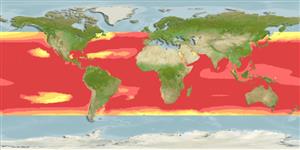
| Native range | All suitable habitat | Point map | Year 2050 |
|
| This map was computer-generated and has not yet been reviewed. |
| Thunnus obesus AquaMaps Data sources: GBIF OBIS |
分類 / 名稱 俗名 | 同種異名 | Catalog of Fishes(屬, 種) | ITIS | CoL | WoRMS | Cloffa
Teleostei > Scombriformes (Mackerels) 鱸形目 (Mackerels) > Scombridae (Mackerels, tunas, bonitos) 鯖科 (Mackerels, tunas, bonitos) > Scombrinae
Etymology: Thunnus: Greek, thynnos = tunna (Ref. 45335).
More on author: Lowe.
Etymology: Thunnus: Greek, thynnos = tunna (Ref. 45335).
More on author: Lowe.
環境: 環境 / 氣候帶 / 深度上下限 / 配送範圍 生態學
海洋 pelagic-oceanic; 海洋洄游的 (Ref. 71039); 深度上下限 0 - 1500 m (Ref. 117020), usually 0 - 500 m (Ref. 117020). 亞熱帶的; 13°C - 29°C (Ref. 168); 52°N - 48°S, 180°W - 180°E
分布 領土 | FAO區域 | 生態系 | 發現紀錄 | 分布圖 | 簡介 | Faunafri
Atlantic, Indian and Pacific: in tropical and subtropical waters. Absent in the Mediterranean. Highly migratory species.
大西洋,印度洋與太平洋: 在熱帶與亞熱帶的水域中。 不存在於地中海。 高度遷移的種,1982年海事法會議的附件一.(參考文獻 26139)
大西洋,印度洋與太平洋: 在熱帶與亞熱帶的水域中。 不存在於地中海。 高度遷移的種,1982年海事法會議的附件一.(參考文獻 26139)
初熟時的長度 / 大小 / 重量 / 年齡
成熟度: Lm 112.5, range 100 - 125 cm
Max length : 250 cm TL 雄魚/尚未辨別雌雄; (Ref. 27000); common length : 180 cm FL 雄魚/尚未辨別雌雄; (Ref. 168); 最大體重: 210.0 kg (Ref. 9987); 最大年齡: 17 年 (Ref. 137697)
Max length : 250 cm TL 雄魚/尚未辨別雌雄; (Ref. 27000); common length : 180 cm FL 雄魚/尚未辨別雌雄; (Ref. 168); 最大體重: 210.0 kg (Ref. 9987); 最大年齡: 17 年 (Ref. 137697)
簡短描述 檢索表 | 型態特徵 | 形態測量圖
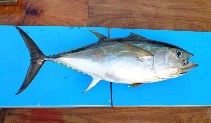
背棘 (總數) : 13 - 14; 背的軟條 (總數) : 14 - 15; 臀棘: 0; 臀鰭軟條: 14; 脊椎骨: 39. This large species is distinguished by the following characters: robust, fusiform body, slightly compressed from side to side; total gill rakers on first gill arch 23-31; dorsal fins separated only by a narrow interspace, the second followed by 8-10 finlets; anal fin followed by 7-10 finlets; pectoral fins moderately long (22 to 31% of fork length) in large specimens (over 110 cm FL), but very long (as long as in Thunnus alalunga) in smaller specimens; 2 flaps (interpelvic process) between pelvic fins; very small scales on body; corselet of larger and thicker scales developed, but not very distinct; caudal peduncle very slender, with a strong lateral keel between 2 smaller keels; ventral surface of liver striated; swimbladder present. Colour of back metallic dark blue, lower sides and belly whitish; a lateral iridescent blue band runs along sides in live specimens; first dorsal fin deep yellow, second dorsal and anal fins light yellow, finlets bright yellow edged with black (Ref. 9684).
Body shape (shape guide): fusiform / normal; Cross section: oval.
一個大的種, 深的在第一背鰭基底的中央的附近。 下側與腹面微白色的; 一條側面的藍色虹彩的條紋在活體中沿著側邊。 第一背鰭是深黃色, 第二個背鰭與臀鰭是淡黃色的,離鰭是鮮黃色的被黑色邊緣的。
Body shape (shape guide): fusiform / normal; Cross section: oval.
一個大的種, 深的在第一背鰭基底的中央的附近。 下側與腹面微白色的; 一條側面的藍色虹彩的條紋在活體中沿著側邊。 第一背鰭是深黃色, 第二個背鰭與臀鰭是淡黃色的,離鰭是鮮黃色的被黑色邊緣的。
Occur in areas where water temperatures range from 13°-29°C, but the optimum is between 17° and 22°C. Variation in occurrence is closely related to seasonal and climatic changes in surface temperature and thermocline. Juveniles and small adults school at the surface in mono-species groups or mixed with other tunas, may be associated with floating objects. Adults stay in deeper waters (Ref. 5377). Eggs and larvae are pelagic (Ref. 6390). Feed on a wide variety of fishes, cephalopods and crustaceans during the day and at night (Ref. 9340). Meat is highly prized and processed into sashimi in Japan. Marketed mainly canned or frozen (Ref. 9684), but also sold fresh (Ref. 9340).
出現在區域水溫範圍從 13個 °-29 °C, 但是最適宜在 17個 ° 與 22個 ° C. 之間 出現位置的變化在水表層與躍溫層中是與季節和氣候變化有密切的關係。 稚魚與小的成魚群集在表面以單一種類的形式或者混和著其他的鮪魚了, 可能是伴隨著漂浮的目標。 成魚停留在較深的水域中。 (參考文獻 5377) 卵與仔魚是大洋性的。 (參考文獻 6390) 捕食各式各樣的魚,頭足類動物與甲殼動物在白天期間而在夜晚.(參考文獻 9340) 肉在日本被高度地珍視而且加工成生魚片。 主要地在市場上銷售將或者裝於罐頭凍結 (參考文獻 9684), 也賣了生鮮地.(參考文獻 9340)
出現在區域水溫範圍從 13個 °-29 °C, 但是最適宜在 17個 ° 與 22個 ° C. 之間 出現位置的變化在水表層與躍溫層中是與季節和氣候變化有密切的關係。 稚魚與小的成魚群集在表面以單一種類的形式或者混和著其他的鮪魚了, 可能是伴隨著漂浮的目標。 成魚停留在較深的水域中。 (參考文獻 5377) 卵與仔魚是大洋性的。 (參考文獻 6390) 捕食各式各樣的魚,頭足類動物與甲殼動物在白天期間而在夜晚.(參考文獻 9340) 肉在日本被高度地珍視而且加工成生魚片。 主要地在市場上銷售將或者裝於罐頭凍結 (參考文獻 9684), 也賣了生鮮地.(參考文獻 9340)
生命週期和交配行為 成熟度 | 繁殖 | 產卵場 | 卵 | 孕卵數 | 仔魚
Are multiple spawners that may spawn every 1 or 2 days over several months (Ref. 30330). They spawn over periods of the full moon (Ref. 6390). Spawn throughout the year in tropical waters (Ref. 6390).大西洋,印度洋與太平洋: 在熱帶與亞熱帶的水域中。 不存在於地中海。 高度遷移的種,1982年海事法會議的附件一.(參考文獻 26139)
主要參考資料
上傳您的推薦信 | 參考文獻 | 合作者 : Collette, Bruce B. | 合作者
Collette, B.B. and C.E. Nauen, 1983. FAO Species Catalogue. Vol. 2. Scombrids of the world. An annotated and illustrated catalogue of tunas, mackerels, bonitos and related species known to date. Rome: FAO. FAO Fish. Synop. 125(2):137 p. (Ref. 168)
CITES
Not Evaluated
對人類具威脅
無害處的
人類使用
漁業: 高經濟性; 游釣魚種: 是的
FAO - 漁業: 著陸, 魚種描繪; Publication: search | FIRMS - Stock assessments | FishSource | 周邊海洋
更多資訊
工具
特別的報告
下載 XML
網路資源
AFORO (otoliths) | Aquatic Commons | BHL | Cloffa | Websites from users | 檢查 FishWatcher | CISTI | Catalog of Fishes: 屬, 種 | DiscoverLife | ECOTOX | FAO - 漁業: 著陸, 魚種描繪; Publication: search | Faunafri | Fishipedia | Fishtrace | GloBI | Google Books | Google Scholar | Google | IGFA World Record | 國家資料庫 | OneZoom | Open Tree of Life | Otolith Atlas of Taiwan Fishes | PubMed | Reef Life Survey | Socotra Atlas | TreeBase | 樹狀分類階層 | Wikipedia: 去, 搜尋 | World Records Freshwater Fishing | 動物學的記錄
基於模型的估計
首選溫度 (參考文獻 123201): 16.8 - 28.6, mean 26.6 °C (based on 3638 cells).
系統發育多樣性指數 (參考文獻 82804): PD50 = 0.5039 [Uniqueness, from 0.5 = low to 2.0 = high].
Bayesian length-weight: a=0.01318 (0.01043 - 0.01666), b=3.03 (2.99 - 3.07), in cm total length, based on LWR estimates for this species (Ref. 93245).
營養階層 (參考文獻 69278): 4.5 ±0.0 se; based on diet studies.
Generation time: 6.6 (4.4 - 10.4) years. Estimated as median ln(3)/K based on 12 growth studies.
回復力 (參考文獻 120179): 中等的, 族群倍增時間最少 1.4 - 4.4年 (K=0.11-0.23; tm=3; tmax=11; Fec=2 million).
Prior r = 0.52, 95% CL = 0.34 - 0.77, Based on 10 full stock assessments.
營養素 (Ref. 124155): Calcium = 22.1 [12.0, 42.2] mg/100g; Iron = 2.65 [1.06, 6.93] mg/100g; Protein = 24 [23, 25] %; Omega3 = 0.453 [0.273, 0.754] g/100g; Selenium = 54.7 [17.4, 171.5] μg/100g; VitaminA = 19.6 [2.7, 180.1] μg/100g; Zinc = 0.278 [0.153, 0.561] mg/100g (wet weight);