



Neosebastes pandus (Richardson, 1842)
Bighead gurnard perch
เพิ่มการสังเกตของคุณใน Fish Watcher
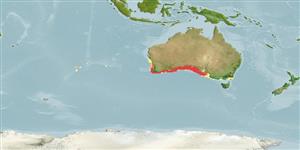
| Native range | All suitable habitat | Point map | Year 2050 |
|
| This map was computer-generated and has not yet been reviewed. |
| Neosebastes pandus AquaMaps Data sources: GBIF OBIS |
อัพโหลดของคุณ ภาพถ่าย และ วิดีโอ
รูปภาพหลายรูป | Google image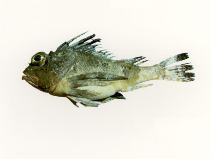 Neosebastes pandus
ภาพโดย CSIRO
รูปภาพหลายรูป | Google image
ภาพโดย CSIRO
การจำแนกประเภท / ชื่อ ชื่อสามัญ | ชื่อพ้อง | Catalog of Fishes(สกุล, ชนิด) | ITIS | CoL | WoRMS | Cloffa
> Perciformes/Scorpaenoidei (Scorpionfishes) > Neosebastidae (Gurnard scorpionfishes)
Etymology: Neosebastes: Greek, neos = new + Greek, sebastes = august, venerable (Ref. 45335).
More on author: Richardson.
Etymology: Neosebastes: Greek, neos = new + Greek, sebastes = august, venerable (Ref. 45335).
More on author: Richardson.
สิ่งแวดล้อม : สิ่งแวดล้อม / เขตภูมิอากาศ / ระดับความลึก / ระยะการกระจายสินค้า นิเวศวิทยา
เกี่ยวกับทะเล,น้ำเค็ม เกี่ยวกับหินโสโครก; ระดับความลึก 15 - 593 m (Ref. 54394), usually 50 - 200 m (Ref. 33839). Subtropical; 28°S - 39°S
การแพร่กระจาย อาณาเขต | พื้นที่จำแนกตาม FAO | ระบบนิเวศหลายระบบ | การปรากฏขึ้น,การเกิดขึ้น,พบ | ตำแหน่งบนแผนที่ | การแนะนำ | Faunafri
Eastern Indian Ocean: southern and southwestern coasts of Australia.
ขนาด / น้ำหนัก / อายุ
คำอธิบายสั้นๆ เครื่องมือที่ใช้ในการแยกชนิดสัตว์,สิ่งมีชีวิตออกจากกัน | สัณฐานวิทยา | ความยาวต่างๆ
เงี่ยงครีบหลัง (รวม) : 8; ก้านครีบอ่อนที่หาง (รวม) : 8 - 9; เงี่ยงครีบก้น: 3; ก้านครีบอ่อนที่ก้น: 5; สัตว์มีกระดูกสันหลัง: 26. Diagnosis: Dorsal fin XIII, 8 (9 in 1 of 56 specimens), third spine longest. Anal rays III, 5. Pectoral rays 20-23 (mode 21), distal margin rounded. Pored lateral-line scales 36-43 (40); longitudinal scale series 60-72 (62); scale rows between base of last dorsal spine and lateral line 5-7 (6). Well-developed gill rakers on upper limb 0 or 1 (1), lower limb 4-7 (6), total 5-8 (7); rudimentary gill rakers on upper limb 3-5 (4), lower limb 4-8 (5). Swim bladder weakly bilobed anteriorly and posteriorly, lobes separated by a concavity (length 16% of SL, width 13% of SL). Dorsal profile of snout steep, forming angle of about 65-750 to horizontal axis of head and body. Nasal spine simple, directed upward or slightly forward, length of former approximately equal to or slightly greater than anterior nostril diameter. Posterior margin of premaxilla ascending process reaching or extending slightly beyond level of anterior margin of posterior nostril when mouth closed. Interorbital ridge indistinct; no scales on mid interorbital space, but small embedded scales present on supraorbital above interorbital ridge; interorbital space extremely deep, about one-third to a half of orbit extending above dorsal profile of head. Preocular with a small simple spine, its length less than that of nasal spine. Supraocular ridge with 3-11 pointed spines (sometimes serrated), canted laterally; supraocular ridge much closer to orbit than interorbital ridge in dorsal view; preocular and supraocular spines indistinct in larger specimens. Sphenotic with 3-13 minute pointed spines. Postorbital spine flattened and serrated. Long, narrow and extremely deep transversal occipital pit, not covered with scales. Nuchal and pterotic spines simple (sometimes pterotic spine with 2-4 points), distal margins serrated or smooth; origin of pterotic spine slightly posterior to that of nuchal spine, base slightly smaller than or equal to that of latter. Upper posttemporal spine flattened and serrated; lower posttemporal spine simple (sometimes with 2 points). Supracleithral spine simple. Posterior margin of maxilla not reaching a vertical at posterior margin of orbit; maxilla with scales extending posteriorly from between anterior and posterior lacrimal spines, but no scales on posterior margin. Underside of mandible smooth with 3 distinct pores on each side. Lacrimal ridge distinct with 1-6 points, sometimes smooth; anterior lacrimal spine simple (sometimes with 2 points), directed downward; posterior lacrimal spine with 2-5 points, directed ventroposteriorly; length of anterior lacrimal spine 2 times or more in that of posterior lacrimal spine. Suborbital pit present, front rimmed by a vertical (sometimes oblique) ridge on lacrimal to ventroanterior margin of orbit; no scales on anterior part of suborbital pit; suborbital ridge with 2 pointed spines in line with lacrimal ridge, spines separated at bases, directed backward; a spine sometimes arising from each suborbital spine; suborbital ridge indistinct in larger specimens; embedded scales 3-5 present between ventral margin of orbit and suborbital ridge; suborbital scales not extending onto eye membrane; preopercle with 5 spines (rarely 6 or 7 spines), 4 lower spines simple, lacking a median ridge, uppermost spine with a median ridge and with a spine distally. Length of uppermost preopercular spine less than pupil diameter; upper opercular spine simple, lacking a median ridge; lower opercular spine with a median ridge and a spine arising from latter; pectoral fin long, posterior tip extending well beyond a vertical at middle of base of dorsal-fin soft rays. Small distinct black spots on the lateral surface of head (except opercle), interorbital space, occipital pit, on lateral line and around lateral line posteriorly on body and caudal peduncle (Ref. 54394).
Body shape (shape guide): short and / or deep.
Body shape (shape guide): short and / or deep.
วงจรชีวิตและพฤติกรรมการผสมพันธุ์ วัยเจริญพันธุ์ | การสืบพันธุ์ | การวางไข่ | เซลสืบพันธ์ของเพศเมีย(ไข่) | ความดกของไข่ | ตัวอ่อน
อ้างอิงหลัก
อัพโหลดข้อมูลอ้างอิงของคุณ | อ้างอิง | ผู้ประสานงาน | ผู้ร่วมมือ
Motomura, H., 2003. Revision of the scorpionfish genus Neosebastes (Scorpaeniformes: Neosebastidae), with descriptions of five new species. Indo-Pac. Fish. (37):46 p. (Ref. 54394)
CITES
Not Evaluated
ภัยคุกคามต่อมนุษย์
Venomous (Ref. 9563)
การใช้ของมนุษย์
FAO - Publication: search | FishSource |
ข้อมูลเพิ่มเติม
นิเวศวิทยาเขตร้อน
รายการอาหาร (เหยื่อ)
องค์ประอบของอาหาร
การบริโภคอาหาร
การจัดสรรอาหาร
ผู้ล่า
รายการอาหาร (เหยื่อ)
องค์ประอบของอาหาร
การบริโภคอาหาร
การจัดสรรอาหาร
ผู้ล่า
พลวัตของประชากร
พารามิเตอร์การเจริญเติบโต
อายุสูงสุด / ขนาด
ความยาว-น้ำหนักสัมพันธ์
ความยาว-ความยาวสัมพันธ์
ความยาว-ความถี่
การแปลงมวล
การทดแทนที่
อุดมสมบรูณ์
พารามิเตอร์การเจริญเติบโต
อายุสูงสุด / ขนาด
ความยาว-น้ำหนักสัมพันธ์
ความยาว-ความยาวสัมพันธ์
ความยาว-ความถี่
การแปลงมวล
การทดแทนที่
อุดมสมบรูณ์
วงจรชีวิต
การสืบพันธุ์
วัยเจริญพันธุ์
ความสมบูรณ์พันธุ์/เหงือกที่เกี่ยวข้อง
ความดกของไข่
การวางไข่
การรวมตัวของสปอน
เซลสืบพันธ์ของเพศเมีย(ไข่)
การพัฒนาไข่
ตัวอ่อน
พลวัตของสัตว์น้ำวัยอ่อน
การสืบพันธุ์
วัยเจริญพันธุ์
ความสมบูรณ์พันธุ์/เหงือกที่เกี่ยวข้อง
ความดกของไข่
การวางไข่
การรวมตัวของสปอน
เซลสืบพันธ์ของเพศเมีย(ไข่)
การพัฒนาไข่
ตัวอ่อน
พลวัตของสัตว์น้ำวัยอ่อน
การแพร่กระจาย
อาณาเขต
พื้นที่จำแนกตาม FAO
ระบบนิเวศหลายระบบ
การปรากฏขึ้น,การเกิดขึ้น,พบ
การแนะนำ
BRUVS - วิดีโอ
อาณาเขต
พื้นที่จำแนกตาม FAO
ระบบนิเวศหลายระบบ
การปรากฏขึ้น,การเกิดขึ้น,พบ
การแนะนำ
BRUVS - วิดีโอ
กายวิภาคศาสตร์
พื้นที่เหงือก
สมอง
หินโสต
พื้นที่เหงือก
สมอง
หินโสต
สรีรวิทยา
องค์ประกอบของร่างกาย
สารอาหาร
การใช้ออกซิเจน
ประเภทการว่ายน้ำ
ระดับความเร็วในการว่ายน้ำ
เม็ดสีที่มองเห็นได้
เสียงปลา
โรคและปรสิต
ความเป็นพิษ (LC50s)
องค์ประกอบของร่างกาย
สารอาหาร
การใช้ออกซิเจน
ประเภทการว่ายน้ำ
ระดับความเร็วในการว่ายน้ำ
เม็ดสีที่มองเห็นได้
เสียงปลา
โรคและปรสิต
ความเป็นพิษ (LC50s)
พันธุศาสตร์
จีโนม
พันธุศาสตร์
ความไม่สมดุลทางเชื้อชาติ
อัตราพันธุกรรม
ความหลากหลายทางพันธุกรรม
จีโนม
พันธุศาสตร์
ความไม่สมดุลทางเชื้อชาติ
อัตราพันธุกรรม
ความหลากหลายทางพันธุกรรม
เกี่ยวข้องกับมนุษย์
ระบบการเพาะเลี้ยงสัตว์น้ำ
ประวัติการเพาะเลี้ยงสัตว์น้ำ
สายพันธุ์
กรณีซิเกวเทอรา
แสตมป์ เหรียญ อื่นๆ
ระบบการเพาะเลี้ยงสัตว์น้ำ
ประวัติการเพาะเลี้ยงสัตว์น้ำ
สายพันธุ์
กรณีซิเกวเทอรา
แสตมป์ เหรียญ อื่นๆ
เครื่องมือ
หนังสืออิเล็กทรอนิกส์ | คู่มือภาคสนาม | ผู้มีความชำนาญในเรื่องความถี่ของความยาว | เครื่องมือในการศึกษาชีวประวัติ | ตำแหน่งบนแผนที่ |
จับ-MSY |
รายงานพิเศษ
ตรวจสอบการบำรุงรักษาตู้ปลา | ตรวจสอบเอกสารข้อเท็จจริงเกี่ยวกับสายพันธุ์ | ตรวจสอบเอกสารข้อเท็จจริงเกี่ยวกับการเพาะเลี้ยงสัตว์น้ำ
ดาวน์โหลด XML
หน้าสรุป | ข้อมูลสำคัญ | ชื่อสามัญ | ภาพถ่าย
แหล่งที่มาจากอินเตอร์เน็ต
AFORO (otoliths) | Aquatic Commons | BHL | Cloffa | Websites from users | Check FishWatcher | CISTI | Catalog of Fishes: สกุล, ชนิด | DiscoverLife | ECOTOX | FAO - Publication: search | Faunafri | Fishipedia | Fishtrace | GloBI | Google Books | Google Scholar | Google | IGFA World Record | OneZoom | Open Tree of Life | Otolith Atlas of Taiwan Fishes | PubMed | Reef Life Survey | Socotra Atlas | TreeBase | แผนภูมิชีวิตแบบต้นไม้ | Wikipedia: Go, ค้นหา | World Records Freshwater Fishing | บันทึกทางด้านสัตววิทยา
การประมาณค่าตามแบบจำลอง
อุณหภูมิที่ต้องการ (อ้างอิง 123201): 14.3 - 18.2, mean 16.6 °C (based on 64 cells).
ดัชนีความหลากหลายทางวิวัฒนาการ (อ้างอิง 82804): PD50 = 0.5002 [Uniqueness, from 0.5 = low to 2.0 = high].
Bayesian length-weight: a=0.01995 (0.00906 - 0.04395), b=3.01 (2.83 - 3.19), in cm total length, based on all LWR estimates for this body shape (Ref. 93245).
ระดับชั้นอาหาร (อ้างอิง 69278): 3.9 ±0.4 se; based on size and trophs of closest relatives
สารอาหาร (Ref. 124155): Calcium = 23.8 [9.4, 67.1] mg/100g; Iron = 0.549 [0.254, 1.115] mg/100g; Protein = 18.2 [16.6, 19.8] %; Omega3 = 0.27 [0.11, 0.88] g/100g; Selenium = 31.9 [14.2, 76.5] μg/100g; VitaminA = 26.8 [6.3, 117.6] μg/100g; Zinc = 0.65 [0.42, 1.01] mg/100g (wet weight);