



Neosebastes pandus (Richardson, 1842)
Bighead gurnard perch
Lägg till din observation i Fish Watcher
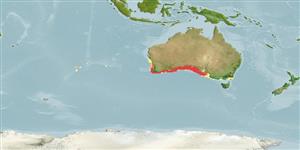
| Native range | All suitable habitat | Point map | Year 2050 |
|
| This map was computer-generated and has not yet been reviewed. |
| Neosebastes pandus AquaMaps Data sources: GBIF OBIS |
Ladda upp din foton och Videor
Bilder | Google image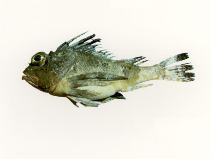 Neosebastes pandus
Bild av CSIRO
Bilder | Google image
Bild av CSIRO
Klassificering / Namn Populärnamn | synonymer | Catalog of Fishes(Släkte, Arter) | ITIS | CoL | WoRMS | Cloffa
> Perciformes/Scorpaenoidei (Scorpionfishes) > Neosebastidae (Gurnard scorpionfishes)
Etymology: Neosebastes: Greek, neos = new + Greek, sebastes = august, venerable (Ref. 45335).
More on author: Richardson.
Etymology: Neosebastes: Greek, neos = new + Greek, sebastes = august, venerable (Ref. 45335).
More on author: Richardson.
Miljö: miljö / Klimatzon / djupintervall / distributionsområde Ekologi
marina revassocierade; djupintervall 15 - 593 m (Ref. 54394), usually 50 - 200 m (Ref. 33839). Subtropical; 28°S - 39°S
Utbredning Territorier | FAO områden | Ekosystem | Förekomster | Prickkarta | Utplanteringar | Faunafri
Eastern Indian Ocean: southern and southwestern coasts of Australia.
Storlek / Vikt / Ålder
Kort beskrivning Bestämningsnycklar | Morfologi | Morfometri
Taggstrålar i ryggfenan (totalt) : 8; Mjukstrålar i ryggfenan (totalt) : 8 - 9; Taggstrålar i analfenan: 3; Mjukstrålar i analfenan: 5; Ryggkotor: 26. Diagnosis: Dorsal fin XIII, 8 (9 in 1 of 56 specimens), third spine longest. Anal rays III, 5. Pectoral rays 20-23 (mode 21), distal margin rounded. Pored lateral-line scales 36-43 (40); longitudinal scale series 60-72 (62); scale rows between base of last dorsal spine and lateral line 5-7 (6). Well-developed gill rakers on upper limb 0 or 1 (1), lower limb 4-7 (6), total 5-8 (7); rudimentary gill rakers on upper limb 3-5 (4), lower limb 4-8 (5). Swim bladder weakly bilobed anteriorly and posteriorly, lobes separated by a concavity (length 16% of SL, width 13% of SL). Dorsal profile of snout steep, forming angle of about 65-750 to horizontal axis of head and body. Nasal spine simple, directed upward or slightly forward, length of former approximately equal to or slightly greater than anterior nostril diameter. Posterior margin of premaxilla ascending process reaching or extending slightly beyond level of anterior margin of posterior nostril when mouth closed. Interorbital ridge indistinct; no scales on mid interorbital space, but small embedded scales present on supraorbital above interorbital ridge; interorbital space extremely deep, about one-third to a half of orbit extending above dorsal profile of head. Preocular with a small simple spine, its length less than that of nasal spine. Supraocular ridge with 3-11 pointed spines (sometimes serrated), canted laterally; supraocular ridge much closer to orbit than interorbital ridge in dorsal view; preocular and supraocular spines indistinct in larger specimens. Sphenotic with 3-13 minute pointed spines. Postorbital spine flattened and serrated. Long, narrow and extremely deep transversal occipital pit, not covered with scales. Nuchal and pterotic spines simple (sometimes pterotic spine with 2-4 points), distal margins serrated or smooth; origin of pterotic spine slightly posterior to that of nuchal spine, base slightly smaller than or equal to that of latter. Upper posttemporal spine flattened and serrated; lower posttemporal spine simple (sometimes with 2 points). Supracleithral spine simple. Posterior margin of maxilla not reaching a vertical at posterior margin of orbit; maxilla with scales extending posteriorly from between anterior and posterior lacrimal spines, but no scales on posterior margin. Underside of mandible smooth with 3 distinct pores on each side. Lacrimal ridge distinct with 1-6 points, sometimes smooth; anterior lacrimal spine simple (sometimes with 2 points), directed downward; posterior lacrimal spine with 2-5 points, directed ventroposteriorly; length of anterior lacrimal spine 2 times or more in that of posterior lacrimal spine. Suborbital pit present, front rimmed by a vertical (sometimes oblique) ridge on lacrimal to ventroanterior margin of orbit; no scales on anterior part of suborbital pit; suborbital ridge with 2 pointed spines in line with lacrimal ridge, spines separated at bases, directed backward; a spine sometimes arising from each suborbital spine; suborbital ridge indistinct in larger specimens; embedded scales 3-5 present between ventral margin of orbit and suborbital ridge; suborbital scales not extending onto eye membrane; preopercle with 5 spines (rarely 6 or 7 spines), 4 lower spines simple, lacking a median ridge, uppermost spine with a median ridge and with a spine distally. Length of uppermost preopercular spine less than pupil diameter; upper opercular spine simple, lacking a median ridge; lower opercular spine with a median ridge and a spine arising from latter; pectoral fin long, posterior tip extending well beyond a vertical at middle of base of dorsal-fin soft rays. Small distinct black spots on the lateral surface of head (except opercle), interorbital space, occipital pit, on lateral line and around lateral line posteriorly on body and caudal peduncle (Ref. 54394).
Body shape (shape guide): short and / or deep.
Body shape (shape guide): short and / or deep.
Livscykel och parningsbeteende Könsmognad | Reproduktion | Lek | Ägg | Fekunditet | Larver
Huvudreferens
Ladda upp dina referenser | referenser | Koordinator | Medarbetare
Motomura, H., 2003. Revision of the scorpionfish genus Neosebastes (Scorpaeniformes: Neosebastidae), with descriptions of five new species. Indo-Pac. Fish. (37):46 p. (Ref. 54394)
CITES
Not Evaluated
Hot mot människor
Venomous (Ref. 9563)
Mänskliga användningsområden
FAO - Publication: search | FishSource |
Ytterligare information
Trofisk ekologi
Livsmedelsartiklar (preys)
Födosammansättning
Födointag
Matransoner
Predatorer
Livsmedelsartiklar (preys)
Födosammansättning
Födointag
Matransoner
Predatorer
Populationsdynamik
Tillväxtparametrar
Max. åldrar / storlekar
Längd-vikt rel.
Längd-längd rel.
Längd-frekvenser
Massakonvertering
Rekrytering
Abundans
Tillväxtparametrar
Max. åldrar / storlekar
Längd-vikt rel.
Längd-längd rel.
Längd-frekvenser
Massakonvertering
Rekrytering
Abundans
Livscykel
Reproduktion
Könsmognad
Mognad/Gills rel.
Fekunditet
Lek
Lekande aggregat
Ägg
Utveckling av ägg
Larver
Larvdynamik
Reproduktion
Könsmognad
Mognad/Gills rel.
Fekunditet
Lek
Lekande aggregat
Ägg
Utveckling av ägg
Larver
Larvdynamik
Anatomi
Gälyta
Hjärna
Otolit
Gälyta
Hjärna
Otolit
Fysiologi
Kroppssammansättning
Näringsämnen
Syreförbrukning
Typ av simning
Simhastighet
Visuella pigment
Ljud från fisk
Sjukdomar & Parasiter
Toxicitet (LC50)
Kroppssammansättning
Näringsämnen
Syreförbrukning
Typ av simning
Simhastighet
Visuella pigment
Ljud från fisk
Sjukdomar & Parasiter
Toxicitet (LC50)
Genetik
Genom
Genetik
Heterozygositet
Ärftlighet
Genetisk mångfald
Genom
Genetik
Heterozygositet
Ärftlighet
Genetisk mångfald
Människorelaterad
Vattenbrukssystem
Vattenbruksprofiler
Avelslinjer
Ciguatera-fall
Frimärken, mynt, diverse.
Vattenbrukssystem
Vattenbruksprofiler
Avelslinjer
Ciguatera-fall
Frimärken, mynt, diverse.
Verktyg
Särskilda rapporter
Kontrollera för underhåll av akvarium | Kontrollera om det finns faktablad om arter | Kontrollera om det finns faktablad om vattenbruk
Ladda ner XML
Internet-källor
AFORO (otoliths) | Aquatic Commons | BHL | Cloffa | Websites from users | Check FishWatcher | CISTI | Catalog of Fishes: Släkte, Arter | DiscoverLife | ECOTOX | FAO - Publication: search | Faunafri | Fishipedia | Fishtrace | GloBI | Google Books | Google Scholar | Google | IGFA World Record | OneZoom | Open Tree of Life | Otolith Atlas of Taiwan Fishes | PubMed | Reef Life Survey | Socotra Atlas | TreeBase | Tree of Life | Wikipedia: Go, sök | World Records Freshwater Fishing | Zoologiskt register
Uppskattningar baserade på modeller
Önskad temperatur (Ref. 123201): 14.3 - 18.2, mean 16.6 °C (based on 64 cells).
Index för fylogenetisk mångfald (Ref. 82804): PD50 = 0.5002 [Uniqueness, from 0.5 = low to 2.0 = high].
Bayesian length-weight: a=0.01995 (0.00906 - 0.04395), b=3.01 (2.83 - 3.19), in cm total length, based on all LWR estimates for this body shape (Ref. 93245).
Trofisk nivå (Ref. 69278): 3.9 ±0.4 se; based on size and trophs of closest relatives
Näringsämnen (Ref. 124155): Calcium = 23.8 [9.4, 67.1] mg/100g; Iron = 0.549 [0.254, 1.115] mg/100g; Protein = 18.2 [16.6, 19.8] %; Omega3 = 0.27 [0.11, 0.88] g/100g; Selenium = 31.9 [14.2, 76.5] μg/100g; VitaminA = 26.8 [6.3, 117.6] μg/100g; Zinc = 0.65 [0.42, 1.01] mg/100g (wet weight);