



Ladda upp din foton och Videor
Bilder | Google image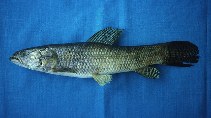 Hoplias microlepis
Bild av Béarez, P.
Bilder | Google image
Bild av Béarez, P.
Klassificering / Namn Populärnamn | synonymer | Catalog of Fishes(Släkte, Arter) | ITIS | CoL | WoRMS | Cloffa
> Characiformes (Characins) > Erythrinidae (Trahiras)
Etymology: Hoplias: Greek, hoplon = weapon (Ref. 45335).
More on author: Günther.
Etymology: Hoplias: Greek, hoplon = weapon (Ref. 45335).
More on author: Günther.
Taxonomic Remarks
See Eigenmann & Eigenmann (1889:102) for key of identification and description.
Miljö: miljö / Klimatzon / djupintervall / distributionsområde Ekologi
; sötvatten bentopelagisk. Tropical; 26°C - 28°C (Ref. 36880)
Utbredning Territorier | FAO områden | Ekosystem | Förekomster | Prickkarta | Utplanteringar | Faunafri
Central and South America: Pacific drainages of Panama; records in the Atlantic coast of Panama are restricted to the Canal Zone, suggesting dispersal through the Panama Canal; Puntarenas in southwestern Costa Rica; río Guayas basin in Ecuador and río Tumbes in northwestern Peru (Ref. 96873); and Colombia (Ref. 37025).
Storlek / Vikt / Ålder
Kort beskrivning Bestämningsnycklar | Morfologi | Morfometri
Mjukstrålar i ryggfenan (totalt) : 13 - 15; Ryggkotor: 42 - 45. Hoplias microlepis is distinguished from all congeners, except species of H. malabaricus group, by the the shape of the dentaries abruptly converging towards the mandibular symphysis (vs. dentaries parallel and only gently converging towards the mandibular symphysis) and by having tooth plates on tongue (vs. absence of tooth plates on tongue). H. microlepis can be separated from H. brasiliensis and H. curupira by having 43-47 scales on lateral line (vs. 38-43 and 34-39, respectively), and from H. australis and H. lacerdae by having 4 pores of the laterosensory system along the ventral surface of dentary (vs. always 5 and 6-8 respectively). It differs from H. aimara by having accessory ectopterygoid and by lacking vertically elongate dark spot on the opercular membrane (vs. absence of accessory ectopterygoid and presence of dark spot). It can be diagnosed from the other members of the H. malabaricus species group by having more circumpeduncular scales (22-24, usually 24 vs. 18-20, usually 20) (Ref. 96873).
Body shape (shape guide): elongated.
Body shape (shape guide): elongated.
Inhabits rivers (Ref. 96873). Collected in creeks and swamps in areas of little or no current on sand and mud bottoms. Lives between 20 and 40 m elevation. Piscivorous (Ref. 36880). Reported to reach 50.0 cm TL (Ref. 9585).
Livscykel och parningsbeteende Könsmognad | Reproduktion | Lek | Ägg | Fekunditet | Larver
Huvudreferens
Ladda upp dina referenser | referenser | Koordinator : Oyakawa, Osvaldo T. | Medarbetare
Mattox, G.M.T., A.G. Bifi and O.T. Oyakawa, 2014. Taxonomic study of Hoplias microlepis (Günther, 1864), a trans-Andean species of trahiras (Ostariophysi: Characiformes: Erythrinidae). Neotrop. Ichthyol. 12(2):343-352. (Ref. 96873)
Status på IUCN:s rödlista (Ref. 130435: Version 2025-2 (Global))
Least Concern (LC) ; Date assessed: 01 April 2019
CITES
Not Evaluated
Hot mot människor
Harmless
Mänskliga användningsområden
Fiskeri: kommersiell
FAO - Publication: search | FishSource |
Ytterligare information
Populationsdynamik
Tillväxtparametrar
Max. åldrar / storlekar
Längd-vikt rel.
Längd-längd rel.
Längd-frekvenser
Massakonvertering
Rekrytering
Abundans
Tillväxtparametrar
Max. åldrar / storlekar
Längd-vikt rel.
Längd-längd rel.
Längd-frekvenser
Massakonvertering
Rekrytering
Abundans
Livscykel
Reproduktion
Könsmognad
Mognad/Gills rel.
Fekunditet
Lek
Lekande aggregat
Ägg
Utveckling av ägg
Larver
Larvdynamik
Reproduktion
Könsmognad
Mognad/Gills rel.
Fekunditet
Lek
Lekande aggregat
Ägg
Utveckling av ägg
Larver
Larvdynamik
Anatomi
Gälyta
Hjärna
Otolit
Gälyta
Hjärna
Otolit
Fysiologi
Kroppssammansättning
Näringsämnen
Syreförbrukning
Typ av simning
Simhastighet
Visuella pigment
Ljud från fisk
Sjukdomar & Parasiter
Toxicitet (LC50)
Kroppssammansättning
Näringsämnen
Syreförbrukning
Typ av simning
Simhastighet
Visuella pigment
Ljud från fisk
Sjukdomar & Parasiter
Toxicitet (LC50)
Genetik
Genom
Genetik
Heterozygositet
Ärftlighet
Genetisk mångfald
Genom
Genetik
Heterozygositet
Ärftlighet
Genetisk mångfald
Människorelaterad
Vattenbrukssystem
Vattenbruksprofiler
Avelslinjer
Ciguatera-fall
Frimärken, mynt, diverse.
Vattenbrukssystem
Vattenbruksprofiler
Avelslinjer
Ciguatera-fall
Frimärken, mynt, diverse.
Verktyg
Särskilda rapporter
Kontrollera för underhåll av akvarium | Kontrollera om det finns faktablad om arter | Kontrollera om det finns faktablad om vattenbruk
Ladda ner XML
Internet-källor
AFORO (otoliths) | Aquatic Commons | BHL | Cloffa | Websites from users | Check FishWatcher | CISTI | Catalog of Fishes: Släkte, Arter | DiscoverLife | ECOTOX | FAO - Publication: search | Faunafri | Fishipedia | Fishtrace | GloBI | Google Books | Google Scholar | Google | IGFA World Record | OneZoom | Open Tree of Life | OsteoBase: skull, spine | Otolith Atlas of Taiwan Fishes | PubMed | Reef Life Survey | Socotra Atlas | TreeBase | Tree of Life | Wikipedia: Go, sök | World Records Freshwater Fishing | Zoologiskt register
Uppskattningar baserade på modeller
Index för fylogenetisk mångfald (Ref. 82804): PD50 = 0.5000 [Uniqueness, from 0.5 = low to 2.0 = high].
Bayesian length-weight: a=0.00676 (0.00304 - 0.01503), b=3.12 (2.93 - 3.31), in cm total length, based on LWR estimates for this (Sub)family-body shape (Ref. 93245).
Trofisk nivå (Ref. 69278): 4.5 ±0.80 se; based on food items.
Resiliens (Ref. 120179): Mellan, lägsta populationsfördubblingstid 1,4-4,4 år (Preliminary K or Fecundity.).