This website uses cookies to enhance your browsing experience and ensure the functionality of our site. For more detailed information about the types of cookies we use and how we protect your privacy, please visit our Privacy Information page.
×
Cookie Settings
This website uses different types of cookies to enhance your experience. Please select your preferences below:
> Eupercaria/misc (Various families in series Eupercaria) > Lutjanidae (Snappers) > Lutjaninae
Etymology: Lutjanus:Malay, ikan lutjan, name of a fish. More on author: Cuvier.
Entorno: milieu / zona climática / rango de profundidad / gama de distribución Ecología
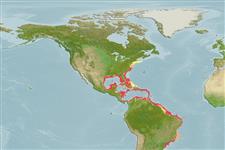
marino; salobre asociado a arrecife; rango de profundidad 25 - 95 m (Ref. 9626), usually 40 - 70 m (Ref. 9626). Tropical; 20°C - 28°C; 42°N - 28°S, 98°W - 31°W (Ref. 55226)
Western Atlantic: Massachusetts, USA and Bermuda (Anderson, pers. comm.) to southeastern Brazil, including the Caribbean Sea and the Gulf of Mexico (Ref. 9626). Most abundant around the Antilles, the Bahamas and off southern Florida.
Longitud en la primera madurez / Tamaño / Peso / Edad
Madurez: Lm43.8, range 28 - 40 cm Max length : 94.0 cm TL macho / no sexado; (Ref. 40637); common length : 50.0 cm TL macho / no sexado; (Ref. 55); peso máximo publicado: 15.6 kg (Ref. 26340); edad máxima reportada: 29 años (Ref. 46200)
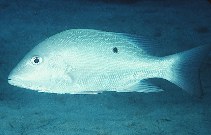
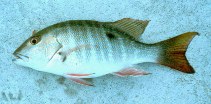
Espinas dorsales (total) : 10 - 11; Radios blandos dorsales (total) : 13 - 14; Espinas anales: 3; Radios blandos anales: 7 - 8. Preopercular notch and knob weak. Pectoral fins are long, reaching level of anus. Scale rows on back rising obliquely above lateral line. Back and upper sides olive green, whitish with a red tinge on lower sides and belly. A black spot is on the upper back just above the lateral line and below the anterior dorsal fin rays. A pair of blue stripes runs on the snout-cheek region, the upper continuing behind eye to upper opercle edge. Body shape (shape guide): fusiform / normal; Cross section: oval.
Adults occur in continental shelf areas as well as clear waters around islands (Ref. 5217). Large adults usually among rocks and coral while juveniles occur over sandy, vegetated (usually Thalassia) bottoms (Ref. 5217). They form small aggregations which disband during the night (Ref. 55). Feed both day and night on fishes, shrimps, crabs, cephalopods, and gastropods (Ref. 55). Flesh considered good quality (Ref. 55). Marketed mainly fresh or frozen (Ref. 55). Traded as an aquarium fish at Clara, Brazil (Ref. 49392).
Allen, G.R., 1985. FAO Species Catalogue. Vol. 6. Snappers of the world. An annotated and illustrated catalogue of lutjanid species known to date. FAO Fish. Synop. 125(6):208 p. Rome: FAO. (Ref. 55)
Situación en la Lista Roja de la UICN (Ref. 130435: Version 2025-2 (Global))
Fisiología Composición corporal Nutrientes Consumo del oxígeno Tipo de natación Velocidad de natación Pigmentos visuales Sonido de peces Enfermedades y parásitos Toxicidad (CL50)