



Hemisorubim platyrhynchos (Valenciennes, 1840)
Porthole shovelnose catfish
Hochladen Photos und videos
Bilder | Google Bild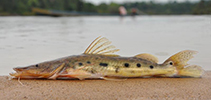 Hemisorubim platyrhynchos
Photo von Sabaj Pérez, M.H.
Bilder | Google Bild
Photo von Sabaj Pérez, M.H.
Klassifizierung / Names Namen | Synonyme | Catalog of Fishes(Gattung, Arten) | ITIS | CoL | WoRMS | Cloffa
> Siluriformes (Catfishes) > Pimelodidae (Long-whiskered catfishes)
Etymology: Hemisorubim: Greek, hemi = half + Brazilian local name, sorubim (Ref. 45335).
More on author: Valenciennes.
Etymology: Hemisorubim: Greek, hemi = half + Brazilian local name, sorubim (Ref. 45335).
More on author: Valenciennes.
Umwelt: Milieu / Klimazone / Tiefenbereich / Verbreitungsgebiet Ökologie
; süßwasser demersal; pH range: 6.0 - 7.8; dH range: ? - 25. Subtropical; 20°C - 22°C (Ref. 2060)
Verbreitung Territorien | FAO Gebiete | Ökosysteme | Vorkommen | Punkt Karte | Einführungen | Faunafri
South America: Amazon, Maroni, Orinoco, and Paraná River basins.
Länge bei der ersten Reifung / Größe / Gewicht / Alter
Geschlechtsreife: Lm 31.6 range ? - ? cm
Max length : 61.0 cm TL (female); max. veröff. Gewicht: 2.7 kg (Ref. 111728)
Max length : 61.0 cm TL (female); max. veröff. Gewicht: 2.7 kg (Ref. 111728)
Kurzbeschreibung Bestimmungsschlüssel | Morphologie | Morphometrie
Body shape (shape guide): elongated.
Rather rare, confined to the deeper and slow-moving parts of large rivers together with some Loricaria and Potamotrygon. Its body shape and color pattern are perfectly adapted to the muddy bottom where they stay (Ref. 35381). Feeds on benthic organisms and fish. The position of the eyes and the shape of the mouth of this piscivorous fish give to its stalking mode of hunting (Ref. 35381).
Lebenszyklus und Paarungsverhalten Geschlechtsreife | Fortpflanzung | Ablaichen | Eier | Fruchtbarkeit | Larven
Hauptreferenz
Laden Sie Ihre Referenzen hoch | Referenzen | Koordinator | Partner
Lundberg, J.G. and M.W. Littmann, 2003. Pimelodidae (Long-whiskered catfishes). p. 432-446. In R.E. Reis, S.O. Kullander and C.J. Ferraris, Jr. (eds.) Checklist of the Freshwater Fishes of South and Central America. Porto Alegre: EDIPUCRS, Brasil. (Ref. 36506)
IUCN Rote Liste Status (Ref. 130435: Version 2025-2 (Global))
nicht bedroht (LC) ; Date assessed: 16 December 2020
CITES
Not Evaluated
Bedrohung für Menschen
Harmless
Nutzung durch Menschen
Fischereien: kommerziell; Aquarium: Öffentliche Aquarien
FAO - Publication: search | FishSource |
Mehr Information
Trophische Ökologie
Lebensmittel (Beutetiere)
Nahrungszusammensetzung
Nahrungsaufnahme
Lebensmittelrationen
Räuber
Lebensmittel (Beutetiere)
Nahrungszusammensetzung
Nahrungsaufnahme
Lebensmittelrationen
Räuber
Populationsdynamik
Wachstumsparameter
Max. Alter/Größen
Länge-Gewicht-Rel.
Länge-Länge-Verhältnis.
Längenhäufigkeiten
Massenkonvertierung
Rekrutierung
Dichte
Wachstumsparameter
Max. Alter/Größen
Länge-Gewicht-Rel.
Länge-Länge-Verhältnis.
Längenhäufigkeiten
Massenkonvertierung
Rekrutierung
Dichte
Lebenszyklus
Fortpflanzung
Geschlechtsreife
Reifung/Kiemen rel.
Fruchtbarkeit
Ablaichen
Laichaggregationen
Eier
Eientwicklung
Larven
Larven Pop.Dyn.
Fortpflanzung
Geschlechtsreife
Reifung/Kiemen rel.
Fruchtbarkeit
Ablaichen
Laichaggregationen
Eier
Eientwicklung
Larven
Larven Pop.Dyn.
Anatomie
Kiemenoberfläche
Gehirn
Otolith
Kiemenoberfläche
Gehirn
Otolith
Physiologie
Körperliche Zusammensetzung
Nährstoffe
Sauerstoffverbrauch
Schwimmart
Schwimmgeschwindigkeit
Visuelle Pigmente
Fischgeräusche
Krankheiten und Parasiten
Toxizität (LC50s)
Körperliche Zusammensetzung
Nährstoffe
Sauerstoffverbrauch
Schwimmart
Schwimmgeschwindigkeit
Visuelle Pigmente
Fischgeräusche
Krankheiten und Parasiten
Toxizität (LC50s)
Menschenbezogen
Aquakultur-Systeme
Aquakultur Profile
Zuchtlinien
Ciguatera-Fälle
Briefmarken, Münzen, Verschiedenes.
Aquakultur-Systeme
Aquakultur Profile
Zuchtlinien
Ciguatera-Fälle
Briefmarken, Münzen, Verschiedenes.
Tools
Zusatzinformationen
Download XML
Zusammenfassung | Punktdaten | Namen | Photos
Internet Quellen
AFORO (otoliths) | Aquatic Commons | BHL | Cloffa | Websites from users | FishWatcher Einträge suchen | CISTI | Catalog of Fishes: Gattung, Arten | DiscoverLife | ECOTOX | FAO - Publication: search | Faunafri | Fishipedia | Fishtrace | GloBI | Google Books | Google Scholar | Google | IGFA World Record | Nationale Datenbanken | OneZoom | Open Tree of Life | Otolith Atlas of Taiwan Fishes | PubMed | Reef Life Survey | Socotra Atlas | TreeBase | Tree of Life | Wikipedia: Gehe zu, Suchen | World Records Freshwater Fishing | Zoologischer Rekord
Schätzungen auf der Grundlage von Modellen
Phylogenetischer Diversitätsindex (Ref. 82804): PD50 = 1.0000 [Uniqueness, from 0.5 = low to 2.0 = high].
Bayesian length-weight: a=0.00692 (0.00594 - 0.00805), b=3.11 (3.07 - 3.15), in cm total length, based on LWR estimates for this species (Ref. 93245).
Trophische Ebene (Ref. 69278): 4.5 ±0.80 se; based on food items.
Generation time: 4.9 ( na - na) years. Estimated as median ln(3)/K based on 1 growth studies.
Widerstandsfähigkeit (Ref. 120179): mittel, Verdopplung der Population dauert 1,4 - 4,4 Jahre. (Preliminary K or Fecundity.).
Nährstoffe (Ref. 124155): Calcium = 49.7 [19.0, 141.3] mg/100g; Iron = 1.31 [0.68, 2.81] mg/100g; Protein = 18 [16, 20] %; Omega3 = 0.455 [0.195, 1.071] g/100g; Selenium = 36.7 [14.8, 83.4] μg/100g; VitaminA = 28.3 [9.5, 87.8] μg/100g; Zinc = 0.674 [0.449, 0.997] mg/100g (wet weight); based on nutrient studies.