



Hochladen Photos und videos
Bilder | Google Bild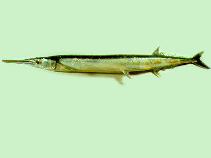 Tylosurus melanotus
Photo von Shao, K.T.
Bilder | Google Bild
Photo von Shao, K.T.
Klassifizierung / Names Namen | Synonyme | Catalog of Fishes(Gattung, Arten) | ITIS | CoL | WoRMS | Cloffa
> Beloniformes (Needle fishes) > Belonidae (Needlefishes)
Etymology: Tylosurus: Greek, tylos = callus + Greek, oura = tail (Ref. 45335).
More on author: Bleeker.
Etymology: Tylosurus: Greek, tylos = callus + Greek, oura = tail (Ref. 45335).
More on author: Bleeker.
Taxonomic Remarks
Considered mostly as a subspecies in the literature. Therefore the upraise at species rank here is considered as a provisionally accepted name, until more works are conducted on T. acus susbepcies to fix their status.
Umwelt: Milieu / Klimazone / Tiefenbereich / Verbreitungsgebiet Ökologie
seewasser; süßwasser; brackwasser riff-verbunden; ozeanodrom (Ref. 51243); tiefenbereich 0 - 1 m (Ref. 58302). Tropical; 32°N - 28°S
Verbreitung Territorien | FAO Gebiete | Ökosysteme | Vorkommen | Punkt Karte | Einführungen | Faunafri
Indo-Pacific: East Africa (Ref. 3130) to the central and south Pacific. Eastern Central Pacific: oceanic islands such as the Revillagigedo, Clipperton and Cocos (Ref. 9279).
Größe / Gewicht / Alter
Geschlechtsreife: Lm ? range ? - ? cm
Max length : 100.0 cm TL Männchen/unbestimmt; (Ref. 9137); common length : 115 cm TL Männchen/unbestimmt; (Ref. 5450)
Max length : 100.0 cm TL Männchen/unbestimmt; (Ref. 9137); common length : 115 cm TL Männchen/unbestimmt; (Ref. 5450)
Kurzbeschreibung Bestimmungsschlüssel | Morphologie | Morphometrie
Rückenflossenstacheln (insgesamt) : 0; Rückenflossenweichstrahlen (insgesamt) : 24 - 27; Afterflossenstacheln: 0; Afterflossenweichstrahlen: 22 - 24; Wirbelzahl: 90 - 95. Anterior part of dorsal fin with a low lobe, contained 10.5-13.3 times in body length; a distinct black lateral keel on caudal peduncle; caudal fin deeply forked. Juveniles have an elevated black lobe in the posterior part of the dorsal fin (Ref. 9682). Longer jaws with more numerous teeth and narrower caudal lobes than T. crocodilus (Ref. 37816).
Body shape (shape guide): elongated.
Body shape (shape guide): elongated.
Found in offshore and coastal waters. Feeds mainly on small fishes. Marketed mostly fresh. The flesh is of good quality (Ref. 9682). Oviparous (Ref. 205). Eggs may be found attached to objects in the water by tendrils on the egg's surface (Ref. 205).
Lebenszyklus und Paarungsverhalten Geschlechtsreife | Fortpflanzung | Ablaichen | Eier | Fruchtbarkeit | Larven
Hauptreferenz
Laden Sie Ihre Referenzen hoch | Referenzen | Koordinator : Collette, Bruce B. | Partner
Collette, B.B., 1984. Belonidae. In W. Fischer and G. Bianchi (eds.) FAO species identification sheets for fishery purposes. Western Indian Ocean (Fishing Area 51), Volume 1. FAO, Rome. (Ref. 3130)
CITES
Not Evaluated
Bedrohung für Menschen
Harmless
Nutzung durch Menschen
Fischereien: kommerziell
FAO - Publication: search | FishSource | Das Meer um uns herum
Mehr Information
Trophische Ökologie
Lebensmittel (Beutetiere)
Nahrungszusammensetzung
Nahrungsaufnahme
Lebensmittelrationen
Räuber
Lebensmittel (Beutetiere)
Nahrungszusammensetzung
Nahrungsaufnahme
Lebensmittelrationen
Räuber
Populationsdynamik
Wachstumsparameter
Max. Alter/Größen
Länge-Gewicht-Rel.
Länge-Länge-Verhältnis.
Längenhäufigkeiten
Massenkonvertierung
Rekrutierung
Dichte
Wachstumsparameter
Max. Alter/Größen
Länge-Gewicht-Rel.
Länge-Länge-Verhältnis.
Längenhäufigkeiten
Massenkonvertierung
Rekrutierung
Dichte
Physiologie
Körperliche Zusammensetzung
Nährstoffe
Sauerstoffverbrauch
Schwimmart
Schwimmgeschwindigkeit
Visuelle Pigmente
Fischgeräusche
Krankheiten und Parasiten
Toxizität (LC50s)
Körperliche Zusammensetzung
Nährstoffe
Sauerstoffverbrauch
Schwimmart
Schwimmgeschwindigkeit
Visuelle Pigmente
Fischgeräusche
Krankheiten und Parasiten
Toxizität (LC50s)
Genetik
Genom
Genetik
Heterozygotie
Vererbbarkeit
Genetische Vielfalt
Genom
Genetik
Heterozygotie
Vererbbarkeit
Genetische Vielfalt
Menschenbezogen
Aquakultur-Systeme
Aquakultur Profile
Zuchtlinien
Ciguatera-Fälle
Briefmarken, Münzen, Verschiedenes.
Aquakultur-Systeme
Aquakultur Profile
Zuchtlinien
Ciguatera-Fälle
Briefmarken, Münzen, Verschiedenes.
Tools
E-Book | Feldführer | Bestimmungsschlüssel | Längenhäufigkeits Tool | Lebensdaten Tool | Punkt Karte |
Catch-MSY |
Zusatzinformationen
Download XML
Zusammenfassung | Punktdaten | Namen | Photos
Internet Quellen
AFORO (otoliths) | Aquatic Commons | BHL | Cloffa | Websites from users | FishWatcher Einträge suchen | CISTI | Catalog of Fishes: Gattung, Arten | DiscoverLife | ECOTOX | FAO - Publication: search | Faunafri | Fishipedia | Fishtrace | GloBI | Google Books | Google Scholar | Google | IGFA World Record | Nationale Datenbanken | OneZoom | Open Tree of Life | Otolith Atlas of Taiwan Fishes | PubMed | Reef Life Survey | Socotra Atlas | TreeBase | Tree of Life | Wikipedia: Gehe zu, Suchen | World Records Freshwater Fishing | Zoologischer Rekord
Schätzungen auf der Grundlage von Modellen
Bevorzugte Temperatur (Ref. 123201): 28.2 - 29.3, mean 28.8 °C (based on 979 cells).
Phylogenetischer Diversitätsindex (Ref. 82804): PD50 = 0.5010 [Uniqueness, from 0.5 = low to 2.0 = high].
Bayesian length-weight: a=0.00148 (0.00078 - 0.00282), b=3.07 (2.91 - 3.23), in cm total length, based on LWR estimates for this species & (Sub)family-body (Ref. 93245).
Trophische Ebene (Ref. 69278): 4.3 ±0.76 se; based on food items.
Widerstandsfähigkeit (Ref. 120179): mittel, Verdopplung der Population dauert 1,4 - 4,4 Jahre. (Preliminary K or Fecundity.).
Nährstoffe (Ref. 124155): Calcium = 63.2 [18.0, 264.5] mg/100g; Iron = 0.484 [0.217, 1.261] mg/100g; Protein = 16.6 [13.8, 19.8] %; Omega3 = 0.0972 [, ] g/100g; Selenium = 18.7 [8.2, 47.9] μg/100g; VitaminA = 272 [40, 1,552] μg/100g; Zinc = 0.953 [0.563, 1.596] mg/100g (wet weight);