



Ajouter votre observation dans Fish Watcher
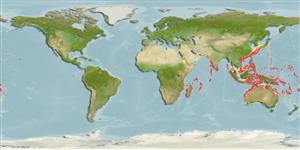
| Native range | All suitable habitat | Point map | Year 2050 |
|
| This map was computer-generated and has not yet been reviewed. |
| Amioides polyacanthus AquaMaps Data sources: GBIF OBIS |
Envoyez vos Photos et vidéos
Images | Images Google Amioides polyacanthus
Photo de Randall, J.E.
Images | Images Google
Photo de Randall, J.E.
Classification / Noms Noms communs | Synonymes | Catalog of Fishes(Genre, Espèce) | ITIS | CoL | WoRMS | Cloffa
> Kurtiformes (Nurseryfishes, cardinalfishes.) > Apogonidae (Cardinalfishes) > Amioidinae
Etymology: Amioides: Gender of genus not indicated by Smith and Radcliffe; a combination of Greek Amia, a feminine noun, for a kind of fish, with the suffix '-oides' meaning like or resembling; thus governed by the gender of the noun, in this case the compound word is feminine; polyacanthus: Vaillant suggested the name polyacanthus based on the canine teeth and spines in the first dorsal fin that differed from Cheilodipterus species (however, no name derivation was given by him). Fraser (2013) assumed that the masculine Greek noun 'akanthos' meaning prickly plant, as acanthus and the prefix 'poly-' meaning many or very; treated as a noun in apposition.
More on author: Vaillant.
Etymology: Amioides: Gender of genus not indicated by Smith and Radcliffe; a combination of Greek Amia, a feminine noun, for a kind of fish, with the suffix '-oides' meaning like or resembling; thus governed by the gender of the noun, in this case the compound word is feminine; polyacanthus: Vaillant suggested the name polyacanthus based on the canine teeth and spines in the first dorsal fin that differed from Cheilodipterus species (however, no name derivation was given by him). Fraser (2013) assumed that the masculine Greek noun 'akanthos' meaning prickly plant, as acanthus and the prefix 'poly-' meaning many or very; treated as a noun in apposition.
More on author: Vaillant.
Environnement : milieu / zone climatique / profondeur / gamme de distribution Écologie
marin benthopélagique; profondeur 70 - 276 m (Ref. 94268). Temperate
Distribution Territoires | Zones FAO | Écosystèmes | Occurrences | Carte par point | Introductions | Faunafri
Indo-Pacific.
Taille / Poids / Âge
Description synthétique Clés d'identification | Morphologie | Morphométrie
Épines dorsales (Total) : 8; Rayons mous dorsaux (Total) : 10; Épines anales: 2; Rayons mous anaux: 8. Body shape similar to chielodipterid fishes, but differs in having 7 spines in the 1st dorsal fin (versus 6 in chielodipterids). Sharp canine teeth present on both jaws. A dark-brown longitudinal stripe runs under the lateral line of midbody but is indistinct at the caudal base.
Body shape (shape guide): elongated; Cross section: compressed.
Body shape (shape guide): elongated; Cross section: compressed.
Inhabits reef slopes in 70-150 m (Ref. 90102).
Cycle de vie et comportement reproducteur Maturité | Reproduction | Frai | Œufs | Fécondité | Larves
Distinct pairing during courtship and spawning (Ref. 205).
Référence principale
Téléchargez vos références | Références | Coordinateur | Collaborateurs
Fraser, T.H., 2013. Family status of Amioides and the senior synonym of Coranthus (Percomorpha: Apogonidae). Copeia 2013(1):23-30. (Ref. 94268)
Statut dans la liste rouge de l'IUCN (Ref. 130435: Version 2025-2 (Global))
Préoccupation mineure (LC) ; Date assessed: 14 August 2023
CITES
Not Evaluated
Menace pour l'homme
Harmless
Utilisations par l'homme
Pêcheries: commercial
FAO - Publication: search | FishSource |
Plus d'informations
Écologie trophique
Aliments (proies)
Composition du régime alimentaire
Consommation alimentaire
Rations alimentaires
Prédateurs
Aliments (proies)
Composition du régime alimentaire
Consommation alimentaire
Rations alimentaires
Prédateurs
Dynamique des populations
Paramètres de croissance
Âges / tailles maximales
Longueur-poids rel.
Rel. longueur-longueur.
Fréquences de longueurs
Conversion de masse
Recrutement
Abondance
Paramètres de croissance
Âges / tailles maximales
Longueur-poids rel.
Rel. longueur-longueur.
Fréquences de longueurs
Conversion de masse
Recrutement
Abondance
Cycle de vie
Reproduction
Maturité
Maturité/épines rel.
Fécondité
Frai
Agrégats de frai
Œufs
Développement de l'œuf
Larves
Dynamique des populations larvaires
Reproduction
Maturité
Maturité/épines rel.
Fécondité
Frai
Agrégats de frai
Œufs
Développement de l'œuf
Larves
Dynamique des populations larvaires
Physiologie
Composition corporelle
Nutriments
Consommation d'oxygène
Type de natation
Vitesse de nage
Pigments visuels
Son de poisson
Maladies et parasites
Toxicité (CL50)
Composition corporelle
Nutriments
Consommation d'oxygène
Type de natation
Vitesse de nage
Pigments visuels
Son de poisson
Maladies et parasites
Toxicité (CL50)
Génétique
génôme
Génétique
Hétérozygotie
Héritabilité
Diversité génétique
génôme
Génétique
Hétérozygotie
Héritabilité
Diversité génétique
Liées à l'homme
Systèmes d'aquaculture
Profils d'aquaculture
Souches
Cas de ciguatera
Timbres, pièces de monnaie, divers
Systèmes d'aquaculture
Profils d'aquaculture
Souches
Cas de ciguatera
Timbres, pièces de monnaie, divers
Outils
E-book | Guide de terrain | Générateur de fréquences de longueur | Outil de dynamique de population | Carte par point |
Capture-MSY |
Articles particuliers
Télécharger en XML
Sources Internet
AFORO (otoliths) | Aquatic Commons | BHL | Cloffa | Websites from users | FishWatcher | CISTI | Catalog of Fishes: Genre, Espèce | DiscoverLife | ECOTOX | FAO - Publication: search | Faunafri | Fishipedia | Fishtrace | GloBI | Google Books | Google Scholar | Google | IGFA World Record | Bases de données nationales | OneZoom | Open Tree of Life | Otolith Atlas of Taiwan Fishes | PubMed | Reef Life Survey | Socotra Atlas | TreeBase | Arbre de Vie | Wikipedia: aller à, chercher | World Records Freshwater Fishing | Zoological Record
Estimations basées sur des modèles
Température préférée (Réf. 123201): 16.9 - 25.9, mean 20.5 °C (based on 203 cells).
Indice de diversité phylogénétique (Réf. 82804): PD50 = 1.0000 [Uniqueness, from 0.5 = low to 2.0 = high].
Bayesian length-weight: a=0.00389 (0.00180 - 0.00842), b=3.12 (2.94 - 3.30), in cm total length, based on all LWR estimates for this body shape (Ref. 93245).
Niveau trophique (Réf. 69278): 3.5 ±0.50 se; based on food items.
Résilience (Réf. 120179): Haut, temps minimum de doublement de population inférieur à 15 mois (Preliminary K or Fecundity.).