



Ajouter votre observation dans Fish Watcher
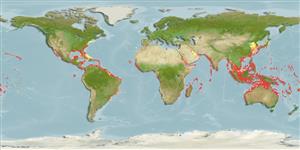
| Native range | All suitable habitat | Point map | Year 2050 |
|
| This map was computer-generated and has not yet been reviewed. |
| Aetobatus narinari AquaMaps Data sources: GBIF OBIS |
Envoyez vos Photos et vidéos
Images | vidéos | Timbres, pièces de monnaie, divers | Images Google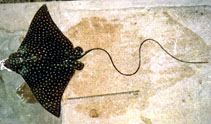 Aetobatus narinari
Photo de Vaske Jr., T.
Images | vidéos | Timbres, pièces de monnaie, divers | Images Google
Photo de Vaske Jr., T.
Classification / Noms Noms communs | Synonymes | Catalog of Fishes(Genre, Espèce) | ITIS | CoL | WoRMS | Cloffa
Élasmobranches (requins et raies) (sharks and rays) > Myliobatiformes (Stingrays) > Aetobatidae (Pacific eagle rays)
Etymology: Aetobatus: Greek, aetos = eagle + Greek, batis, batidos = a ray (Raja sp.) (Ref. 45335).
Eponymy: Narinari was a word used in Brazil in the 17th and 18th centuries and means ‘stingray’. [...] (Ref. 128868), visit book page.
Etymology: Aetobatus: Greek, aetos = eagle + Greek, batis, batidos = a ray (Raja sp.) (Ref. 45335).
Eponymy: Narinari was a word used in Brazil in the 17th and 18th centuries and means ‘stingray’. [...] (Ref. 128868), visit book page.
Taxonomic Remarks
Status of Aetobatus latirostris Duméril, 1861 requires further investigation. Species information (common names) should be linked to correct species (see Ref. 114963).
Environnement : milieu / zone climatique / profondeur / gamme de distribution Écologie
marin; saumâtre benthopélagique; amphidrome (Ref. 129822); profondeur 1 - 80 m (Ref. 9710). Subtropical; 36°N - 24°S, 98°W - 15°E
Distribution Territoires | Zones FAO | Écosystèmes | Occurrences | Carte par point | Introductions | Faunafri
Western Atlantic and probably Eastern Atlantic. Indo-Pacific species refer to Aetobatus ocellatus; Eastern Pacific species refers to A. laticeps.
Longueur à la première maturité / Taille / Poids / Âge
Maturité: Lm 107.4, range 110 - 120 cm
Max length : 230 cm WD mâle / non sexé; (Ref. 114953); common length : 140 cm WD mâle / non sexé; (Ref. 114953); poids max. publié: 230.0 kg (Ref. 7251)
Max length : 230 cm WD mâle / non sexé; (Ref. 114953); common length : 140 cm WD mâle / non sexé; (Ref. 114953); poids max. publié: 230.0 kg (Ref. 7251)
Description synthétique Clés d'identification | Morphologie | Morphométrie
Épines dorsales (Total) : 0; Épines anales: 0. An eagleray with a long snout, flat and rounded like a duck's bill, a thick head, and a pectoral disc with sharply curved, angular corners, and no caudal fin; jaws usually with single row of flat, chevron-shaped teeth (Ref. 5578). Each tooth a crescent-shaped plate joined into a band (Ref. 26938). Numerous white spots on black or bluish disc; white below (Ref. 5578). Long whiplike tail, with a long spine near the base, behind small dorsal fin. No spines on disk (Ref. 7251).
Body shape (shape guide): other; Cross section: flattened.
Body shape (shape guide): other; Cross section: flattened.
Commonly found in coastal habitats to at least 60 m depth (Ref. 114953). Swims close to the surface, occasionally leaping out of the water, or close to the bottom (Ref. 3175). Frequently forming large schools during the non-breeding season (Ref. 7251). Feeds on polychaetes, bivalves, gastropods, cepahlopods, shrimps and small fishes (Ref. 114953). Ovoviviparous (Ref. 50449). Bears young in litters of 2-4 (Ref. 26938, 114953).
Cycle de vie et comportement reproducteur Maturité | Reproduction | Frai | Œufs | Fécondité | Larves
Exhibit ovoviparity (aplacental viviparity), with embryos feeding initially on yolk, then receiving additional nourishment from the mother by indirect absorption of uterine fluid enriched with mucus, fat or protein through specialised structures (Ref. 50449). Bears up to 4 young (Ref. 5578, 6871, 37816). Width at birth 17-35 cm (Ref. 37816).
According to Uchida et al (1990) (Ref. 51119) 'the male chases the female in mid water, then nibbles on her dorsal surface. The female stops swimming to begin copulation. The male bites the female on a pectoral fin and bends one clasper forward, then attempts an abdomen to abdomen copulation with either clasper, usually mid-water' (Ref. 49562). Copulation lasted for 20 seconds to 1 minute (Ref. 49562).
Référence principale
Téléchargez vos références | Références | Coordinateur | Collaborateurs
Last, P.R., W.T. White, M.R. de Carvalho, B. Séret, M.F.W. Stehmann and G.J.P. Naylor, 2016. Rays of the world. CSIRO Publishing, Comstock Publishing Associates. i-ix + 1-790. (Ref. 114953)
Statut dans la liste rouge de l'IUCN (Ref. 130435: Version 2025-2 (Global))
Menacé (EN) (A2bd); Date assessed: 28 July 2020
CITES
Not Evaluated
Menace pour l'homme
Traumatogenic (Ref. 4690)
Utilisations par l'homme
Pêcheries: intérêt commercial mineur
FAO - Publication: search | FishSource | Sea Around Us
Plus d'informations
Écologie trophique
Aliments (proies)
Composition du régime alimentaire
Consommation alimentaire
Rations alimentaires
Prédateurs
Aliments (proies)
Composition du régime alimentaire
Consommation alimentaire
Rations alimentaires
Prédateurs
Dynamique des populations
Paramètres de croissance
Âges / tailles maximales
Longueur-poids rel.
Rel. longueur-longueur.
Fréquences de longueurs
Conversion de masse
Recrutement
Abondance
Paramètres de croissance
Âges / tailles maximales
Longueur-poids rel.
Rel. longueur-longueur.
Fréquences de longueurs
Conversion de masse
Recrutement
Abondance
Cycle de vie
Reproduction
Maturité
Maturité/épines rel.
Fécondité
Frai
Agrégats de frai
Œufs
Développement de l'œuf
Larves
Dynamique des populations larvaires
Reproduction
Maturité
Maturité/épines rel.
Fécondité
Frai
Agrégats de frai
Œufs
Développement de l'œuf
Larves
Dynamique des populations larvaires
Physiologie
Composition corporelle
Nutriments
Consommation d'oxygène
Type de natation
Vitesse de nage
Pigments visuels
Son de poisson
Maladies et parasites
Toxicité (CL50)
Composition corporelle
Nutriments
Consommation d'oxygène
Type de natation
Vitesse de nage
Pigments visuels
Son de poisson
Maladies et parasites
Toxicité (CL50)
Liées à l'homme
Systèmes d'aquaculture
Profils d'aquaculture
Souches
Cas de ciguatera
Timbres, pièces de monnaie, divers
Systèmes d'aquaculture
Profils d'aquaculture
Souches
Cas de ciguatera
Timbres, pièces de monnaie, divers
Outils
Quiz bio | E-book | Guide de terrain | Clés d'identification | Générateur de fréquences de longueur | Outil de dynamique de population | Carte par point |
Capture-MSY |
Articles particuliers
Télécharger en XML
Sources Internet
AFORO (otoliths) | Aquatic Commons | BHL | Cloffa | Websites from users | FishWatcher | CISTI | Catalog of Fishes: Genre, Espèce | DiscoverLife | DORIS | ECOTOX | FAO - Publication: search | Faunafri | Fishipedia | Fishtrace | GloBI | GoMexSI (interaction data) | Google Books | Google Scholar | Google | IGFA World Record | Bases de données nationales | OceanAdapt | OneZoom | Open Tree of Life | Otolith Atlas of Taiwan Fishes | Aquariums publics | PubMed | Reef Life Survey | Socotra Atlas | TreeBase | Arbre de Vie | Wikipedia: aller à, chercher | World Records Freshwater Fishing | Zoological Record
Estimations basées sur des modèles
Température préférée (Réf. 123201): 22.3 - 29, mean 27.5 °C (based on 4014 cells).
Indice de diversité phylogénétique (Réf. 82804): PD50 = 0.5625 [Uniqueness, from 0.5 = low to 2.0 = high].
Bayesian length-weight: a=0.01000 (0.00244 - 0.04107), b=3.04 (2.81 - 3.27), in cm total length, based on all LWR estimates for this body shape (Ref. 93245).
Niveau trophique (Réf. 69278): 4.2 ±0.1 se; based on diet studies.
Résilience (Réf. 120179): Très faible, temps minimum de doublement de population supérieur à 14 ans (tm=4-6; Fec=1-2).
Prior r = 0.06, 95% CL = 0.04 - 0.09, Based on 1 data-limited stock assessment.
Nutriments (Ref. 124155): Calcium = 9.92 [1.89, 44.45] mg/100g; Iron = 0.495 [0.123, 1.361] mg/100g; Protein = 22 [17, 27] %; Omega3 = 0.253 [0.077, 0.713] g/100g; Selenium = 25.2 [7.7, 73.8] μg/100g; VitaminA = 8.16 [2.83, 22.84] μg/100g; Zinc = 0.526 [0.255, 0.991] mg/100g (wet weight);