This website uses cookies to enhance your browsing experience and ensure the functionality of our site. For more detailed information about the types of cookies we use and how we protect your privacy, please visit our Privacy Information page.
×
Cookie Settings
This website uses different types of cookies to enhance your experience. Please select your preferences below:
> Gobiiformes (Gobies) > Gobiidae (Gobies) > Gobiinae
Etymology: Macrodontogobius:Greek, makros = great + Greek, odous = teeth + Latin, gobius = gudgeon (Ref. 45335). Eponymy: Dr Ray Lyman Wilbur (1875–1949) was an American physician who became the third President of Stanford University (1916–1943), which had awarded his BA (1896) and MA (1897), and the 31st US Secretary of the Interior (1929–1933) appointed by Hoover. [...] (Ref. 128868), visit book page. More on author: Herre.
Umwelt: Milieu / Klimazone / Tiefenbereich / Verbreitungsgebiet Ökologie
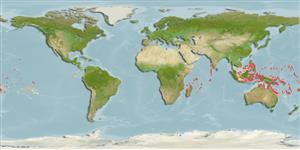
seewasser; brackwasser riff-verbunden; tiefenbereich 0 - 20 m (Ref. 48637), usually 1 - 10 m (Ref. 90102). Tropical; 15°N - 30°S
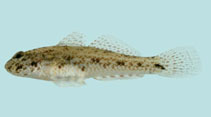
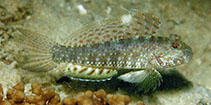
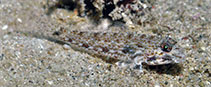
Rückenflossenstacheln (insgesamt) : 7; Rückenflossenweichstrahlen (insgesamt) : 9 - 11; Afterflossenstacheln: 1; Afterflossenweichstrahlen: 9 - 10; Wirbelzahl: 26. Ground color of dorsal part of body greenish brown, ventral whitish yellow; a black spot at base of caudal fin; 7 dark brown blotches longitudinally arranged in mid-lateral area; black spots on cheeks and operculae, one ventral to the eye; pectoral fins hyaline; white pelvic fins. Pigment intensity variable among localities. 7 or less predorsal scales. Large, ctenoid scales except for cycloid scales in isthmus (Ref. 403); pelvic fins united with well-developed frenum; rounded caudal fin, slightly longer than head; longitudinal scale series 27-31; fully scaled cheek and opercle; depth of body 4.6-6.3 in SL (Ref. 90102). Body shape (shape guide): fusiform / normal; Cross section: oval.
Inhabits coastal bays, lagoons and estuaries on fine sand along reef margins to about 20 meters depth (Ref. 48637). Solitary (Ref. 90102). Specimens collected from shallow waters to 7 m, near coral reefs. In southern Japan, the species inhabits sandy bay bottoms.
Murdy, E.O., 1985. A review of the gobiid fish genera Exyrias and Macrodontogobius, with description of a new species of Exyrias. Indo-Pac. Fish. (10):14 p. (Ref. 403)
IUCN Rote Liste Status (Ref. 130435: Version 2025-2 (Global))
Bevorzugte Temperatur (Ref. 123201): 25.4 - 29.3, mean 28.5 °C (based on 2331 cells).
Phylogenetischer Diversitätsindex (Ref. 82804): PD50 = 1.0000 [Uniqueness, from 0.5 = low to 2.0 = high].
Bayesian length-weight: a=0.01023 (0.00477 - 0.02194), b=3.01 (2.83 - 3.19), in cm total length, based on LWR estimates for this (Sub)family-body shape (Ref. 93245).
Trophische Ebene (Ref. 69278): 2.8 ±0.4 se; based on diet studies.
Widerstandsfähigkeit (Ref. 120179): hoch, Verdopplung der Population dauert weniger als 15 Monate. (Preliminary K or Fecundity.).
Anfälligkeit der Fischerei (Ref. 59153): Low vulnerability (10 of 100). 🛈