



Beobachtung melden im Fish Watcher
| Native range | All suitable habitat | Point map | Year 2050 |

|
| This map was computer-generated and has not yet been reviewed. |
| Cynoscion nothus AquaMaps Data sources: GBIF OBIS |
Hochladen Photos und videos
Bilder | Google Bild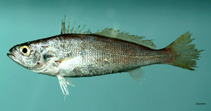 Cynoscion nothus
Photo von NOAA\NMFS\Mississippi Laboratory
Bilder | Google Bild
Photo von NOAA\NMFS\Mississippi Laboratory
Klassifizierung / Names Namen | Synonyme | Catalog of Fishes(Gattung, Arten) | ITIS | CoL | WoRMS | Cloffa
> Eupercaria/misc (Various families in series Eupercaria) > Sciaenidae (Drums or croakers)
Etymology: Cynoscion: Greek, kyon = dog + Greek, odous = teeth + Greek, skion, skiaina = barbel, red mullet (Ref. 45335).
Etymology: Cynoscion: Greek, kyon = dog + Greek, odous = teeth + Greek, skion, skiaina = barbel, red mullet (Ref. 45335).
Umwelt: Milieu / Klimazone / Tiefenbereich / Verbreitungsgebiet Ökologie
seewasser; brackwasser demersal; tiefenbereich 2 - 18 m (Ref. 1183). Subtropical; 39°N - 9°N, 98°W - 59°W
Verbreitung Territorien | FAO Gebiete | Ökosysteme | Vorkommen | Punkt Karte | Einführungen | Faunafri
Western Atlantic: Maryland to northeastern Florida in the USA and throughout Gulf of Mexico. Reported from Campeche Bank in Mexico (Ref. 5733). Often misidentified as Cynoscion regalis (Ref. 3702).
Länge bei der ersten Reifung / Größe / Gewicht / Alter
Geschlechtsreife: Lm 15.8, range 14 - 17 cm
Max length : 36.0 cm TL Männchen/unbestimmt; (Ref. 3702); common length : 25.0 cm TL Männchen/unbestimmt; (Ref. 3702); max. veröff. Alter: 1.20 Jahre (Ref. 31629)
Max length : 36.0 cm TL Männchen/unbestimmt; (Ref. 3702); common length : 25.0 cm TL Männchen/unbestimmt; (Ref. 3702); max. veröff. Alter: 1.20 Jahre (Ref. 31629)
Kurzbeschreibung Bestimmungsschlüssel | Morphologie | Morphometrie
Rückenflossenstacheln (insgesamt) : 11; Rückenflossenweichstrahlen (insgesamt) : 26 - 31; Afterflossenstacheln: 2; Afterflossenweichstrahlen: 8 - 11; Wirbelzahl: 27. Colour greyish above and changing abruptly to silvery below. Back and upper sides sometimes with very faint irregular rows of spots. Dorsal fin dusky, other fins pale to yellowish. Mouth large, oblique, lower jaw projecting. Upper jaw with a pair of large canine-like teeth at tip. Lower jaw with a row of sharp enlarged inner-row teeth, widely spaced. Chin without barbels or pores. Snout with 2 marginal pores. Gas bladder with a pair of straight, horn-like anterior appendages. Soft portion of dorsal fin covered with small scales on basal half of in (Ref 51721).
Body shape (shape guide): fusiform / normal.
Body shape (shape guide): fusiform / normal.
Occurs usually over sandy bottoms in inshore waters along beaches and in river mouths. Feeds mainly on crustaceans and fishes.
Lebenszyklus und Paarungsverhalten Geschlechtsreife | Fortpflanzung | Ablaichen | Eier | Fruchtbarkeit | Larven
Hauptreferenz
Laden Sie Ihre Referenzen hoch | Referenzen | Koordinator | Partner
Robins, C.R. and G.C. Ray, 1986. A field guide to Atlantic coast fishes of North America. Houghton Mifflin Company, Boston, U.S.A. 354 p. (Ref. 7251)
IUCN Rote Liste Status (Ref. 130435: Version 2025-2 (Global))
nicht bedroht (LC) ; Date assessed: 15 October 2019
CITES
Not Evaluated
Bedrohung für Menschen
Harmless
Nutzung durch Menschen
Fischereien: weniger kommerziell; Sportfisch: ja
FAO - Publication: search | FishSource | Das Meer um uns herum
Mehr Information
Trophische Ökologie
Lebensmittel (Beutetiere)
Nahrungszusammensetzung
Nahrungsaufnahme
Lebensmittelrationen
Räuber
Lebensmittel (Beutetiere)
Nahrungszusammensetzung
Nahrungsaufnahme
Lebensmittelrationen
Räuber
Populationsdynamik
Wachstumsparameter
Max. Alter/Größen
Länge-Gewicht-Rel.
Länge-Länge-Verhältnis.
Längenhäufigkeiten
Massenkonvertierung
Rekrutierung
Dichte
Wachstumsparameter
Max. Alter/Größen
Länge-Gewicht-Rel.
Länge-Länge-Verhältnis.
Längenhäufigkeiten
Massenkonvertierung
Rekrutierung
Dichte
Lebenszyklus
Fortpflanzung
Geschlechtsreife
Reifung/Kiemen rel.
Fruchtbarkeit
Ablaichen
Laichaggregationen
Eier
Eientwicklung
Larven
Larven Pop.Dyn.
Fortpflanzung
Geschlechtsreife
Reifung/Kiemen rel.
Fruchtbarkeit
Ablaichen
Laichaggregationen
Eier
Eientwicklung
Larven
Larven Pop.Dyn.
Anatomie
Kiemenoberfläche
Gehirn
Otolith
Kiemenoberfläche
Gehirn
Otolith
Physiologie
Körperliche Zusammensetzung
Nährstoffe
Sauerstoffverbrauch
Schwimmart
Schwimmgeschwindigkeit
Visuelle Pigmente
Fischgeräusche
Krankheiten und Parasiten
Toxizität (LC50s)
Körperliche Zusammensetzung
Nährstoffe
Sauerstoffverbrauch
Schwimmart
Schwimmgeschwindigkeit
Visuelle Pigmente
Fischgeräusche
Krankheiten und Parasiten
Toxizität (LC50s)
Genetik
Genom
Genetik
Heterozygotie
Vererbbarkeit
Genetische Vielfalt
Genom
Genetik
Heterozygotie
Vererbbarkeit
Genetische Vielfalt
Menschenbezogen
Aquakultur-Systeme
Aquakultur Profile
Zuchtlinien
Ciguatera-Fälle
Briefmarken, Münzen, Verschiedenes.
Aquakultur-Systeme
Aquakultur Profile
Zuchtlinien
Ciguatera-Fälle
Briefmarken, Münzen, Verschiedenes.
Tools
E-Book | Feldführer | Bestimmungsschlüssel | Längenhäufigkeits Tool | Lebensdaten Tool | Punkt Karte |
Catch-MSY |
Zusatzinformationen
Download XML
Zusammenfassung | Punktdaten | Namen | Photos
Internet Quellen
AFORO (otoliths) | Aquatic Commons | BHL | Cloffa | Websites from users | FishWatcher Einträge suchen | CISTI | Catalog of Fishes: Gattung, Arten | DiscoverLife | ECOTOX | FAO - Publication: search | Faunafri | Fishipedia | Fishtrace | GloBI | GoMexSI (interaction data) | Google Books | Google Scholar | Google | IGFA World Record | OceanAdapt | OneZoom | Open Tree of Life | Otolith Atlas of Taiwan Fishes | PubMed | Reef Life Survey | Socotra Atlas | TreeBase | Tree of Life | Wikipedia: Gehe zu, Suchen | World Records Freshwater Fishing | Zoologischer Rekord
Schätzungen auf der Grundlage von Modellen
Bevorzugte Temperatur (Ref. 123201): 23.4 - 28, mean 26.8 °C (based on 492 cells).
Phylogenetischer Diversitätsindex (Ref. 82804): PD50 = 0.5000 [Uniqueness, from 0.5 = low to 2.0 = high].
Bayesian length-weight: a=0.01259 (0.00787 - 0.02013), b=3.00 (2.87 - 3.13), in cm total length, based on LWR estimates for this species & Genus-body shape (Ref. 93245).
Trophische Ebene (Ref. 69278): 4.0 ±0.60 se; based on food items.
Generation time: 5.0 ( na - na) years. Estimated as median ln(3)/K based on 1 growth studies.
Widerstandsfähigkeit (Ref. 120179): mittel, Verdopplung der Population dauert 1,4 - 4,4 Jahre. (K=0.22).
Nährstoffe (Ref. 124155): Calcium = 88.6 [49.6, 178.0] mg/100g; Iron = 0.932 [0.487, 1.800] mg/100g; Protein = 19 [18, 21] %; Omega3 = 0.33 [0.18, 0.55] g/100g; Selenium = 16 [8, 33] μg/100g; VitaminA = 17.9 [5.9, 62.9] μg/100g; Zinc = 0.905 [0.638, 1.335] mg/100g (wet weight); based on nutrient studies.