This website uses cookies to enhance your browsing experience and ensure the functionality of our site. For more detailed information about the types of cookies we use and how we protect your privacy, please visit our Privacy Information page.
×
Cookie Settings
This website uses different types of cookies to enhance your experience. Please select your preferences below:
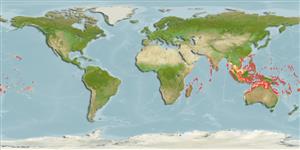
Indo-Pacific: East Africa (but apparently absent north of the Chagos Archipelago) to the Philippines and the Moluccas and eastward to island groups of the Pacific Plate.
Storlek / Vikt / Ålder
Könsmognad: Lm? range ? - ? cm Max length : 9.0 cm SL hane/ej könsbestämd; (Ref. 54980)
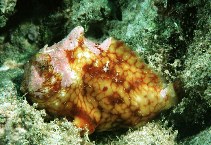
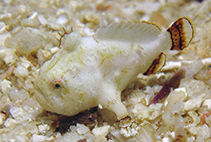
Taggstrålar i ryggfenan (totalt) : 3; Mjukstrålar i ryggfenan (totalt) : 12; Taggstrålar i analfenan: 0; Mjukstrålar i analfenan: 7 - 8. Illicium slightly longer than 2nd dorsal spine tapering to a non-filamentous simple tentacle that lacks an esca. Lacks a groove between the upper jaw and base of the illicium. Distinctive color pattern in which there is a broad dark band and marginal dark bands on the anal and caudal fins.
Body shape (shape guide): short and / or deep; Cross section: compressed.
Benthic species (Ref. 58302, 75154) found in inshore coral reef (Ref. 75154). The average depth for all known captures was 11.2 m. Individuals maintained in experimental aquaria change in color from dark gray to light cream within 2 weeks. Oviparous. Eggs are bound in ribbon-like sheath or mass of gelatinous mucus called 'egg raft' or 'veil' (Ref. 6773). Solitary and sometimes among hard coral branches (Ref 90102).
Pietsch, T.W. and D.B. Grobecker, 1987. Frogfishes of the world. Systematics, zoogeography, and behavioral ecology. Stanford University Press, Stanford, California. 420 p. (Ref. 6773)
Status på IUCN:s rödlista (Ref. 130435: Version 2025-2 (Global))
Önskad temperatur (Ref. 123201): 25 - 29.3, mean 28.2 °C (based on 2427 cells).
Index för fylogenetisk mångfald (Ref. 82804): PD50 = 0.5625 [Uniqueness, from 0.5 = low to 2.0 = high].
Bayesian length-weight: a=0.02692 (0.01067 - 0.06789), b=2.96 (2.73 - 3.19), in cm total length, based on LWR estimates for this (Sub)family-body shape (Ref. 93245).
Trofisk nivå (Ref. 69278): 3.8 ±0.7 se; based on size and trophs of closest relatives
Resiliens (Ref. 120179): Hög, lägsta populationsfördubblingstid mindre än 15 månader (Fec assumed to be > 10,000).
Sårbarhet i fisket (Ref. 59153): Low vulnerability (10 of 100). 🛈