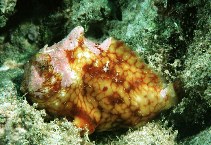
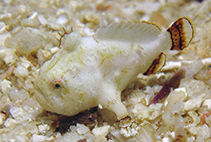
Antennatus tuberosus, Tuberculated frogfish

Antennatus tuberosus (Cuvier, 1817)

Tuberculated frogfish
Waarneming toevoegen in Fish Watcher
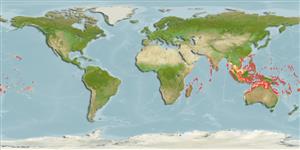
Native range | All suitable habitat | Point map | Year 2050
This map was computer-generated and has not yet been reviewed.
Antennatus tuberosus   AquaMaps   Data sources: GBIF OBIS
Uploaden van uw Foto's en video's
Afbeeldingen | Google afbeelding

Classificatie / Namen Lokale namen | Synoniemen | Catalog of Fishes(Genus, Soort(en)) | ITIS | CoL | WoRMS | Cloffa

> Lophiiformes (Anglerfishes) > Antennariidae (Frogfishes)
Etymology: Antennatus: From Latin, antenna, antemna = sensory organ, that has got antennae (Ref. 45335).
More on author: Cuvier.

Milieu: milieu / Klimaatzone / Diepte / verspreidingsgebied Ecologie

marien rifbewoner; diepte 0 - 73 m (Ref. 6773), usually 0 - 10 m (Ref. 90102). Tropical; 25°N - 35°S, 29°E - 140°W (Ref. 57379)

Verspreiding Gebieden | FAO regio's | Ecosystemen | Voorkomen | Verspreidingskaart | Introducties | Faunafri

Indo-Pacific: East Africa (but apparently absent north of the Chagos Archipelago) to the Philippines and the Moluccas and eastward to island groups of the Pacific Plate.

Grootte / Gewicht / Leeftijd

Maturiteit: Lm ?  range ? - ? cm
Max length : 9.0 cm SL mannelijk / geslacht onbekend; (Ref. 54980)

Korte beschrijving Determinatiesleutels | Morfologie | Morfometrie

Dorsale stekels (totaal) : 3; Dorsale zachte stralen (totaal) : 12; Anale stekels: 0; Anale zachte stralen: 7 - 8. Illicium slightly longer than 2nd dorsal spine tapering to a non-filamentous simple tentacle that lacks an esca. Lacks a groove between the upper jaw and base of the illicium. Distinctive color pattern in which there is a broad dark band and marginal dark bands on the anal and caudal fins.
Body shape (shape guide): short and / or deep; Cross section: compressed.

Biologie     Verklarende woordenlijst (bv. epibenthic)

Benthic species (Ref. 58302, 75154) found in inshore coral reef (Ref. 75154). The average depth for all known captures was 11.2 m. Individuals maintained in experimental aquaria change in color from dark gray to light cream within 2 weeks. Oviparous. Eggs are bound in ribbon-like sheath or mass of gelatinous mucus called 'egg raft' or 'veil' (Ref. 6773). Solitary and sometimes among hard coral branches (Ref 90102).

Levenscyclus en paargedrag Maturiteit | Voortplanting | Paaien | Eieren | Fecunditeit | Larven

Oviparous. Eggs are bound in ribbon-like sheath or mass of gelatinous mucus called 'egg raft' or 'veil' (Ref. 6773).

Hoofdreferentie Upload uw referenties | Referenties | Coördinator | Medewerkers

Pietsch, T.W. and D.B. Grobecker, 1987. Frogfishes of the world. Systematics, zoogeography, and behavioral ecology. Stanford University Press, Stanford, California. 420 p. (Ref. 6773)

Status op de Rode Lijst van het IUCN (Ref. 130435: Version 2025-2 (Global))

  Niet bedreigd (LC) ; Date assessed: 06 September 2021

CITES

Not Evaluated

CMS (Ref. 116361)

Not Evaluated

Gevaar voor de mens

  Poisonous to eat


Gebruik door de mens

Visserij: van geen belang
FAO - Publication: search | FishSource |

Meer informatie

Trofische ecologie
Voedsel (prooien)
Dieetsamenstelling
Voedselconsumptie
Voedselrantsoenen
Predatoren
Ecologie
Ecologie
Populatiedynamica
Groeiparameters
Max. leeftijden / maten
Lengte-gewicht rel.
Lengte-lengte rel.
Lengtefrequenties
Massaconversie
Rekrutering
Abundantie
Levenscyclus
Voortplanting
Maturiteit
Rijpheid/kieuwen rel.
Fecunditeit
Paaien
Paaibestanden
Eieren
Ontwikkeling van de eieren
Larven
Larvale populatiedynamiek
Verspreiding
Gebieden
FAO regio's
Ecosystemen
Voorkomen
Introducties
BRUVS - Video's
Anatomie
Kieuwoppervlak
Hersenen
Otoliet
Fysiologie
Lichaamssamenstelling
Voedingsstoffen
Zuurstofverbruik
Type zwemmen
Zwemsnelheid
Visuele pigmenten
Vis geluid
Ziekten en parasieten
Toxiciteit (LC50)
Genetica
genoom
Genetica
Heterozygositeit
Erfelijkheid
Genetische diversiteit
Menselijk gerelateerd
Aquacultuursystemen
Aquacultuurprofielen
Kweeklijnen
Ciguatera gevallen
Postzegels, munten, diversen.
Outreach
Medewerkers
Referenties
Referenties

Tools

Speciale rapporten

Download XML

Internetbronnen

AFORO (otoliths) | Aquatic Commons | BHL | Cloffa | Websites from users | Bekijk FishWatcher | CISTI | Catalog of Fishes: Genus, Soort(en) | DiscoverLife | ECOTOX | FAO - Publication: search | Faunafri | Fishipedia | Fishtrace | GloBI | Google Books | Google Scholar | Google | IGFA World Record | Nationale databanken | OneZoom | Open Tree of Life | Otolith Atlas of Taiwan Fishes | PubMed | Reef Life Survey | Socotra Atlas | TreeBase | Tree of Life | Wikipedia: ga naar, zoek | World Records Freshwater Fishing | Zoological Record

Schattingen op basis van modellen

Gewenste temperatuur (Ref. 123201): 25 - 29.3, mean 28.2 °C (based on 2427 cells).
Fylogenetische diversiteitsindex (Ref. 82804):  PD50 = 0.5625   [Uniqueness, from 0.5 = low to 2.0 = high].
Bayesian length-weight: a=0.02692 (0.01067 - 0.06789), b=2.96 (2.73 - 3.19), in cm total length, based on LWR estimates for this (Sub)family-body shape (Ref. 93245).
Trofisch niveau (Ref. 69278):  3.8   ±0.7 se; based on size and trophs of closest relatives
Weerstandsvermogen (Ref. 120179):  Hoog, minimale populatieverdubbelingstijd minder dan 15 maanden (Fec assumed to be > 10,000).
Kwetsbaarheid van de visserij (Ref. 59153):  Low vulnerability (10 of 100). 🛈
Voedingsstoffen (Ref. 124155):  Calcium = 79.3 [34.8, 153.3] mg/100g; Iron = 0.686 [0.339, 1.315] mg/100g; Protein = 18.6 [16.0, 21.8] %; Omega3 = 0.137 [0.048, 0.355] g/100g; Selenium = 21.2 [8.2, 56.3] μg/100g; VitaminA = 326 [73, 1,416] μg/100g; Zinc = 1.28 [0.76, 2.11] mg/100g (wet weight);