



Rastrelliger brachysoma (Bleeker, 1851)
Short mackerel
Beobachtung melden im Fish Watcher
| Native range | All suitable habitat | Point map | Year 2050 |

|
| This map was computer-generated and has not yet been reviewed. |
| Rastrelliger brachysoma AquaMaps Data sources: GBIF OBIS |
Hochladen Photos und videos
Bilder | Briefmarken, Münzen, Verschiedenes. | Google Bild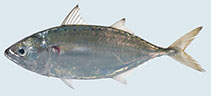 Rastrelliger brachysoma
Photo von Williams, J.T.
Bilder | Briefmarken, Münzen, Verschiedenes. | Google Bild
Photo von Williams, J.T.
Klassifizierung / Names Namen | Synonyme | Catalog of Fishes(Gattung, Arten) | ITIS | CoL | WoRMS | Cloffa
> Scombriformes (Mackerels) > Scombridae (Mackerels, tunas, bonitos) > Scombrinae
Etymology: Rastrelliger: Latin, rastra = rake + Latin, gero = to carry.
More on author: Bleeker.
Etymology: Rastrelliger: Latin, rastra = rake + Latin, gero = to carry.
More on author: Bleeker.
Umwelt: Milieu / Klimazone / Tiefenbereich / Verbreitungsgebiet Ökologie
seewasser; brackwasser pelagic-neritic; ozeanodrom (Ref. 51243); tiefenbereich 15 - 200 m (Ref. 28016). Tropical; 20°C - 30°C (Ref. 54858); 18°N - 18°S, 93°E - 180°E (Ref. 54858)
Verbreitung Territorien | FAO Gebiete | Ökosysteme | Vorkommen | Punkt Karte | Einführungen | Faunafri
Pacific Ocean: Andaman Sea to Thailand, Indonesia, Papua New Guinea, Philippines, Solomon Islands and Fiji.
Länge bei der ersten Reifung / Größe / Gewicht / Alter
Geschlechtsreife: Lm 17.3 range ? - ? cm
Max length : 34.5 cm FL Männchen/unbestimmt; (Ref. 168); common length : 20.0 cm FL Männchen/unbestimmt; (Ref. 168); max. veröff. Alter: 2.00 Jahre (Ref. 796)
Max length : 34.5 cm FL Männchen/unbestimmt; (Ref. 168); common length : 20.0 cm FL Männchen/unbestimmt; (Ref. 168); max. veröff. Alter: 2.00 Jahre (Ref. 796)
Kurzbeschreibung Bestimmungsschlüssel | Morphologie | Morphometrie
Rückenflossenstacheln (insgesamt) : 8 - 11; Rückenflossenweichstrahlen (insgesamt) : 12; Afterflossenstacheln: 0; Afterflossenweichstrahlen: 12; Wirbelzahl: 31. This species is distinguished by the following characters: body very deep, its depth at posterior margin of opercle 3.7-4.3 times in fork length; head equal to or less than body depth; maxilla covered by lacrimal bone but extending nearly to end of lacrimal; gill rakers very long, visible when mouth is opened, 30-48 on lower limb of first gill arch; numerous bristles on longest gill raker, about 150 on one side in specimens of 12.7 cm, 210 in specimens of 16 cm, and 240 at 19 cm fork length; intestine very long, 3.2-3.6 times fork length; snout pointed; swim bladder present; vertebrae 13 + 18 = 31; interpelvic process small and single; anal spine rudimentary. Colour of spinous dorsal fin yellowish with a black edge, pectoral and pelvic fins dusky, other fins yellowish (Ref. 168, 9684).
Body shape (shape guide): fusiform / normal; Cross section: oval.
Body shape (shape guide): fusiform / normal; Cross section: oval.
An epipelagic, neritic species that tolerates slightly reduced salinities in estuarine habitats and in areas where surface temperature range between 20° and 30°C. It forms schools of equally sized individuals. Batch spawning is believed to extend from March through September. Feeds chiefly on microzooplankton with a high phytoplankton component. Marketed fresh, frozen, canned, dried salted and smoked (Ref. 168, 9684).
Lebenszyklus und Paarungsverhalten Geschlechtsreife | Fortpflanzung | Ablaichen | Eier | Fruchtbarkeit | Larven
Hauptreferenz
Laden Sie Ihre Referenzen hoch | Referenzen | Koordinator : Collette, Bruce B. | Partner
Collette, B.B. and C.E. Nauen, 1983. FAO Species Catalogue. Vol. 2. Scombrids of the world. An annotated and illustrated catalogue of tunas, mackerels, bonitos and related species known to date. Rome: FAO. FAO Fish. Synop. 125(2):137 p. (Ref. 168)
IUCN Rote Liste Status (Ref. 130435: Version 2025-2 (Global))
Verwundbar (VU) (A2bd); Date assessed: 01 March 2022
CITES
Not Evaluated
Bedrohung für Menschen
Harmless
Nutzung durch Menschen
Fischereien: hoch kommerziell; Sportfisch: ja
FAO - Fischereien: landungen, Artbeschreibung; Publication: search | FishSource | Das Meer um uns herum
Mehr Information
Trophische Ökologie
Lebensmittel (Beutetiere)
Nahrungszusammensetzung
Nahrungsaufnahme
Lebensmittelrationen
Räuber
Lebensmittel (Beutetiere)
Nahrungszusammensetzung
Nahrungsaufnahme
Lebensmittelrationen
Räuber
Populationsdynamik
Wachstumsparameter
Max. Alter/Größen
Länge-Gewicht-Rel.
Länge-Länge-Verhältnis.
Längenhäufigkeiten
Massenkonvertierung
Rekrutierung
Dichte
Wachstumsparameter
Max. Alter/Größen
Länge-Gewicht-Rel.
Länge-Länge-Verhältnis.
Längenhäufigkeiten
Massenkonvertierung
Rekrutierung
Dichte
Lebenszyklus
Fortpflanzung
Geschlechtsreife
Reifung/Kiemen rel.
Fruchtbarkeit
Ablaichen
Laichaggregationen
Eier
Eientwicklung
Larven
Larven Pop.Dyn.
Fortpflanzung
Geschlechtsreife
Reifung/Kiemen rel.
Fruchtbarkeit
Ablaichen
Laichaggregationen
Eier
Eientwicklung
Larven
Larven Pop.Dyn.
Anatomie
Kiemenoberfläche
Gehirn
Otolith
Kiemenoberfläche
Gehirn
Otolith
Physiologie
Körperliche Zusammensetzung
Nährstoffe
Sauerstoffverbrauch
Schwimmart
Schwimmgeschwindigkeit
Visuelle Pigmente
Fischgeräusche
Krankheiten und Parasiten
Toxizität (LC50s)
Körperliche Zusammensetzung
Nährstoffe
Sauerstoffverbrauch
Schwimmart
Schwimmgeschwindigkeit
Visuelle Pigmente
Fischgeräusche
Krankheiten und Parasiten
Toxizität (LC50s)
Menschenbezogen
Aquakultur-Systeme
Aquakultur Profile
Zuchtlinien
Ciguatera-Fälle
Briefmarken, Münzen, Verschiedenes.
Aquakultur-Systeme
Aquakultur Profile
Zuchtlinien
Ciguatera-Fälle
Briefmarken, Münzen, Verschiedenes.
Tools
E-Book | Feldführer | Bestimmungsschlüssel | Längenhäufigkeits Tool | Lebensdaten Tool | Punkt Karte |
Catch-MSY |
Zusatzinformationen
Download XML
Zusammenfassung | Punktdaten | Namen | Photos
Internet Quellen
AFORO (otoliths) | Aquatic Commons | BHL | Cloffa | Websites from users | FishWatcher Einträge suchen | CISTI | Catalog of Fishes: Gattung, Arten | DiscoverLife | ECOTOX | FAO - Fischereien: landungen, Artbeschreibung; Publication: search | Faunafri | Fishipedia | Fishtrace | GloBI | Google Books | Google Scholar | Google | IGFA World Record | OneZoom | Open Tree of Life | Otolith Atlas of Taiwan Fishes | PubMed | Reef Life Survey | Socotra Atlas | TreeBase | Tree of Life | Wikipedia: Gehe zu, Suchen | World Records Freshwater Fishing | Zoologischer Rekord
Schätzungen auf der Grundlage von Modellen
Bevorzugte Temperatur (Ref. 123201): 23.3 - 28.4, mean 27.2 °C (based on 781 cells).
Phylogenetischer Diversitätsindex (Ref. 82804): PD50 = 0.6250 [Uniqueness, from 0.5 = low to 2.0 = high].
Bayesian length-weight: a=0.00955 (0.00817 - 0.01116), b=3.06 (3.02 - 3.10), in cm total length, based on LWR estimates for this species (Ref. 93245).
Trophische Ebene (Ref. 69278): 2.7 ±0.31 se; based on food items.
Generation time: 0.9 (0.8 - 1.1) years. Estimated as median ln(3)/K based on 38 growth studies.
Widerstandsfähigkeit (Ref. 120179): hoch, Verdopplung der Population dauert weniger als 15 Monate. (K=0.6-1.6; tmax=2).
Prior r = 1.19, 95% CL = 0.79 - 1.79, Based on 3 data-limited stock assessments.
Nährstoffe (Ref. 124155): Calcium = 241 [85, 719] mg/100g; Iron = 3.44 [1.55, 7.60] mg/100g; Protein = 20.8 [19.5, 22.1] %; Omega3 = 0.366 [0.161, 0.855] g/100g; Selenium = 66.4 [19.0, 217.7] μg/100g; VitaminA = 10.8 [2.1, 48.4] μg/100g; Zinc = 1.95 [1.04, 5.00] mg/100g (wet weight); based on nutrient studies.