



Hochladen Photos und videos
Bilder | videos | Google Bild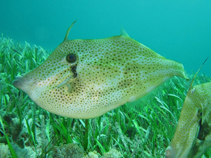 Aluterus schoepfii
Photo von Johnson, L.
Bilder | videos | Google Bild
Photo von Johnson, L.
Klassifizierung / Names Namen | Synonyme | Catalog of Fishes(Gattung, Arten) | ITIS | CoL | WoRMS | Cloffa
> Tetraodontiformes (Puffers and filefishes) > Monacanthidae (Filefishes)
Etymology: Aluterus: Name from Greek meaning not free or detached, referring to the pelvis that does not form a spiny project (as it does in triggerfish) (R. Chandler, pers. Comm. 10/2014).
Eponymy: Dr Johann David Schoepf (1752–1800) was a German botanist, zoologist and physician. [...] (Ref. 128868), visit book page.
More on author: Walbaum.
Etymology: Aluterus: Name from Greek meaning not free or detached, referring to the pelvis that does not form a spiny project (as it does in triggerfish) (R. Chandler, pers. Comm. 10/2014).
Eponymy: Dr Johann David Schoepf (1752–1800) was a German botanist, zoologist and physician. [...] (Ref. 128868), visit book page.
More on author: Walbaum.
Umwelt: Milieu / Klimazone / Tiefenbereich / Verbreitungsgebiet Ökologie
seewasser riff-verbunden; tiefenbereich 3 - 900 m (Ref. 3592), usually ? - 50 m (Ref. 3592). Subtropical; 46°N - 27°S, 97°W - 13°E
Verbreitung Territorien | FAO Gebiete | Ökosysteme | Vorkommen | Punkt Karte | Einführungen | Faunafri
Western Atlantic: Nova Scotia (Canada), Bermuda, and northern Gulf of Mexico to Brazil. Eastern Atlantic: Cape Blanc, Mauritania to Angola (Ref. 3592).
Größe / Gewicht / Alter
Geschlechtsreife: Lm ? range ? - ? cm
Max length : 61.0 cm TL Männchen/unbestimmt; (Ref. 26340); common length : 40.0 cm TL Männchen/unbestimmt; (Ref. 3592)
Max length : 61.0 cm TL Männchen/unbestimmt; (Ref. 26340); common length : 40.0 cm TL Männchen/unbestimmt; (Ref. 3592)
Kurzbeschreibung Bestimmungsschlüssel | Morphologie | Morphometrie
Rückenflossenstacheln (insgesamt) : 2; Rückenflossenweichstrahlen (insgesamt) : 32 - 39; Afterflossenstacheln: 0; Afterflossenweichstrahlen: 35 - 41. Pelvic terminus always absent; head and body with numerous small round orange or orange-yellow spots; lips often blackish (Ref. 13442).
Body shape (shape guide): short and / or deep.
Body shape (shape guide): short and / or deep.
Usually found over bottoms with seagrass, sand, or mud (Ref. 3790). Juveniles are associated with floating Sargassum. Solitary or in pairs (Ref. 9710). Feeds on a variety of plants, including algae and seagrasses (Ref. 3790). Generally considered as trash fish, rarely consumed (Ref. 3790). Traded as an aquarium fish at Ceará, Brazil (Ref. 49392).
Lebenszyklus und Paarungsverhalten Geschlechtsreife | Fortpflanzung | Ablaichen | Eier | Fruchtbarkeit | Larven
Distinct pairing (Ref. 205).
Hauptreferenz
Laden Sie Ihre Referenzen hoch | Referenzen | Koordinator : Hutchins, Barry | Partner
Harmelin-Vivien, M.L. and J.-C. Quéro, 1990. Monacanthidae. p. 1061-1066. In J.C. Quero, J.C. Hureau, C. Karrer, A. Post and L. Saldanha (eds.) Check-list of the fishes of the eastern tropical Atlantic (CLOFETA). JNICT, Lisbon; SEI, Paris; and UNESCO, Paris. Vol. 2. (Ref. 3592)
IUCN Rote Liste Status (Ref. 130435: Version 2025-2 (Global))
nicht bedroht (LC) ; Date assessed: 27 February 2014
CITES
Not Evaluated
Bedrohung für Menschen
Reports of ciguatera poisoning (Ref. 30911)
Nutzung durch Menschen
Fischereien: kleinfischerei; Aquarium: Kommerziell
FAO - Publication: search | FishSource | Das Meer um uns herum
Mehr Information
Trophische Ökologie
Lebensmittel (Beutetiere)
Nahrungszusammensetzung
Nahrungsaufnahme
Lebensmittelrationen
Räuber
Lebensmittel (Beutetiere)
Nahrungszusammensetzung
Nahrungsaufnahme
Lebensmittelrationen
Räuber
Populationsdynamik
Wachstumsparameter
Max. Alter/Größen
Länge-Gewicht-Rel.
Länge-Länge-Verhältnis.
Längenhäufigkeiten
Massenkonvertierung
Rekrutierung
Dichte
Wachstumsparameter
Max. Alter/Größen
Länge-Gewicht-Rel.
Länge-Länge-Verhältnis.
Längenhäufigkeiten
Massenkonvertierung
Rekrutierung
Dichte
Lebenszyklus
Fortpflanzung
Geschlechtsreife
Reifung/Kiemen rel.
Fruchtbarkeit
Ablaichen
Laichaggregationen
Eier
Eientwicklung
Larven
Larven Pop.Dyn.
Fortpflanzung
Geschlechtsreife
Reifung/Kiemen rel.
Fruchtbarkeit
Ablaichen
Laichaggregationen
Eier
Eientwicklung
Larven
Larven Pop.Dyn.
Anatomie
Kiemenoberfläche
Gehirn
Otolith
Kiemenoberfläche
Gehirn
Otolith
Physiologie
Körperliche Zusammensetzung
Nährstoffe
Sauerstoffverbrauch
Schwimmart
Schwimmgeschwindigkeit
Visuelle Pigmente
Fischgeräusche
Krankheiten und Parasiten
Toxizität (LC50s)
Körperliche Zusammensetzung
Nährstoffe
Sauerstoffverbrauch
Schwimmart
Schwimmgeschwindigkeit
Visuelle Pigmente
Fischgeräusche
Krankheiten und Parasiten
Toxizität (LC50s)
Menschenbezogen
Aquakultur-Systeme
Aquakultur Profile
Zuchtlinien
Ciguatera-Fälle
Briefmarken, Münzen, Verschiedenes.
Aquakultur-Systeme
Aquakultur Profile
Zuchtlinien
Ciguatera-Fälle
Briefmarken, Münzen, Verschiedenes.
Tools
E-Book | Feldführer | Bestimmungsschlüssel | Längenhäufigkeits Tool | Lebensdaten Tool | Punkt Karte |
Catch-MSY |
Zusatzinformationen
Download XML
Zusammenfassung | Punktdaten | Namen | Photos
Internet Quellen
AFORO (otoliths) | Aquatic Commons | BHL | Cloffa | Websites from users | FishWatcher Einträge suchen | CISTI | Catalog of Fishes: Gattung, Arten | DiscoverLife | ECOTOX | FAO - Publication: search | Faunafri | Fishipedia | Fishtrace | GloBI | Google Books | Google Scholar | Google | IGFA World Record | Nationale Datenbanken | OceanAdapt | OneZoom | Open Tree of Life | Otolith Atlas of Taiwan Fishes | Öffentliche Aquarien | PubMed | Reef Life Survey | Socotra Atlas | TreeBase | Tree of Life | Wikipedia: Gehe zu, Suchen | World Records Freshwater Fishing | Zoologischer Rekord
Schätzungen auf der Grundlage von Modellen
Bevorzugte Temperatur (Ref. 123201): 20 - 28, mean 25.6 °C (based on 842 cells).
Phylogenetischer Diversitätsindex (Ref. 82804): PD50 = 0.5625 [Uniqueness, from 0.5 = low to 2.0 = high].
Bayesian length-weight: a=0.01905 (0.00905 - 0.04012), b=2.93 (2.75 - 3.11), in cm total length, based on LWR estimates for this (Sub)family-body shape (Ref. 93245).
Trophische Ebene (Ref. 69278): 2.0 ±0.1 se; based on diet studies.
Widerstandsfähigkeit (Ref. 120179): mittel, Verdopplung der Population dauert 1,4 - 4,4 Jahre. (Preliminary K or Fecundity.).
Nährstoffe (Ref. 124155): Calcium = 15.4 [5.5, 43.4] mg/100g; Iron = 0.54 [0.24, 1.41] mg/100g; Protein = 18.3 [15.9, 20.5] %; Omega3 = 0.159 [0.065, 0.358] g/100g; Selenium = 37 [14, 102] μg/100g; VitaminA = 20.1 [3.6, 108.2] μg/100g; Zinc = 0.785 [0.452, 1.359] mg/100g (wet weight);