This website uses cookies to enhance your browsing experience and ensure the functionality of our site. For more detailed information about the types of cookies we use and how we protect your privacy, please visit our Privacy Information page.
×
Cookie Settings
This website uses different types of cookies to enhance your experience. Please select your preferences below:
> Ovalentaria/misc (Various families in series Ovalentaria) > Pomacentridae (Damselfishes) > Pomacentrinae
Etymology: Neoglyphidodon:Greek, para = the side of + Greek, glyphis = carved + Greek, odous = teeth. More on author: Bleeker.
Environnement : milieu / zone climatique / profondeur / gamme de distribution Écologie
marin récifal; non migrateur; profondeur 1 - 20 m (Ref. 7247). Tropical; 45°N - 14°S
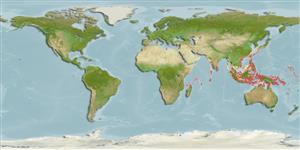
Indo-West Pacific: Sri Lanka to the Indo-Australian Archipelago including Sumatra, Java, Sulawesi, and the Solomon Islands. Records from other locations are mostly misidentifications.
Taille / Poids / Âge
Maturité: Lm? range ? - ? cm Max length : 13.5 cm TL mâle / non sexé; (Ref. 90102)
Épines dorsales (Total) : 13; Rayons mous dorsaux (Total) : 15 - 16; Épines anales: 2; Rayons mous anaux: 13 - 15. Body shape (shape guide): short and / or deep; Cross section: compressed.
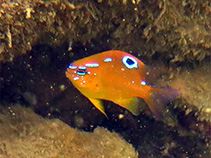
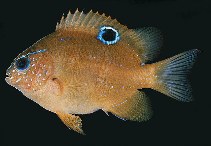
Adults inhabit coral reefs (Ref. 9710), probably subject to surge to 20 m depth. Poorly known species that is seldom seen. Probably overlooked because of the drab appearance. Juveniles unknown and probably have large ocellus like N. thoracotaeniatus (Ref. 48636). Life history characteristics for the family specify that this group is oviparous, with distinct pairing during breeding (Ref. 205). Eggs are demersal and adhere to the substrate (Ref. 205). Males guard and aerate the eggs (Ref. 205). Diurnal species (Ref. 113699).
Cycle de vie et comportement reproducteur Maturité | Reproduction | Frai | Œufs | Fécondité | Larves
Life history characteristics for the family specify that this group is oviparous, with distinct pairing during breeding (Ref. 205). Eggs are demersal and adhere to the substrate (Ref. 205). Males guard and aerate the eggs (Ref. 205).
Cycle de vie Reproduction Maturité Maturité/épines rel. Fécondité Frai Agrégats de frai Œufs Développement de l'œuf Larves Dynamique des populations larvaires
Physiologie Composition corporelle Nutriments Consommation d'oxygène Type de natation Vitesse de nage Pigments visuels Son de poisson Maladies et parasites Toxicité (CL50)
Température préférée (Réf. 123201): 28.2 - 29.3, mean 28.8 °C (based on 731 cells).
Indice de diversité phylogénétique (Réf. 82804): PD50 = 0.5020 [Uniqueness, from 0.5 = low to 2.0 = high].
Bayesian length-weight: a=0.02344 (0.01149 - 0.04783), b=2.98 (2.80 - 3.16), in cm total length, based on LWR estimates for this (Sub)family-body shape (Ref. 93245).
Niveau trophique (Réf. 69278): 2.7 ±0.3 se; based on size and trophs of closest relatives
Résilience (Réf. 120179): Haut, temps minimum de doublement de population inférieur à 15 mois (Preliminary K or Fecundity.).
Vulnérabilité de la pêche (Ref. 59153): Low vulnerability (10 of 100). 🛈