



Aetomylaeus nichofii (Bloch & Schneider, 1801)
Banded eagle ray
添加你自己的观测位置在 Fish Watcher
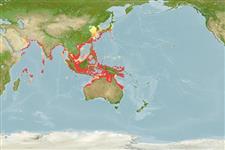
| Native range | All suitable habitat | Point map | Year 2050 |
|
| This map was computer-generated and has not yet been reviewed. |
| Aetomylaeus nichofii AquaMaps Data sources: GBIF OBIS |
上传你的 图片 和 影像
照片 | 谷歌图片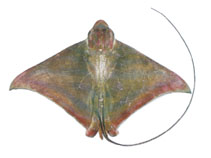 Aetomylaeus nichofii
图片提供人 Iranian Fisheries Research Organization (IFRO)
照片 | 谷歌图片
图片提供人 Iranian Fisheries Research Organization (IFRO)
分类 / 名称 俗名 | 同种异名 | Catalog of Fishes(属, 种) | ITIS | CoL | WoRMS | Cloffa
Elasmobranchii 板鳃亚纲 (鲨鱼与 鱼) (sharks and rays) > Myliobatiformes (Stingrays) > Myliobatidae (Eagle and manta rays)
Etymology: Aetomylaeus: Greek, aetos = eagle + Greek, mylio = mill, grinder (Ref. 45335).
Eponymy: Johan Nieuhoff (1618–1672) was a Dutch traveller who wrote about his journeys to India, China and Brazil. [...] (Ref. 128868), visit book page.
More on authors: Bloch & Schneider.
Etymology: Aetomylaeus: Greek, aetos = eagle + Greek, mylio = mill, grinder (Ref. 45335).
Eponymy: Johan Nieuhoff (1618–1672) was a Dutch traveller who wrote about his journeys to India, China and Brazil. [...] (Ref. 128868), visit book page.
More on authors: Bloch & Schneider.
环境:氛围 / 气候带 / 深度上下限 / 分布范围 生态学
分布 领土 | FAO区域 | 生态系 | 标本纪录 | 分布图 | 简介 | Faunafri
Indo-West Pacific: Persian Gulf to the Philippines, north to Korea and southern Japan, south to northern Australia. Possibly in the Red Sea and eastern and southern Africa.
e Indo-West Pacific from the Persian/Arabian Gulf westwards to Indonesia, and north to Taiwan, China and southern Japan.
印度-西太平洋: 波斯灣到菲律賓, 北至韓國與日本南部, 南至澳洲北部。 可能地在紅海與非洲東部與南部。
印度-西太平洋: 波斯灣到菲律賓, 北至韓國與日本南部, 南至澳洲北部。 可能地在紅海與非洲東部與南部。
首次成熟时的长度 / 大小 / 重量 / 年龄
简单描述 检索表 | 型态特徵 | 形态测量图
This small species of Aetomylaeus (reaching to about 72.0 cm DW) is distinguished by the following set of characters: dorsal surface is greyish brown with a series of usually 8 (sometimes 7) transverse pale bluish bands (which are sometimes faint), no dark spots or blotches; ventral surface is whitish, pectoral fins is dusky distally; tail is rather long (1.4-1.8 times DW); without stinging spine; short and narrow head; fleshy rostral lobe, relatively broad, short, with a rounded apex; teeth usually in 7 rows in each jaw, with a broad median row flanked by 3 smaller rows on each side; dorsal-fin origin level with pelvic-fin insertions; radials of pectoral-fin 84-88 (excluding concealed propterygial radials anterior of eyes); total vertebral centra (including synarcual) 83-93; males have 16-19 pelvic radials (excluding clasper); females have 20 or 21 pelvic radials (Ref. 103981).
Body shape (shape guide): other; Cross section: flattened.
Body shape (shape guide): other; Cross section: flattened.
Maximum depth reported taken from Ref. 9773.
生活于近海与外海, 从潮间带到至少 70 公尺深.(参考文献 9862) 可能进入半淡咸水。 吃蠕虫,甲壳动物,蜗牛与硬骨鱼类。 (参考文献 12951) 卵胎生的.(参考文献 50449) 每胎超过 4 个幼鱼。 出生时的大小大约 17 公分 WD 。 (参考文献 6871)
生活于近海与外海, 从潮间带到至少 70 公尺深.(参考文献 9862) 可能进入半淡咸水。 吃蠕虫,甲壳动物,蜗牛与硬骨鱼类。 (参考文献 12951) 卵胎生的.(参考文献 50449) 每胎超过 4 个幼鱼。 出生时的大小大约 17 公分 WD 。 (参考文献 6871)
生命周期和交配行为 成熟度 | 繁殖 | 产卵场 | 卵 | 孕卵数 | 仔鱼
Exhibit ovoviparity (aplacental viviparity), with embryos feeding initially on yolk, then receiving additional nourishment from the mother by indirect absorption of uterine fluid enriched with mucus, fat or protein through specialised structures (Ref. 50449). Gives birth to ~4 pups; born at ~17 cm WD (Ref.58048).印度-西太平洋: 波斯灣到菲律賓, 北至韓國與日本南部, 南至澳洲北部。 可能地在紅海與非洲東部與南部。
主要参考文献
上传您的参考资料 | 参考文献 | 合作者 : McEachran, John | 合作者
Last, P.R. and J.D. Stevens, 1994. Sharks and rays of Australia. CSIRO, Australia. 513 p. (Ref. 6871)
CITES
Not Evaluated
对人类的威胁
无害处的
人类利用
渔业: 低经济
FAO - Publication: search | FishSource |
更多信息
工具
特别资料
下载 XML
网络资源
AFORO (otoliths) | Aquatic Commons | BHL | Cloffa | Websites from users | 核实 FishWatcher | CISTI | Catalog of Fishes: 属, 种 | DiscoverLife | ECOTOX | FAO - Publication: search | Faunafri | Fishipedia | Fishtrace | GloBI | Google Books | Google Scholar | Google | IGFA World Record | 国家资料库 | OneZoom | Open Tree of Life | Otolith Atlas of Taiwan Fishes | PubMed | Reef Life Survey | Socotra Atlas | TreeBase | 树状分类阶层 | Wikipedia: 转至, 搜寻 | World Records Freshwater Fishing | 动物学的记录
基于模型的估算
首选温度 (参考文献 123201): 23.8 - 28.3, mean 27.3 °C (based on 618 cells).
系统发育多样性指数 (参考文献 82804): PD50 = 0.5039 [Uniqueness, from 0.5 = low to 2.0 = high].
Bayesian length-weight: a=0.00389 (0.00124 - 0.01219), b=3.08 (2.83 - 3.33), in cm total length, based on LWR estimates for this (Sub)family-body shape (Ref. 93245).
营养阶层 (参考文献 69278): 3.9 ±0.48 se; based on food items.
回复力 (参考文献 120179): 非常低的, 最小族群倍增时间超过14 年 (Fec=4).
营养素 (Ref. 124155): Calcium = 46.2 [10.7, 204.4] mg/100g; Iron = 0.822 [0.206, 2.137] mg/100g; Protein = 21.5 [16.4, 26.6] %; Omega3 = 0.14 [0.04, 0.52] g/100g; Selenium = 36.8 [9.5, 98.7] μg/100g; VitaminA = 16.9 [7.5, 36.5] μg/100g; Zinc = 1.07 [0.53, 1.96] mg/100g (wet weight);