



Aetomylaeus nichofii (Bloch & Schneider, 1801)
Banded eagle ray
Add your observation in Fish Watcher
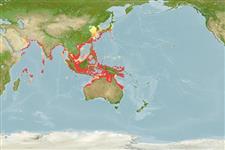
| Native range | All suitable habitat | Point map | Year 2050 |
|
| This map was computer-generated and has not yet been reviewed. |
| Aetomylaeus nichofii AquaMaps Data sources: GBIF OBIS |
Upload your photos and videos
Pictures | Google image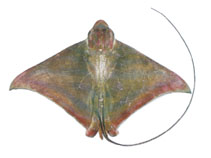 Aetomylaeus nichofii
Picture by Iranian Fisheries Research Organization (IFRO)
Pictures | Google image
Picture by Iranian Fisheries Research Organization (IFRO)
Classification / Names Common names | Synonyms | Catalog of Fishes(genus, species) | ITIS | CoL | WoRMS | Cloffa
Elasmobranchii (sharks and rays) > Myliobatiformes (Stingrays) > Myliobatidae (Eagle and manta rays)
Etymology: Aetomylaeus: Greek, aetos = eagle + Greek, mylio = mill, grinder (Ref. 45335).
Eponymy: Johan Nieuhoff (1618–1672) was a Dutch traveller who wrote about his journeys to India, China and Brazil. [...] (Ref. 128868), visit book page.
More on authors: Bloch & Schneider.
Etymology: Aetomylaeus: Greek, aetos = eagle + Greek, mylio = mill, grinder (Ref. 45335).
Eponymy: Johan Nieuhoff (1618–1672) was a Dutch traveller who wrote about his journeys to India, China and Brazil. [...] (Ref. 128868), visit book page.
More on authors: Bloch & Schneider.
Environment: milieu / climate zone / depth range / distribution range Ecology
Marine; brackish; demersal; amphidromous (Ref. 51243); depth range 1 - 100 m (Ref. 6871). Tropical; 41°N - 24°S, 51°E - 154°E
Distribution Territories | FAO areas | Ecosystems | Occurrences | Point map | Introductions | Faunafri
Indo-West Pacific: Persian Gulf to the Philippines, north to Korea and southern Japan, south to northern Australia. Possibly in the Red Sea and eastern and southern Africa.
e Indo-West Pacific from the Persian/Arabian Gulf westwards to Indonesia, and north to Taiwan, China and southern Japan.
Length at first maturity / Size / Weight / Age
Short description Identification keys | Morphology | Morphometrics
This small species of Aetomylaeus (reaching to about 72.0 cm DW) is distinguished by the following set of characters: dorsal surface is greyish brown with a series of usually 8 (sometimes 7) transverse pale bluish bands (which are sometimes faint), no dark spots or blotches; ventral surface is whitish, pectoral fins is dusky distally; tail is rather long (1.4-1.8 times DW); without stinging spine; short and narrow head; fleshy rostral lobe, relatively broad, short, with a rounded apex; teeth usually in 7 rows in each jaw, with a broad median row flanked by 3 smaller rows on each side; dorsal-fin origin level with pelvic-fin insertions; radials of pectoral-fin 84-88 (excluding concealed propterygial radials anterior of eyes); total vertebral centra (including synarcual) 83-93; males have 16-19 pelvic radials (excluding clasper); females have 20 or 21 pelvic radials (Ref. 103981).
Body shape (shape guide): other; Cross section: flattened.
Body shape (shape guide): other; Cross section: flattened.
Maximum depth reported taken from Ref. 9773.
Life cycle and mating behavior Maturity | Reproduction | Spawning | Eggs | Fecundity | Larvae
Exhibit ovoviparity (aplacental viviparity), with embryos feeding initially on yolk, then receiving additional nourishment from the mother by indirect absorption of uterine fluid enriched with mucus, fat or protein through specialised structures (Ref. 50449). Gives birth to ~4 pups; born at ~17 cm WD (Ref.58048).
Main reference
Upload your references | References | Coordinator : McEachran, John | Collaborators
Last, P.R. and J.D. Stevens, 1994. Sharks and rays of Australia. CSIRO, Australia. 513 p. (Ref. 6871)
IUCN Red List Status (Ref. 130435: Version 2025-2 (Global))
Vulnerable (VU) (A2bd); Date assessed: 10 October 2015
CITES
Not Evaluated
Threat to humans
Harmless
Human uses
Fisheries: minor commercial
FAO - Publication: search | FishSource |
More information
Population dynamics
Growth parameters
Max. ages / sizes
Length-weight rel.
Length-length rel.
Length-frequencies
Mass conversion
Recruitment
Abundance
Growth parameters
Max. ages / sizes
Length-weight rel.
Length-length rel.
Length-frequencies
Mass conversion
Recruitment
Abundance
Life cycle
Reproduction
Maturity
Maturity/Gills rel.
Fecundity
Spawning
Spawning aggregations
Eggs
Egg development
Larvae
Larval dynamics
Reproduction
Maturity
Maturity/Gills rel.
Fecundity
Spawning
Spawning aggregations
Eggs
Egg development
Larvae
Larval dynamics
Anatomy
Gill area
Brain
Otolith
Gill area
Brain
Otolith
Physiology
Body composition
Nutrients
Oxygen consumption
Swimming type
Swimming speed
Visual pigments
Fish sound
Diseases & Parasites
Toxicity (LC50s)
Body composition
Nutrients
Oxygen consumption
Swimming type
Swimming speed
Visual pigments
Fish sound
Diseases & Parasites
Toxicity (LC50s)
Genetics
Genome
Genetics
Heterozygosity
Heritability
Genetic Diversity
Genome
Genetics
Heterozygosity
Heritability
Genetic Diversity
Human related
Aquaculture systems
Aquaculture profiles
Strains
Ciguatera cases
Stamps, coins, misc.
Aquaculture systems
Aquaculture profiles
Strains
Ciguatera cases
Stamps, coins, misc.
Tools
E-book | Field guide | Identification keys | Length-frequency wizard | Life-history tool | Point map |
Catch-MSY |
Special reports
Download XML
Internet sources
AFORO (otoliths) | Aquatic Commons | BHL | Cloffa | Websites from users | Check FishWatcher | CISTI | Catalog of Fishes: genus, species | DiscoverLife | ECOTOX | FAO - Publication: search | Faunafri | Fishipedia | Fishtrace | GloBI | Google Books | Google Scholar | Google | IGFA World Record | National databases | OneZoom | Open Tree of Life | Otolith Atlas of Taiwan Fishes | PubMed | Reef Life Survey | Socotra Atlas | TreeBase | Tree of Life | Wikipedia: Go, Search | | Zoological Record
Estimates based on models
|
Phylogenetic diversity index (Ref. 82804) |
PD50 = 0.5039 [Uniqueness, from 0.5 = low to 2.0 = high]. |
| Bayesian length-weight | a=0.00389 (0.00123 - 0.01230), b=3.09 (2.84 - 3.34), in cm total length, based on LWR estimates for this (Sub)family-body shape (Ref. 93245). |
|
Trophic level (Ref. 69278) |
3.9 ±0.48 se; based on food items. |
|
Resilience (Ref. 120179) |
Very Low, minimum population doubling time more than 14 years (Fec=4). |
|
Fishing Vulnerability (Ref. 59153) |
High vulnerability (61 of 100). 🛈 |
|
Price category (Ref. 80766) |
Medium. |
|
Nutrients (Ref. 124155) |
Calcium = 46.2 [10.7, 204.4] mg/100g; Iron = 0.822 [0.206, 2.137] mg/100g; Protein = 21.5 [16.4, 26.6] %; Omega3 = 0.14 [0.04, 0.52] g/100g; Selenium = 36.8 [9.5, 98.7] μg/100g; VitaminA = 16.9 [7.5, 36.5] μg/100g; Zinc = 1.07 [0.53, 1.96] mg/100g (wet weight); |