



Protopterus dolloi Boulenger, 1900
Slender lungfish
Sube tu fotos y Vídeos
Imágenes | Google image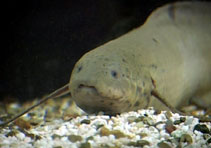 Protopterus dolloi
Foto de Bekins, R.
Imágenes | Google image
Foto de Bekins, R.
Clasificación / Nombres Nombres comunes | Sinónimos | Catalog of Fishes(Género, Especie) | ITIS | CoL | WoRMS | Cloffa
> Ceratodontiformes (Australian lungfishes) > Protopteridae (African lungfishes)
Etymology: Protopterus: Greek, pro = first, in front of + Greek, pteron = wing, fin (Ref. 45335); dolloi: Named after Louis Dollo, for his work on the phylogeny of the lungfishes (Ref. 41613).
Eponymy: Dr Louis Antoine Marie Joséph Dollo (1857–1931) was a French-born Belgian palaeontologist, known for his work on fossil reptiles. [...] (Ref. 128868), visit book page.
More on author: Boulenger.
Etymology: Protopterus: Greek, pro = first, in front of + Greek, pteron = wing, fin (Ref. 45335); dolloi: Named after Louis Dollo, for his work on the phylogeny of the lungfishes (Ref. 41613).
Eponymy: Dr Louis Antoine Marie Joséph Dollo (1857–1931) was a French-born Belgian palaeontologist, known for his work on fossil reptiles. [...] (Ref. 128868), visit book page.
More on author: Boulenger.
Entorno: milieu / zona climática / rango de profundidad / gama de distribución Ecología
; agua dulce demersal. Tropical
Distribución Territorios | Áreas FAO | Ecosistemas | Ocurrencias, apariciones | Mapa de puntos | Introducciones | Faunafri
Africa: widespread in the lower and middle Congo River basin (Ref. 3498, 40587, 81627, 104724). Also known from the Ogowe, Kouilou-Niari and Loeme rivers (Ref. 3498, 40587, 81627).
Tamaño / Peso / Edad
Madurez: Lm ? range ? - ? cm
Max length : 130 cm TL macho / no sexado; (Ref. 3498); peso máximo publicado: 11.0 kg (Ref. 41589)
Max length : 130 cm TL macho / no sexado; (Ref. 3498); peso máximo publicado: 11.0 kg (Ref. 41589)
Descripción breve Claves de identificación | Morfología | Morfometría
Diagnosis: Body cylindrical and more elongate than in other Protopterus species (Ref. 81627). Pectoral and pelvic fins filamentous (Ref. 40587). About 85-95 scales on the longitudinal line between operculum and anus (Ref. 104724).
Body shape (shape guide): elongated; Cross section: circular.
Body shape (shape guide): elongated; Cross section: circular.
Obligate air-breathing (Ref. 126274); Protopterus dolloi is not aestivating in cocoons during the dry-season, because the habitat in which it lives is never completely dry (Ref. 81627); although it never lost the capability to aestivate (Ref. 40587). Therefore, the tunnel which it digs is not for hibernation but functions as a protected chamber during reproduction, which takes place in the dry season (Ref. 81627). The male guards the eggs and larvae in the nest, which is built in the mud of the swamps, while the females can be found in the open water of the rivers (Ref. 41587, 81627). The food of Protopterus dolloi are fishes and insects, but during the time of reproduction its food is more vegetarian (Ref. 40587, 46852).
Ciclo vital y comportamiento de apareamiento Madurez | Reproducción | Puesta | Huevos | Fecundidad | Larva
Nests are found from June until October; the male guards the eggs and young (Ref. 40587).
Referencia principal
Suba sus referencias | Referencias | Coordinador | Colaboradores
Boden, G., 2007. Protopteridae. p. 165-167. In M.L.J. Stiassny, G.G. Teugels and C.D. Hopkins (eds.) The fresh and brackish water fishes of Lower Guinea, West-Central Africa. Volume I. Collection Faune et Flore tropicales 42. Institut de Recherche pour le Développement, Paris, France, Muséum National d’Histoire Naturelle, Paris, France, and Musée Royal de l’Afrique Centrale, Tervuren, Belgium. 800 pp. (Ref. 81627)
Situación en la Lista Roja de la UICN (Ref. 130435: Version 2025-2 (Global))
Least Concern (LC) ; Date assessed: 16 February 2009
CITES
Not Evaluated
Amenaza para el ser humano
Harmless
Usos humanos
Pesquerías: escaso valor comercial
FAO - Publication: search | FishSource |
Más información
Ecología Trófica
Alimentos (presas)
Composición de la dieta
consumo de alimento
Raciones de comida
Despredadores
Alimentos (presas)
Composición de la dieta
consumo de alimento
Raciones de comida
Despredadores
Dinámica de la población
Coeficiente del crecimiento para
Edades / tallas máximas
Longitud-peso rel.
Longitud-longitud rel.
Longitud-frecuencias
Conversión de masas
Reclutamiento
Abundancia
Coeficiente del crecimiento para
Edades / tallas máximas
Longitud-peso rel.
Longitud-longitud rel.
Longitud-frecuencias
Conversión de masas
Reclutamiento
Abundancia
Ciclo de vida
Reproducción
Madurez
Madurez/Gills rel.
Fecundidad
Puesta
Agregaciones de desove
Huevos
Desarrollo de los huevos
Larva
Dinámica larvaria
Reproducción
Madurez
Madurez/Gills rel.
Fecundidad
Puesta
Agregaciones de desove
Huevos
Desarrollo de los huevos
Larva
Dinámica larvaria
Distribución
Territorios
Áreas FAO
Ecosistemas
Ocurrencias, apariciones
Introducciones
BRUVS - Vídeos
Territorios
Áreas FAO
Ecosistemas
Ocurrencias, apariciones
Introducciones
BRUVS - Vídeos
Anatomía
Superficie branquial
Cerebro
Otolito
Superficie branquial
Cerebro
Otolito
Fisiología
Composición corporal
Nutrientes
Consumo del oxígeno
Tipo de natación
Velocidad de natación
Pigmentos visuales
Sonido de peces
Enfermedades y parásitos
Toxicidad (CL50)
Composición corporal
Nutrientes
Consumo del oxígeno
Tipo de natación
Velocidad de natación
Pigmentos visuales
Sonido de peces
Enfermedades y parásitos
Toxicidad (CL50)
Relacionados con el ser humano
Sistemas de acuicultura
Perfiles de acuicultura
Razas
Ciguatera cases
Sellos, monedas, varios
Sistemas de acuicultura
Perfiles de acuicultura
Razas
Ciguatera cases
Sellos, monedas, varios
Herramientas
Cuestionario orgánico | Libro electrónico | Guía de campo | Asistente para frecuencias de tallas | Herramienta de ciclo de vida | Mapa de puntos |
Catch-MSY |
Informes especiales
Comprobar el mantenimiento del acuario | Buscar fichas sobre especies | Consulte las hojas informativas sobre acuicultura
Descargar XML
Fuentes de Internet
AFORO (otoliths) | Aquatic Commons | BHL | Cloffa | Websites from users | Check FishWatcher | CISTI | Catalog of Fishes: Género, Especie | DiscoverLife | ECOTOX | FAO - Publication: search | Faunafri | Fishipedia | Fishtrace | GloBI | Google Books | Google Scholar | Google | IGFA World Record | OneZoom | Open Tree of Life | Otolith Atlas of Taiwan Fishes | Acuarios públicos | PubMed | Reef Life Survey | Socotra Atlas | TreeBase | Árbol de la vida | Wikipedia: Go, búsqueda | World Records Freshwater Fishing | Zoobank | Expediente Zoológico
Estimaciones basadas en modelos
Índice de diversidad filogenética (Referencia 82804): PD50 = 0.6562 [Uniqueness, from 0.5 = low to 2.0 = high].
Bayesian length-weight: a=0.00380 (0.00151 - 0.00959), b=3.10 (2.88 - 3.32), in cm total length, based on LWR estimates for this (Sub)family-body shape (Ref. 93245).
Nivel trófico (Referencia 69278): 3.2 ±0.40 se; based on food items.
Resiliencia (Referencia 120179): Muy bajo, población duplicada en un tiempo mínimo superior a 14 años (Assuming tmax > 30).
Nutrientes (Ref. 124155): Calcium = 34.6 [7.9, 105.9] mg/100g; Iron = 0.98 [0.38, 4.94] mg/100g; Protein = 3.18 [0.00, 7.00] %; Omega3 = 0.247 [0.082, 0.731] g/100g; Selenium = 78.3 [23.7, 253.2] μg/100g; VitaminA = 18.9 [6.9, 48.5] μg/100g; Zinc = 1.29 [0.66, 2.50] mg/100g (wet weight);