



Coryphaenoides rupestris Gunnerus, 1765
Roundnose grenadier
個人による観察記録の追加 Fish Watcher
| Native range | All suitable habitat | Point map | Year 2050 |

|
| This map was computer-generated and has not yet been reviewed. |
| Coryphaenoides rupestris AquaMaps Data sources: GBIF OBIS |
アップロード 写真 そして ビデオ
画像 | グーグルの画像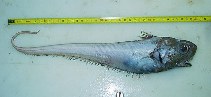 Coryphaenoides rupestris
画像によって Garazo Fabregat, A.
画像 | グーグルの画像
画像によって Garazo Fabregat, A.
分類 / 名前 共通名の | 類義語 | Catalog of Fishes(部類, 種) | ITIS | CoL | WoRMS | Cloffa
> Gadiformes (Cods) > Macrouridae (Grenadiers or rattails)
Etymology: Coryphaenoides: Greek, koryphaina = dolphin fish + Suffix oides = similar to (Ref. 45335).
Etymology: Coryphaenoides: Greek, koryphaina = dolphin fish + Suffix oides = similar to (Ref. 45335).
環境:環境 / 気候帯 / 深さの範囲 / 分布範囲 生態学
海 深海浮遊性; 深さの範囲 180 - 2600 m (Ref. 58426), usually 400 - 1200 m (Ref. 1371). Deep-water; 73°N - 20°N, 77°W - 32°E
分布 領土 | 国連食糧農業機関の区域 | エコシステム | 事件 | 目的のマップ | 導入 | Faunafri
North Atlantic: from about 37°N to Baffin Island and Greenland in the western Atlantic, and off Iceland and Norway to 73°N to Barents Sea, south to North Africa in the eastern Atlantic. Reported to occur from the tongue of the Ocean east of Andros Islands (about 24°N, 77°W) in the Bahamas.
初回成熟時の長さ / サイズ / 重さ / 年齢
成熟: Lm 52.7, range 60 - ? cm
Max length : 110 cm TL オス/雌雄の選別がない; (Ref. 35388); 最大公表体重: 1.7 kg (Ref. 40637); 最大記録サイズ: 54 年 (Ref. 41452)
Max length : 110 cm TL オス/雌雄の選別がない; (Ref. 35388); 最大公表体重: 1.7 kg (Ref. 40637); 最大記録サイズ: 54 年 (Ref. 41452)
簡単な記述 検索表 | 形態学 | 形態計測学
背面の脊椎 (合計) : 2; 肛門の骨: 0. Head broad, rather soft; snout broad, rounded, with a large blunt tubercular scute at its tip; chin with small barbel. Scales relatively adherent; spinules dense on body scales, long, thin and recurved, narrowly lanceolate, with longitudinal anterior concavity. Pyloric caeca 29 to 31, long and slender. Color medium brown to grayish; orbits, oral and branchial cavities, and fins blackish to brownish gray.
Body shape (shape guide): elongated; Cross section: circular.
Body shape (shape guide): elongated; Cross section: circular.
Benthopelagic to bathypelagic in about 400 and 1200 m depth. Minimum depth from Ref. 1371. Form large schools at 600 to 900 m depth (Ref. 9988). Feed on a variety of fish and invertebrates, but primarily on pelagic crustaceans such as shrimps, amphipods and cumaceans; cephalopods and lantern fishes constitute a lesser portion of the diet. Batch spawner (Ref. 51846). This species is currently facing overexploitation in the North Atlantic. Utilized frozen and for fishmeal; can be fried and baked (Ref. 9988).
ライフサイクルと交尾行動 成熟 | 繁殖 | 放精 | 卵 | 生産力 | 幼生
主な参考文献
参考文献のアップロード | 参考文献 | コーディネーター : Iwamoto, Tomio | 協力者
Cohen, D.M., T. Inada, T. Iwamoto and N. Scialabba, 1990. FAO species catalogue. Vol. 10. Gadiform fishes of the world (Order Gadiformes). An annotated and illustrated catalogue of cods, hakes, grenadiers and other gadiform fishes known to date. FAO Fish. Synop. 125(10). Rome: FAO. 442 p. (Ref. 1371)
IUCNのレッドリストの状況は (Ref. 130435: Version 2025-2 (Global))
絶滅寸前の危機的状況 (CR) (A4bd); Date assessed: 11 July 2012
CITES
Not Evaluated
人間に対する脅威
Harmless
人間の用途
水産業: 商業
FAO - 水産業: 種の外形, landings search; Publication: search | FIRMS - Stock assessments | FishSource | 私達の周りの海
より多くの情報
遺伝子の
ゲノム
遺伝子の
ヘテロ接合性
遺伝
遺伝的多様性
ゲノム
遺伝子の
ヘテロ接合性
遺伝
遺伝的多様性
用具
特記事項
XMLをダウンロードして下さい
インターネットの情報源
AFORO (otoliths) | Aquatic Commons | BHL | Cloffa | Websites from users | Check FishWatcher | CISTI | Catalog of Fishes: 部類, 種 | DiscoverLife | ECOTOX | FAO - 水産業: 種の外形, landings search; Publication: search | Faunafri | Fishipedia | Fishtrace | GloBI | Google Books | Google Scholar | Google | IGFA World Record | 国のデーターベース | OneZoom | Open Tree of Life | Otolith Atlas of Taiwan Fishes | PubMed | Reef Life Survey | Socotra Atlas | TreeBase | 生命の木 | Wikipedia: 行く, 検索する | World Records Freshwater Fishing | Zoobank | 動物に関する記録
モデルに基づく推定値
|
系統多様性指数 (参照 82804) |
PD50 = 0.5000 [Uniqueness, from 0.5 = low to 2.0 = high]. |
| Bayesian length-weight | a=0.00219 (0.00112 - 0.00429), b=3.20 (3.03 - 3.37), in cm total length, based on LWR estimates for this (Sub)family-body shape (Ref. 93245). |
|
栄養段階 (参照 69278) |
3.7 ±0.56 se; based on food items. |
|
回復力 (参照 120179) |
低い, 4.5年~14年の倍増期間の最小個体群 (K=0.1; tm=9-11; tmax=54; Fec=10,000). |
| Rate of population increase | Prior r = 0.27, 95% CL = 0.18 - 0.40, Based on 4 full stock assessments. |
|
漁業の脆弱性 (Ref. 59153) |
High to very high vulnerability (72 of 100). 🛈 |
|
気候脆弱性 (Ref. 125649) |
Moderate vulnerability (38 of 100). 🛈 |
|
価格帯 (Ref. 80766) |
Low. |
|
栄養素 (Ref. 124155) |
Calcium = 17.4 [5.5, 40.4] mg/100g; Iron = 0.296 [0.130, 0.842] mg/100g; Protein = 17.3 [15.4, 19.0] %; Omega3 = 0.104 [0.041, 0.263] g/100g; Selenium = 26.9 [9.0, 74.3] μg/100g; VitaminA = 21.2 [2.7, 168.7] μg/100g; Zinc = 0.429 [0.232, 0.866] mg/100g (wet weight); |