



Aapticheilichthys websteri (Huber, 2007)
Carregue seu(sua) Fotos e vídeos
Fotos | Imagem do Google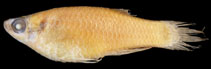 Aapticheilichthys websteri
Foto de Musschoot, T.
Fotos | Imagem do Google
Foto de Musschoot, T.
Classificação / Nomes Nomes comuns | Sinônimos | Catalog of Fishes(Gênero, Espécies) | ITIS | CoL | WoRMS | Cloffa
> Cyprinodontiformes (Rivulines, killifishes and live bearers) > Procatopodidae (African lampeyes) > Procatopodinae
Etymology: websteri: Named for Kent Webster, discoverer of the species on the night of the Asian tsunami, who has devoted much of his life to breeding aquarium fishes, notably Australian and New Guinean rainbows, professionally in the Peninsula Hatchery, Gardena, California (Ref. 78622).
Eponymy: Kent Webster (d: 1959) is an American aquarist at the Peninsula Hatchery, Gardena, California. He discovered this killifish and was honoured as he has “…devoted much of his life to breeding aquarium fishes”, notably Australasian rainbowfish. (Ref. 128868), visit book page.
Etymology: websteri: Named for Kent Webster, discoverer of the species on the night of the Asian tsunami, who has devoted much of his life to breeding aquarium fishes, notably Australian and New Guinean rainbows, professionally in the Peninsula Hatchery, Gardena, California (Ref. 78622).
Eponymy: Kent Webster (d: 1959) is an American aquarist at the Peninsula Hatchery, Gardena, California. He discovered this killifish and was honoured as he has “…devoted much of his life to breeding aquarium fishes”, notably Australasian rainbowfish. (Ref. 128868), visit book page.
Meio ambiente: milieu / Zona climática / intervalo de profundidade / faixa de distribuição Ecologia
; Água doce bentopelágico. Tropical
Distribuição Territórios | Áreas da FAO | Ecossistemas | Ocorrências | Mapa de pontos | Introduções | Faunafri
Africa: Akaka Camp in western Gabon (Ref. 78622).
Tamanho / Peso / Idade
Descrição suscinta Chaves de identificação | Morfologia | Morfometria
Espinhos dorsais (total) : 0; Raios dorsais (total) : 7 - 9; Espinhos anais: 0; Raios anais : 11 - 13. Diagnosis: It is distinguished from all other lampeyes by the superimposed insertion of dorsal and anal fins vs. dorsal fin insertion always posterior to anal fin insertion by at least 4 rays; besides it is separated from the similarly patterned and sympatric Aplocheilichthys spilauchen by the smaller maximum size in both sexes, by the more advanced dorsal fin, by the less high peduncular depth, by the presence of red pigment markings on male sides and unpaired fins vs. silvery or gold markings, by the absence of a barred pattern on male sides vs. presence, by the absence of melanistic pigments on body vs. with many dark small spots, by the absence of extended rays in male posterior anal fin vs. presence, and by being more laterally compressed; it is separated from Procatopus, Plataplochilus and Rhexipanchax species by the more sharply pointed mouth in addition to the D/A value (Ref. 78622). It is separated from its congeners living in the same region from southern Equatorial Guinea to Cabinda by the rounded shape of the posterior margin of dorsal and anal fins in both sexes vs. cut straight along the last ray, by the vertical red bars in male vs. never such a pattern, by the more conspicious reticulated gray 'net along scale edges vs. faint or absent, and by the absence of an upper acumen or extension in caudal fin of dominant male vs. presence (Ref. 78622).
Body shape (shape guide): fusiform / normal.
Body shape (shape guide): fusiform / normal.
Found in a river less than 10 meters wide and less than 1 meter depth during dry season, warm water of over 80°F during the day, slightly acid water, pH just over 6, in primary forest (Ref. 78622). Non-annual reproduction with two weeks' water incubation of eggs and schooling in small groups of a few dozens of specimens of various ages and dominance; several individualos may have gone through a sex change (Ref. 78622).
Ciclo de vida ou comportamento de acasalamento Maturidade | Reprodução | Desova | Ovos | Fecundidade | Larvas
Referência principal
Carregar suas referências | Referências | Coordenador | Colaboradores
Huber, J.H., 2007. Procatopus websteri: a new species of lampeye killifish from Akaka Camp, western Gabon (Teleostei: Poeciliidae: Aplocheilichthyinae), exhibiting similarities of pattern and morphology with another sympatric lampeye species, Aplocheilichthys spilauchen. Trop. Fish Hobbyist 55(1):110-114. (Ref. 78622)
CITES
Not Evaluated
Ameaça para os humanos
Harmless
Uso pelos humanos
Pescarias: sem interesse
FAO - Publication: search | FishSource |
Mais informação
Ecologia Trófica
Itens alimentares (presas)
Composição da dieta
Consumo alimentar
Rações alimentares
Predadores
Itens alimentares (presas)
Composição da dieta
Consumo alimentar
Rações alimentares
Predadores
Dinâmica populacional
Parâmetros de crescimento
Idade máxima / tamanhos
Relação comprimento-peso.
Relação comprimento-comprimento.
Frequências de comprimento
Conversão de massa
Recrutamento
Abundância
Parâmetros de crescimento
Idade máxima / tamanhos
Relação comprimento-peso.
Relação comprimento-comprimento.
Frequências de comprimento
Conversão de massa
Recrutamento
Abundância
Ciclo de vida
Reprodução
Maturidade
Maturidade/Rel. das guelras
Fecundidade
Desova
Agregações de desova
Ovos
Desenvolvimento dos ovos
Larvas
Dinâmica larval
Reprodução
Maturidade
Maturidade/Rel. das guelras
Fecundidade
Desova
Agregações de desova
Ovos
Desenvolvimento dos ovos
Larvas
Dinâmica larval
Anatomia
Área branquial
Cérebro
Otólito
Área branquial
Cérebro
Otólito
Fisiologia
Composição corporal
Nutrientes
Consumo de oxigênio
Tipo de natação
Velocidade de natação
Pigmentos visuais
Som de peixe
Doenças e Parasitas
Toxicidade (LC50s)
Composição corporal
Nutrientes
Consumo de oxigênio
Tipo de natação
Velocidade de natação
Pigmentos visuais
Som de peixe
Doenças e Parasitas
Toxicidade (LC50s)
Genética
genoma
Genética
Heterozigosidade
Hereditariedade
Diversidade genética
genoma
Genética
Heterozigosidade
Hereditariedade
Diversidade genética
Relacionado a humanos
Sistemas de aquicultura
Perfis para aquacultura
Estirpes
Casos de Ciguatera
Selos, moedas, diversos.
Sistemas de aquicultura
Perfis para aquacultura
Estirpes
Casos de Ciguatera
Selos, moedas, diversos.
Ferramentas
Livro eletrônico | Guia de campo | Ferramenta auxiliar de frequências de comprimento | Ferramenta sobre a história de vida | Mapa de pontos |
Catch-MSY |
Relatórios especiais
Checar Manutenção em Aquário | Checar Planilhas de Fatos sobre as Espécies | Checar Planilhas de Fatos sobre Aquicultura
Baixar XML
Fontes da internet
AFORO (otoliths) | Aquatic Commons | BHL | Cloffa | Websites from users | Checar Observador de Peixes (FishWatcher) | CISTI | Catalog of Fishes: Gênero, Espécies | DiscoverLife | ECOTOX | FAO - Publication: search | Faunafri | Fishipedia | Fishtrace | GloBI | Google Books | Google Scholar | Google | IGFA World Record | OneZoom | Open Tree of Life | Otolith Atlas of Taiwan Fishes | PubMed | Reef Life Survey | Socotra Atlas | TreeBase | Árvore da vida | Wikipedia: Ir para, procura | World Records Freshwater Fishing | Registro zoológico
Estimativas baseadas em modelos
Índice de diversidade filogenética (Ref. 82804): PD50 = 1.0000 [Uniqueness, from 0.5 = low to 2.0 = high].
Bayesian length-weight: a=0.01122 (0.00514 - 0.02450), b=3.04 (2.87 - 3.21), in cm total length, based on all LWR estimates for this body shape (Ref. 93245).
Nível Trófico (Ref. 69278): 3.1 ±0.4 se; based on size and trophs of closest relatives