This website uses cookies to enhance your browsing experience and ensure the functionality of our site. For more detailed information about the types of cookies we use and how we protect your privacy, please visit our Privacy Information page.
×
Cookie Settings
This website uses different types of cookies to enhance your experience. Please select your preferences below:
> Gobiiformes (Gobies) > Gobiidae (Gobies) > Gobiinae
Etymology: Trimma:Greek, trimma, -atos = something crushed (Ref. 45335); hamartium:Name from the Greek word 'hamartia' (ἁμαρτία) m alluding to the author’s error in not recognizing the differences between this species and T. preclarum when describing the latter (the term encompasses 'wrongdoings' which may be either accidental or deliberate).
Окружающая среда: среда / климатическая зона / пределы глубины / диапазон распространения экология
морской ассоциированный с рифами; пределы глубины 7 - 50 m (Ref. 116838). Tropical
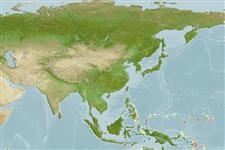
Western Pacific: southwest Palau and probably true for Fiji (paratypes of T. preclarum), Niue, Solomon Is., Indonesia (Mapia Atoll), Australia (GBR) and Kiribati (Abaiang Atoll).
Размер / Вес / Возраст
половая зрелость: Lm? range ? - ? cm Max length : 2.5 cm SL самец/пол неопределен; (Ref. 116838)
Краткое описание определительные ключи | морфология | морфометрия
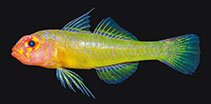
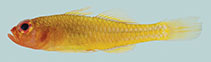
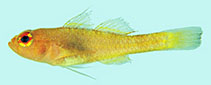
колючие лучи спинного плавника (общее число) : 7; членистые (мягкие) лучи спинного плавника (общее число) : 9; колючие лучи анального плавника: 1; членистые (мягкие) лучи анального плавника: 8 - 9. This species is distinguished by the following characters: no scales on the cheeks and opercle; 8-9 scales in predorsal midline; short second dorsal spine reaching to a mean of the base of the first ray of the second dorsal fin when abducted; pectoral-fin rays 17-19 with 5-10 branched rays in the middle of the fin; an unbranched 5th pelvic-fin ray, 51-64% the length of 4th ray; total gill rakers 17-19; papillae in row c 6, below the eye; U-shaped bony interorbital with a narrow slit-like postorbital trench which ends at the posteriormost papilla in row p; colour when freshly collected, a reddish head with 3-4 yellow bars on the cheek, red iris with four yellow spots, yellow body which is lighter posteriorly, scales pockets outlined with melanophores and scale rows above and below midlateral row much lighter posterior to second dorsal fin origin (giving appearance of three yellow stripes on body); colour when preserved with fairly evenly distributed melanophores over the dorsal surface of the snout (Ref. 116838). Body shape (shape guide): elongated; Cross section: oval.
Found in areas with heavy cover of hard corals (Acropora, Pocillopora, Millepora, plate corals, lettuce corals star and cactus corals), variety of sponges, sea whips, ascidians, alcyonarians, tunicates, hydoids (in caves), soft corals, gorgonians, brown encrusting algae; and also on steep reef slopes and almost vertical walls with several large caves with sand/rubble floors, undercuts and small platforms (Ref. 116838).
Жизненный цикл и брачное поведение половая зрелость | размножение | нерест | икра | Плодовитость | личинки
Winterbottom, R., 2018. A new species of Trimma (Pisces; Gobiidae) from the South-West Islands of Palau, western Pacific Ocean. Zootaxa 4370(2):123-136. (Ref. 116838)
Статус Красного Списка МСОП (Ref. 130435: Version 2025-2 (Global))
Динамика численности населения Параметры роста Макс. возраст / размер Отношение длины к весу. Отношение длины к длине. Размерный состав Преобразование массы пополнение численность
Жизненный цикл размножение половая зрелость Зрелость/Жиры относительно. Плодовитость нерест Нерестовые скопления икра Развитие икры личинки динамика численности личинок
распространение Территории регионы FAO Экосистемы места находок интродукции BRUVS - Видео
Анатомия жаберная область Мозг Отолит
Физиология Состав тела Питательные вещества Потребление кислорода Тип плавания Скорость плавания Зрительные пигменты Звук рыбы Болезни и паразиты Токсичность (LC50s)
Индекс филогенетического разнообразия (ссылка 82804): PD50 = 0.5000 [Uniqueness, from 0.5 = low to 2.0 = high].
Bayesian length-weight: a=0.00741 (0.00347 - 0.01582), b=3.09 (2.91 - 3.27), in cm total length, based on LWR estimates for this (Sub)family-body shape (Ref. 93245).
устойчивость к внешним воздействиям (ссылка 120179): высокий, минимальное время удвоения популяции до 15 месяцев (Preliminary K or Fecundity.).