This website uses cookies to enhance your browsing experience and ensure the functionality of our site. For more detailed information about the types of cookies we use and how we protect your privacy, please visit our Privacy Information page.
×
Cookie Settings
This website uses different types of cookies to enhance your experience. Please select your preferences below:
> Gobiiformes (Gobies) > Gobiidae (Gobies) > Gobiinae
Etymology: Trimma:Greek, trimma, -atos = something crushed (Ref. 45335); hamartium:Name from the Greek word 'hamartia' (ἁμαρτία) m alluding to the author’s error in not recognizing the differences between this species and T. preclarum when describing the latter (the term encompasses 'wrongdoings' which may be either accidental or deliberate).
Ambiente: milieu / zona climatica / distribuzione batimetrica / gamma di distribuzione Ecologia
marino associati a barriera corallina; distribuzione batimetrica 7 - 50 m (Ref. 116838). Tropical
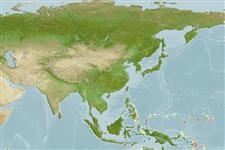
Western Pacific: southwest Palau and probably true for Fiji (paratypes of T. preclarum), Niue, Solomon Is., Indonesia (Mapia Atoll), Australia (GBR) and Kiribati (Abaiang Atoll).
Dimensione / Peso / Età
Maturità: Lm? range ? - ? cm Max length : 2.5 cm SL maschio/sesso non determinato; (Ref. 116838)
Breve descrizione Chiavi di identificazione | Morfologia | Morfometria
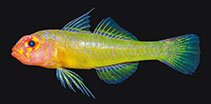
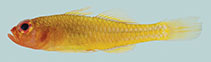
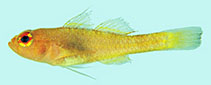
Spine dorsali (totale) : 7; Raggi dorsali molli (totale) : 9; Spine anali: 1; Raggi anali molli: 8 - 9. This species is distinguished by the following characters: no scales on the cheeks and opercle; 8-9 scales in predorsal midline; short second dorsal spine reaching to a mean of the base of the first ray of the second dorsal fin when abducted; pectoral-fin rays 17-19 with 5-10 branched rays in the middle of the fin; an unbranched 5th pelvic-fin ray, 51-64% the length of 4th ray; total gill rakers 17-19; papillae in row c 6, below the eye; U-shaped bony interorbital with a narrow slit-like postorbital trench which ends at the posteriormost papilla in row p; colour when freshly collected, a reddish head with 3-4 yellow bars on the cheek, red iris with four yellow spots, yellow body which is lighter posteriorly, scales pockets outlined with melanophores and scale rows above and below midlateral row much lighter posterior to second dorsal fin origin (giving appearance of three yellow stripes on body); colour when preserved with fairly evenly distributed melanophores over the dorsal surface of the snout (Ref. 116838). Body shape (shape guide): elongated; Cross section: oval.
Found in areas with heavy cover of hard corals (Acropora, Pocillopora, Millepora, plate corals, lettuce corals star and cactus corals), variety of sponges, sea whips, ascidians, alcyonarians, tunicates, hydoids (in caves), soft corals, gorgonians, brown encrusting algae; and also on steep reef slopes and almost vertical walls with several large caves with sand/rubble floors, undercuts and small platforms (Ref. 116838).
Ciclo vitale e comportamento di accoppiamento Maturità | Riproduzione | Deposizione | Uova | Fecondità | Larve
Winterbottom, R., 2018. A new species of Trimma (Pisces; Gobiidae) from the South-West Islands of Palau, western Pacific Ocean. Zootaxa 4370(2):123-136. (Ref. 116838)
Stato della Lista Rossa IUCN (Ref. 130435: Version 2025-2 (Global))
Dinamica della popolazione Parametri di crescita Età massima / dimensioni massime Rapporto lunghezza-peso. Lunghezza-lunghezza rel. Lunghezza-frequenze Conversione di massa Reclutamento Abbondanza
Ciclo di vita Riproduzione Maturità Maturità/Gli occhielli sono relativi. Fecondità Deposizione Aggregazioni riproduttive Uova Sviluppo delle uova Larve Dinamica popolazioni larvali
Distribuzione Territories Aree FAO Ecosistemi Presenze Introduzioni BRUVS - Video
Anatomia Area branchiale Cervello Otolite
Fisiologia Composizione corporea Nutrienti Consumo di ossigeno Tipo di nuoto Velocità di nuoto Pigmenti visivi Suono del pesce Malattie e parassiti Tossicità (LC50)
Indice di diversità filogenetica (Fonte Biblio. 82804): PD50 = 0.5000 [Uniqueness, from 0.5 = low to 2.0 = high].
Bayesian length-weight: a=0.00741 (0.00347 - 0.01582), b=3.09 (2.91 - 3.27), in cm total length, based on LWR estimates for this (Sub)family-body shape (Ref. 93245).
Resilienza (Fonte Biblio. 120179): Alto, tempo minimo di raddoppiamento della popolazione meno di 15 mesi (Preliminary K or Fecundity.).
Vulnerabilità della pesca (Ref. 59153): Low vulnerability (10 of 100). 🛈