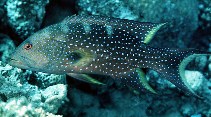
Variola louti, Yellow-edged lyretail : fisheries, gamefish, aquarium

Variola louti (Fabricius, 1775)

Yellow-edged lyretail
Lägg till din observation i Fish Watcher
Native range | All suitable habitat | Point map | Year 2050
This map was computer-generated and has not yet been reviewed.
Variola louti   AquaMaps   Data sources: GBIF OBIS
Ladda upp din foton och Videor
Bilder | Videor | Frimärken, mynt, diverse. | Google image

Klassificering / Namn Populärnamn | synonymer | Catalog of Fishes(Släkte, Arter) | ITIS | CoL | WoRMS | Cloffa

> Perciformes/Serranoidei (Groupers) > Epinephelidae (Groupers)
Etymology: Variola: Latin, variolus = pustule, pock (Ref. 45335).
Eponymy: This is not an eponym but, according to the author, Louti was an Arabic name for the fish. (Ref. 128868), visit book page.

Miljö: miljö / Klimatzon / djupintervall / distributionsområde Ekologi

marina revassocierade; ej vandrande; djupintervall 3 - 300 m (Ref. 89972), usually 15 - ? m (Ref. 5222). Tropical; 30°N - 37°S, 30°E - 23°W (Ref. 5222)

Utbredning Territorier | FAO områden | Ekosystem | Förekomster | Prickkarta | Utplanteringar | Faunafri

Indo-Pacific: Red Sea to South Africa and the Pitcairn Islands, north to southern Japan, south to New South Wales, Australia. Not found in the Persian Gulf nor in Hawaii.

Längd vid första mognad / Storlek / Vikt / Ålder

Könsmognad: Lm 47.6, range 41 - ? cm
Max length : 83.0 cm TL hane/ej könsbestämd; (Ref. 40637); common length : 75.0 cm TL hane/ej könsbestämd; (Ref. 5450); publicerad maxvikt: 12.0 kg (Ref. 5222)

Kort beskrivning Bestämningsnycklar | Morfologi | Morfometri

Taggstrålar i ryggfenan (totalt) : 9; Mjukstrålar i ryggfenan (totalt) : 13 - 14; Taggstrålar i analfenan: 3; Mjukstrålar i analfenan: 8. This species is distinguished by the following characters: body oblong, its depth less than head length and 2.8-3.3 in SL; preopercle rounded, finely serrate, the lower edge fleshy; opercle with 3 flat spines; upper edge of operculum almost straight; 1-3 large canines at midside of lower jaw; gill rakers of first gill arch 7-10 + 15-18 (including 6-87 rudiments on each limb); D IX,13-14; caudal fin lunate, the upper and lower lobes produced, about twice length of middle rays; pectoral-fin rays 16-19; lateral-line scales 66-77; lateral scale series 113-135. Colour of head, body, and median fins yellowish brown to orange-red (specimens from deep water more reddish) with numerous small round or elongate spots of blue, lavender or pink; rear margin of median fins broadly yellow; pectoral-fin rays red to brown, the distal third abruptly yellow[ large juveniles (10-25 cm SL) with irregular black band along dorsal part of body ending below rear of dorsal fin and continuing on head (up to eye) as 3 irregular black spots; black blotch at base of upper caudal-fin rays; head and body (including black band) with small pale blue to pink spots; a pale yellow or white stripe mid-dorsally on head from tip of lower jaw to dorsal-fin origin; small juveniles (< 7 cm SL) lack the black band and black spots on dorsal part of head and body (Ref. 39231, 89707, 90102).
Body shape (shape guide): fusiform / normal; Cross section: oval.

Biologi     Ordlista (t.ex. epibenthic)

Usually seen in clear-water areas at depths below 15 m, and prefers islands and offshore reefs rather than continental shores. Feeds mainly on fishes, and on crabs, shrimps and stomatopods. It is highly appreciated for the quality of its flesh. It may not be sold in Mauritius because of cases of ciguatera poisoning (Ref. 11888). In the Hong Kong live fish markets (Ref. 27253). This common and important food fish is caught with handlines, spear, and traps (Ref. 39231).

Livscykel och parningsbeteende Könsmognad | Reproduktion | Lek | Ägg | Fekunditet | Larver

Huvudreferens Ladda upp dina referenser | referenser | Koordinator | Medarbetare

Heemstra, P.C. and J.E. Randall, 1993. FAO Species Catalogue. Vol. 16. Groupers of the world (family Serranidae, subfamily Epinephelinae). An annotated and illustrated catalogue of the grouper, rockcod, hind, coral grouper and lyretail species known to date. Rome: FAO. FAO Fish. Synop. 125(16):382 p. (Ref. 5222)

Status på IUCN:s rödlista (Ref. 130435: Version 2025-2 (Global))

  Least Concern (LC) ; Date assessed: 22 November 2016

CITES

Not Evaluated

CMS (Ref. 116361)

Not Evaluated

Hot mot människor

  Reports of ciguatera poisoning (Ref. 4690)


Mänskliga användningsområden

Fiskeri: kommersiell; sportfisk: ja; Akvarium: Kommersiell
FAO - fiskeri: landningar; Publication: search | FishSource | Havet omkring oss

Ytterligare information

Trofisk ekologi
Livsmedelsartiklar (preys)
Födosammansättning
Födointag
Matransoner
Predatorer
Ekologi
Ekologi
Populationsdynamik
Tillväxtparametrar
Max. åldrar / storlekar
Längd-vikt rel.
Längd-längd rel.
Längd-frekvenser
Massakonvertering
Rekrytering
Abundans
Livscykel
Reproduktion
Könsmognad
Mognad/Gills rel.
Fekunditet
Lek
Lekande aggregat
Ägg
Utveckling av ägg
Larver
Larvdynamik
Utbredning
Territorier
FAO områden
Ekosystem
Förekomster
Utplanteringar
BRUVS - Videor
Anatomi
Gälyta
Hjärna
Otolit
Fysiologi
Kroppssammansättning
Näringsämnen
Syreförbrukning
Typ av simning
Simhastighet
Visuella pigment
Ljud från fisk
Sjukdomar & Parasiter
Toxicitet (LC50)
Genetik
Genom
Genetik
Heterozygositet
Ärftlighet
Genetisk mångfald
Människorelaterad
Vattenbrukssystem
Vattenbruksprofiler
Avelslinjer
Ciguatera-fall
Frimärken, mynt, diverse.
Uppsökande verksamhet
Medarbetare
referenser
referenser

Verktyg

Särskilda rapporter

Ladda ner XML

Internet-källor

AFORO (otoliths) | Aquatic Commons | BHL | Cloffa | Websites from users | Check FishWatcher | CISTI | Catalog of Fishes: Släkte, Arter | DiscoverLife | ECOTOX | FAO - fiskeri: landningar; Publication: search | Faunafri | Fishipedia | Fishtrace | GloBI | Google Books | Google Scholar | Google | IGFA World Record | Nationella databaser | OneZoom | Open Tree of Life | Otolith Atlas of Taiwan Fishes | PubMed | Reef Life Survey | Socotra Atlas | TreeBase | Tree of Life | Wikipedia: Go, sök | World Records Freshwater Fishing | Zoologiskt register

Uppskattningar baserade på modeller

Önskad temperatur (Ref. 123201): 20.1 - 28.9, mean 27.2 °C (based on 2394 cells).
Index för fylogenetisk mångfald (Ref. 82804):  PD50 = 0.7500   [Uniqueness, from 0.5 = low to 2.0 = high].
Bayesian length-weight: a=0.01096 (0.00998 - 0.01204), b=3.04 (3.01 - 3.07), in cm total length, based on LWR estimates for this species (Ref. 93245).
Trofisk nivå (Ref. 69278):  4.3   ±0.7 se; based on diet studies.
Generation time: 6.1 ( na - na) years. Estimated as median ln(3)/K based on 2 growth studies.
Resiliens (Ref. 120179):  Mellan, lägsta populationsfördubblingstid 1,4-4,4 år (Tmax=7-15; K=0.18).
Sårbarhet i fisket (Ref. 59153):  Moderate vulnerability (43 of 100). 🛈
Sårbarhet för klimatet (Ref. 125649):  High to very high vulnerability (72 of 100). 🛈
Priskategori (Ref. 80766):   Very high.
Näringsämnen (Ref. 124155):  Calcium = 23.1 [14.3, 39.1] mg/100g; Iron = 0.488 [0.265, 0.792] mg/100g; Protein = 18.6 [16.8, 20.3] %; Omega3 = 0.161 [0.108, 0.250] g/100g; Selenium = 51.4 [30.8, 91.4] μg/100g; VitaminA = 106 [40, 341] μg/100g; Zinc = 0.738 [0.519, 1.037] mg/100g (wet weight);