



Hochladen Photos und videos
Bilder | Google Bild
Bilder | Google Bild
- Channa punctata
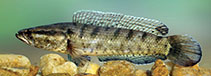
Photo von Ramani Shirantha
- Channa punctata

Juvenile Photo von Ramani Shirantha
Klassifizierung / Names Namen | Synonyme | Catalog of Fishes(Gattung, Arten) | ITIS | CoL | WoRMS | Cloffa
> Anabantiformes (Gouramies, snakeheads) > Channidae (Snakeheads)
Etymology: Channa: Greek, channe, -es = an anchovy (Ref. 45335).
More on author: Bloch.
Etymology: Channa: Greek, channe, -es = an anchovy (Ref. 45335).
More on author: Bloch.
Umwelt: Milieu / Klimazone / Tiefenbereich / Verbreitungsgebiet Ökologie
; süßwasser; brackwasser benthopelagisch; potamodrom (Ref. 51243). Tropical; 22°C - 28°C (Ref. 2059)
Verbreitung Territorien | FAO Gebiete | Ökosysteme | Vorkommen | Punkt Karte | Einführungen | Faunafri
Asia: Afghanistan, Pakistan, India, Sri Lanka, Nepal, Bangladesh, Myanmar and Yunnan in China.
Größe / Gewicht / Alter
Geschlechtsreife: Lm ? range ? - ? cm
Max length : 31.0 cm TL Männchen/unbestimmt; (Ref. 4833); common length : 15.0 cm TL Männchen/unbestimmt; (Ref. 6028)
Max length : 31.0 cm TL Männchen/unbestimmt; (Ref. 4833); common length : 15.0 cm TL Männchen/unbestimmt; (Ref. 6028)
Kurzbeschreibung Bestimmungsschlüssel | Morphologie | Morphometrie
Body shape (shape guide): elongated.
Obligate air-breathing (Ref. 126274); Found in ponds, swamps, brackish water (Ref. 6028), ditches and beels (Ref. 1479). Adults prefer stagnant waters in muddy streams (Ref. 4833). Feed on worms, insects and small fish (Ref. 6028). Accept chopped fish and shrimp in the aquarium. Breed throughout the year. Mitochondrial hypertrophy, noted in the double cone of the retina of this species, is considered a basic process in oil droplet formation (Ref. 10557) believed to be an adaptation for enhanced visual contrast detection in turbid waters (Ref. 10407). Used as live bait for angling larger snakeheads.
Lebenszyklus und Paarungsverhalten Geschlechtsreife | Fortpflanzung | Ablaichen | Eier | Fruchtbarkeit | Larven
Spawning usually takes place at night in shallow water with a silty substrate. Eggs are laid in nests through elaborate tunnels in vegetated areas which look like vertical columns of water with the eggs floating in the center (Ref. 205). The male and female move towards the center of the nest during spawning where the male entwines his body to the female moving upward while releasing the eggs to be fertilised (Ref. 45309). Eggs are guarded by one or both parents. Hatching takes place in a day (Ref. 6028).
Hauptreferenz
Laden Sie Ihre Referenzen hoch | Referenzen | Koordinator | Partner
Pethiyagoda, R., 1991. Freshwater fishes of Sri Lanka. The Wildlife Heritage Trust of Sri Lanka, Colombo. 362 p. (Ref. 6028)
IUCN Rote Liste Status (Ref. 130435: Version 2025-2 (Global))
nicht bedroht (LC) ; Date assessed: 11 August 2019
CITES
Not Evaluated
Bedrohung für Menschen
Harmless
Nutzung durch Menschen
Fischereien: kommerziell; Aquakultur: kommerziell; Aquarium: Kommerziell; Köder: occasionally
FAO - Publication: search | FishSource |
Mehr Information
Trophische Ökologie
Lebensmittel (Beutetiere)
Nahrungszusammensetzung
Nahrungsaufnahme
Lebensmittelrationen
Räuber
Lebensmittel (Beutetiere)
Nahrungszusammensetzung
Nahrungsaufnahme
Lebensmittelrationen
Räuber
Populationsdynamik
Wachstumsparameter
Max. Alter/Größen
Länge-Gewicht-Rel.
Länge-Länge-Verhältnis.
Längenhäufigkeiten
Massenkonvertierung
Rekrutierung
Dichte
Wachstumsparameter
Max. Alter/Größen
Länge-Gewicht-Rel.
Länge-Länge-Verhältnis.
Längenhäufigkeiten
Massenkonvertierung
Rekrutierung
Dichte
Lebenszyklus
Fortpflanzung
Geschlechtsreife
Reifung/Kiemen rel.
Fruchtbarkeit
Ablaichen
Laichaggregationen
Eier
Eientwicklung
Larven
Larven Pop.Dyn.
Fortpflanzung
Geschlechtsreife
Reifung/Kiemen rel.
Fruchtbarkeit
Ablaichen
Laichaggregationen
Eier
Eientwicklung
Larven
Larven Pop.Dyn.
Physiologie
Körperliche Zusammensetzung
Nährstoffe
Sauerstoffverbrauch
Schwimmart
Schwimmgeschwindigkeit
Visuelle Pigmente
Fischgeräusche
Krankheiten und Parasiten
Toxizität (LC50s)
Körperliche Zusammensetzung
Nährstoffe
Sauerstoffverbrauch
Schwimmart
Schwimmgeschwindigkeit
Visuelle Pigmente
Fischgeräusche
Krankheiten und Parasiten
Toxizität (LC50s)
Menschenbezogen
Aquakultur-Systeme
Aquakultur Profile
Zuchtlinien
Ciguatera-Fälle
Briefmarken, Münzen, Verschiedenes.
Aquakultur-Systeme
Aquakultur Profile
Zuchtlinien
Ciguatera-Fälle
Briefmarken, Münzen, Verschiedenes.
Tools
Bio-Quiz | E-Book | Feldführer | Längenhäufigkeits Tool | Lebensdaten Tool | Punkt Karte |
Catch-MSY |
Zusatzinformationen
Download XML
Zusammenfassung | Punktdaten | Namen | Photos
Internet Quellen
AFORO (otoliths) | Aquatic Commons | BHL | Cloffa | Websites from users | FishWatcher Einträge suchen | CISTI | Catalog of Fishes: Gattung, Arten | DiscoverLife | ECOTOX | FAO - Publication: search | Faunafri | Fishipedia | Fishtrace | GloBI | Google Books | Google Scholar | Google | IGFA World Record | OneZoom | Open Tree of Life | Otolith Atlas of Taiwan Fishes | PubMed | Reef Life Survey | Socotra Atlas | TreeBase | Tree of Life | Wikipedia: Gehe zu, Suchen | World Records Freshwater Fishing | Zoologischer Rekord
Schätzungen auf der Grundlage von Modellen
Phylogenetischer Diversitätsindex (Ref. 82804): PD50 = 0.5000 [Uniqueness, from 0.5 = low to 2.0 = high].
Bayesian length-weight: a=0.00955 (0.00783 - 0.01165), b=2.98 (2.93 - 3.03), in cm total length, based on LWR estimates for this species (Ref. 93245).
Trophische Ebene (Ref. 69278): 3.8 ±0.70 se; based on food items.
Generation time: 1.2 (0.9 - 2.4) years. Estimated as median ln(3)/K based on 11 growth studies.
Widerstandsfähigkeit (Ref. 120179): mittel, Verdopplung der Population dauert 1,4 - 4,4 Jahre. (K=0.2; Fec=2,300).
Nährstoffe (Ref. 124155): Calcium = 144 [56, 374] mg/100g; Iron = 1.07 [0.71, 1.61] mg/100g; Protein = 17.5 [16.6, 18.4] %; Omega3 = 0.138 [0.069, 0.274] g/100g; Selenium = 29.4 [12.4, 70.3] μg/100g; VitaminA = 55.9 [26.3, 115.7] μg/100g; Zinc = 1.27 [0.86, 1.81] mg/100g (wet weight); based on nutrient studies.