This website uses cookies to enhance your browsing experience and ensure the functionality of our site. For more detailed information about the types of cookies we use and how we protect your privacy, please visit our Privacy Information page.
×
Cookie Settings
This website uses different types of cookies to enhance your experience. Please select your preferences below:
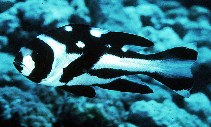
Macolor niger, Black and white snapper : fisheries, gamefish, aquarium
Épines dorsales (Total) : 10; Rayons mous dorsaux (Total) : 13 - 15; Épines anales: 3; Rayons mous anaux: 10 - 11. This species is distinguished by the following characters: body relatively deep and laterally compressed, greatest body depth 2.2-2.4 in SL; dorsal profile of head convex in adults, in oblique straight line in young; maxilla without scales or longitudinal ridges; preopercle with a deep notch (or gash) receiving elongate interopercular spine (none for individuals less than 16 cm SL); gill rakers of first gill arch 26-38 + 60-71 = 89-107; soft rays of dorsal fin usually 14, in anal fin 11, in pectoral fin 17; continuous dorsal fin with spinous portion distinctly notched in young; dorsal and anal fins distinctly pointed posteriorly, the soft ray of both fins, shorter than next to last ray; caudal fin rounded with middle rays elongated in small juveniles, slightly notched at intermediate sizes and emarginate in adults; pelvic fins short and rounded for all sizes; soft dorsal and anal fins with scales basally; tubed lateral-line scales 50-55; juveniles with very long pelvic fins. Colour of adults silvery grey, strongly blotched with blackish patches, lacks yellow on head and body and without blue markings on head and body, much duller iris; juveniles with black and white pattern but broader white area encompassing posterior head and adjacent body and with less than 5 white spots on back (Ref 9821, 90102). Body shape (shape guide): fusiform / normal; Cross section: compressed.
Adults are found on steep outer walls of lagoon, channel and seaward slopes in large schools (Ref. 9710, 48635). Juveniles are solitary (Ref. 30573). Feeds largely on fishes and crustaceans Caught with handlines, gill nets, and traps, but also speared by divers and are frequently seen in markets and sold mainly fresh (Ref. 9821).
Cycle de vie et comportement reproducteur Maturité | Reproduction | Frai | Œufs | Fécondité | Larves
Allen, G.R., 1985. FAO Species Catalogue. Vol. 6. Snappers of the world. An annotated and illustrated catalogue of lutjanid species known to date. FAO Fish. Synop. 125(6):208 p. Rome: FAO. (Ref. 55)
Statut dans la liste rouge de l'IUCN (Ref. 130435: Version 2025-2 (Global))
Cycle de vie Reproduction Maturité Maturité/épines rel. Fécondité Frai Agrégats de frai Œufs Développement de l'œuf Larves Dynamique des populations larvaires
Physiologie Composition corporelle Nutriments Consommation d'oxygène Type de natation Vitesse de nage Pigments visuels Son de poisson Maladies et parasites Toxicité (CL50)
Température préférée (Réf. 123201): 24.7 - 29.1, mean 28.1 °C (based on 1828 cells).
Indice de diversité phylogénétique (Réf. 82804): PD50 = 0.7500 [Uniqueness, from 0.5 = low to 2.0 = high].
Bayesian length-weight: a=0.01585 (0.00982 - 0.02557), b=2.99 (2.86 - 3.12), in cm total length, based on LWR estimates for this species & (Sub)family-body (Ref. 93245).
Niveau trophique (Réf. 69278): 4.0 ±0.66 se; based on food items.
Résilience (Réf. 120179): Milieu, temps minimum de doublement de population : 1,4 à 4,4 années (Preliminary K or Fecundity.).
Vulnérabilité de la pêche (Ref. 59153): Moderate to high vulnerability (50 of 100). 🛈