



Adicionar sua observação em Fish Watcher
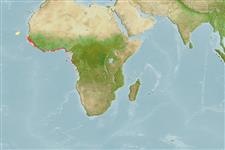
| Native range | All suitable habitat | Point map | Year 2050 |
|
| This map was computer-generated and has not yet been reviewed. |
| Porogobius schlegelii AquaMaps Data sources: GBIF OBIS |
Carregue seu(sua) Fotos e vídeos
Imagem do Google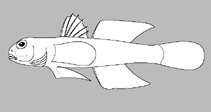 No image available for this species;
drawing shows typical species in Gobiidae.
Imagem do Google
drawing shows typical species in Gobiidae.
Classificação / Nomes Nomes comuns | Sinônimos | Catalog of Fishes(Gênero, Espécies) | ITIS | CoL | WoRMS | Cloffa
> Gobiiformes (Gobies) > Gobiidae (Gobies) > Gobiinae
Etymology: Porogobius: Greek, poros = porous + Latin, gobius = gudgeon (Ref. 45335).
Eponymy: Hermann Schlegel (1804–1884) was a German-born zoologist who spent much of his life in the Netherlands. [...] (Ref. 128868), visit book page.
More on author: Günther.
Etymology: Porogobius: Greek, poros = porous + Latin, gobius = gudgeon (Ref. 45335).
Eponymy: Hermann Schlegel (1804–1884) was a German-born zoologist who spent much of his life in the Netherlands. [...] (Ref. 128868), visit book page.
More on author: Günther.
Meio ambiente: milieu / Zona climática / intervalo de profundidade / faixa de distribuição Ecologia
marinhas; Água doce; estuarina demersal; anfídromo (Ref. 46888). Tropical
Distribuição Territórios | Áreas da FAO | Ecossistemas | Ocorrências | Mapa de pontos | Introduções | Faunafri
Africa: Senegal to Democratic Republic of the Congo (Ref. 7390, 57403, 79590, 80060). Also known from Cape Verde and islands in the Gulf of Guinea (Ref. 5299, 79590).
Tamanho / Peso / Idade
Descrição suscinta Chaves de identificação | Morfologia | Morfometria
Espinhos dorsais (total) : 7; Raios dorsais (total) : 9 - 10; Espinhos anais: 1; Raios anais : 8 - 9. Diagnosis: each side of lower jaw with a recurved canine tooth approximately midway along its length (Ref. 57403). Outer row of teeth on lower jaw ending posteriorly in one or more long, recurved teeth (Ref. 79590). Angle of mouth reaching to below anterior margin of eye; 30-35 ctenoid scales in longitudinal series (including about 2-3 scales on caudal fin base), 9 scales in rearward transverse series; 1st dorsal fin: VI; 2nd dorsal fin: I,9 (infrequently 10); anal fin: I,8-9; pectoral fins: 19; pelvic fins just reaching to anus, relatively broad but with thin membrane between spines; caudal fin with 17 segmented rays (usually 14 of which are branched) (Ref. 57403, 79590).
Coloration: Preserved specimens: very pale (whitish in alcohol); body covered with numerous small, black spots, larger and more close-set on dorsum; lateral part of head with a dark band running in a crescent from above posterior tip of jaw up towards eye, continuing under ventral margin of eye, and extending posteriorly to dorsal edge of operculum; head with dark, median predorsal band; flanks, below lateral line, with several short vertical bars of fine black dots, darkest bars located at level of 2nd dorsal fin; pectoral fin with dark patch near base of upper rays; just posterior to this there is a band of dark pigment running posteroventrally down upper part of fin; lower, anterior part of pectoral fin bears a narrow, longitudinal, band of dark pigment; other parts of fin with fine black speckling; white longitudinal band along middle of each dorsal fin, and a black longitudinal band along middle of anal fin; pelvic fins with black pigment between rays; caudal fin speckled black, with some dark spots aligned in vertical or slightly oblique rows (Ref. 57403, 79590).
Body shape (shape guide): fusiform / normal.
Body shape (shape guide): fusiform / normal.
Occurs inshore, in the intertidal zone (Ref. 4343), in brackish and freshwaters, particularly estuaries, coastal lagoons, mangrove swamps (Ref. 4343, 57403, 79590), creeks and lower river basins (Ref. 57403). Tolerant of fresh waters and may ascend rivers, although less common in these habitats; may establish burrows in subtidal mud (Ref. 79590). Feeds on fish, lamellibranchs, phytoplankton and detritus (Ref. 28587).
Ciclo de vida ou comportamento de acasalamento Maturidade | Reprodução | Desova | Ovos | Fecundidade | Larvas
Referência principal
Carregar suas referências | Referências | Coordenador | Colaboradores
Harrison, I.J., P.J. Miller and F. Pezold, 2003. Gobiidae. p. 625-666 In C. Lévêque, D. Paugy and G.G. Teugels (eds.) Faune des poissons d'eaux douce et saumâtres de l'Afrique de l'Ouest, Tome 2. Coll. Faune et Flore tropicales 40. Musée Royal de l'Afrique Centrale, Tervuren, Belgique, Museum National d'Histoire Naturalle, Paris, France and Institut de Recherche pour le Développement, Paris, France. 815 p. (Ref. 57403)
Status na Lista Vermelha da UICN (Ref. 130435: Version 2025-2 (Global))
Segura ou pouco preocupante (LC) ; Date assessed: 14 June 2019
CITES
Not Evaluated
Ameaça para os humanos
Harmless
Uso pelos humanos
FAO - Publication: search | FishSource |
Mais informação
Ecologia Trófica
Itens alimentares (presas)
Composição da dieta
Consumo alimentar
Rações alimentares
Predadores
Itens alimentares (presas)
Composição da dieta
Consumo alimentar
Rações alimentares
Predadores
Dinâmica populacional
Parâmetros de crescimento
Idade máxima / tamanhos
Relação comprimento-peso.
Relação comprimento-comprimento.
Frequências de comprimento
Conversão de massa
Recrutamento
Abundância
Parâmetros de crescimento
Idade máxima / tamanhos
Relação comprimento-peso.
Relação comprimento-comprimento.
Frequências de comprimento
Conversão de massa
Recrutamento
Abundância
Ciclo de vida
Reprodução
Maturidade
Maturidade/Rel. das guelras
Fecundidade
Desova
Agregações de desova
Ovos
Desenvolvimento dos ovos
Larvas
Dinâmica larval
Reprodução
Maturidade
Maturidade/Rel. das guelras
Fecundidade
Desova
Agregações de desova
Ovos
Desenvolvimento dos ovos
Larvas
Dinâmica larval
Anatomia
Área branquial
Cérebro
Otólito
Área branquial
Cérebro
Otólito
Fisiologia
Composição corporal
Nutrientes
Consumo de oxigênio
Tipo de natação
Velocidade de natação
Pigmentos visuais
Som de peixe
Doenças e Parasitas
Toxicidade (LC50s)
Composição corporal
Nutrientes
Consumo de oxigênio
Tipo de natação
Velocidade de natação
Pigmentos visuais
Som de peixe
Doenças e Parasitas
Toxicidade (LC50s)
Genética
genoma
Genética
Heterozigosidade
Hereditariedade
Diversidade genética
genoma
Genética
Heterozigosidade
Hereditariedade
Diversidade genética
Relacionado a humanos
Sistemas de aquicultura
Perfis para aquacultura
Estirpes
Casos de Ciguatera
Selos, moedas, diversos.
Sistemas de aquicultura
Perfis para aquacultura
Estirpes
Casos de Ciguatera
Selos, moedas, diversos.
Ferramentas
Livro eletrônico | Guia de campo | Chaves de identificação | Ferramenta auxiliar de frequências de comprimento | Ferramenta sobre a história de vida | Mapa de pontos |
Catch-MSY |
Relatórios especiais
Checar Manutenção em Aquário | Checar Planilhas de Fatos sobre as Espécies | Checar Planilhas de Fatos sobre Aquicultura
Baixar XML
Fontes da internet
AFORO (otoliths) | Aquatic Commons | BHL | Cloffa | Websites from users | Checar Observador de Peixes (FishWatcher) | CISTI | Catalog of Fishes: Gênero, Espécies | DiscoverLife | ECOTOX | FAO - Publication: search | Faunafri | Fishipedia | Fishtrace | GloBI | Google Books | Google Scholar | Google | IGFA World Record | OneZoom | Open Tree of Life | Otolith Atlas of Taiwan Fishes | PubMed | Reef Life Survey | Socotra Atlas | TreeBase | Árvore da vida | Wikipedia: Ir para, procura | World Records Freshwater Fishing | Registro zoológico
Estimativas baseadas em modelos
Temperatura preferida (Ref. 123201): 25.6 - 28, mean 27.4 °C (based on 163 cells).
Índice de diversidade filogenética (Ref. 82804): PD50 = 1.0000 [Uniqueness, from 0.5 = low to 2.0 = high].
Bayesian length-weight: a=0.00776 (0.00488 - 0.01236), b=3.05 (2.92 - 3.18), in cm total length, based on LWR estimates for this species & (Sub)family-body (Ref. 93245).
Nível Trófico (Ref. 69278): 2.9 ±0.38 se; based on food items.
Resiliência (Ref. 120179): médio(a), tempo mínimo de duplicação da população 1,4 - 4,4 anos (Preliminary K or Fecundity.).
Nutrientes (Ref. 124155): Calcium = 287 [156, 628] mg/100g; Iron = 1.26 [0.69, 2.39] mg/100g; Protein = 17.4 [15.5, 18.9] %; Omega3 = 0.155 [0.065, 0.317] g/100g; Selenium = 42.7 [21.4, 102.3] μg/100g; VitaminA = 26.8 [8.9, 71.3] μg/100g; Zinc = 2.14 [1.50, 3.10] mg/100g (wet weight);